Astronomers using the James Webb Space Telescope (JWST) have found what may be one of the most distant supernovas ever observed. And in a stroke of cosmic luck, the team thinks they’re seeing what the explosion looked like just days after it ignited.
The supernova, named AT 2026abck, dates to around 1.15 billion years after the Big Bang, when the universe was less than one-tenth of its current age and bursting with massive stars flickering into life. The massive exploding star violently released its light over 12.5 billion years ago, according to the researchers — so long ago that the distance between us has effectively ballooned sixfold due to the expansion of the universe.
The discovery was described in a paper that was uploaded to the preprint server arXiv Sept. 29 and has not yet been peer reviewed. According to the study authors, this ancient speck of light is stupendously bright.
Latest Videos FromLive Science
“At its peak, the supernova is about 8 billion times the brightness of the sun … almost as bright as the whole Milky Way Galaxy,” study co-author Xiaohui Fan, an observational cosmologist and professor of astronomy at the University of Arizona, told Live Science via email. “Over the course of the explosion, it radiates the energy that the sun will radiate over about 2 billion years.”
A beacon from the beginning of space-time
The newly discovered supernova shines brilliantly at over 30,000 degrees Fahrenheit (16,000 degrees Celsius). Its incandescent shell of ejected material has billowed to a radius of approximately 46 astronomical units — about 46 times the distance between Earth and the sun, or about as far as Pluto swings at its farthest point from the sun.
The supernova’s host galaxy, designated ID101411, holds about 6.3 billion solar masses and is “forming new stars more than ten times faster than our Milky Way,” first author Mingyang Zhuang, an observational astrophysicist at the University of Illinois Urbana-Champaign, told Live Science via email.
As with other early galaxies, ID101411 is deficient in metals, meaning any elements heavier than hydrogen and helium, because not enough time had passed to create those heavier elements in the forges of massive stars and their apocalyptic explosions.
Get the world’s most fascinating discoveries delivered straight to your inbox.
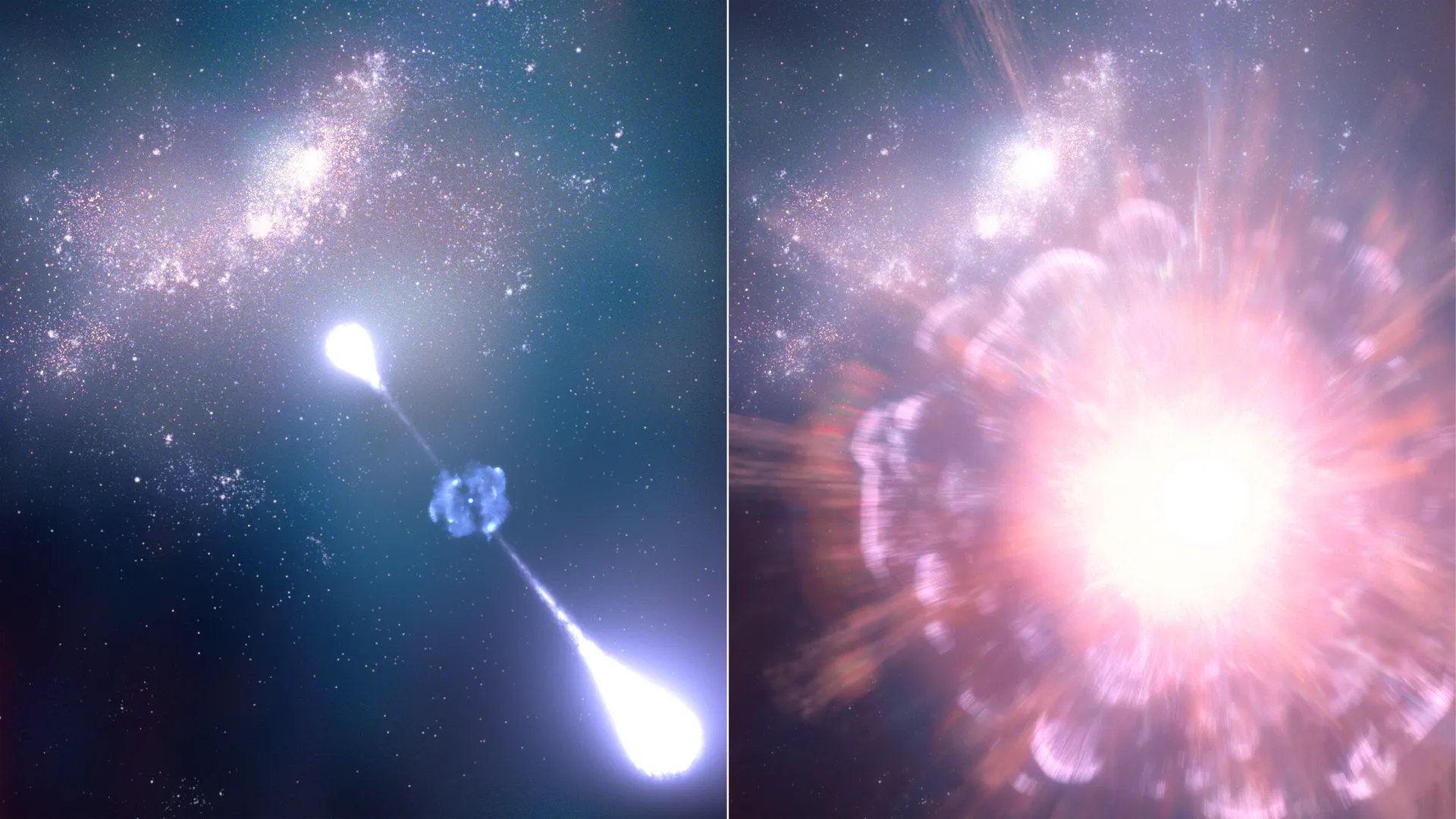
An illustration of a supernova erupting when the universe was just 730 million years old.
(Image credit: NASA, ESA, CSA, STScI, L. Hustak (STScI))
The study authors estimate that they observed the supernova as it would have looked just four to 10 days after it exploded. Although this is relatively common, spotting one at such an incredible distance “is extremely rare,” Zhuang emphasized. “You have to observe the exact same tiny patch of sky repeatedly with [JWST], and the explosion has to happen at the right moment. We were lucky.”
There’s another layer of luck that made the discovery even more remarkable: It was observed without the aid of a cosmological quirk called gravitational lensing — a phenomenon predicted by Einstein in which the gravity of a massive object in space bends and magnifies the light emitted by objects behind it.
“Most supernovas this far away were found with help from a massive foreground galaxy cluster acting as a natural magnifying glass,” Zhuang explained. “It’s the most distant one we’ve actually seen appear.”
This supernova was discovered as part of the NEXUS Treasury program, in which JWST intermittently scours patches of the sky for ancient explosions. It had previously observed the explosion’s host galaxy over the past few years and finally witnessed the supernova on Aug. 7 of this year.
An explosion in slow motion
Intriguingly, the star had not yet exploded in JWST’s previous viewing, on May 28, 2026, meaning that 71 days passed on our Earthly clocks, even though only about 12 days passed in the supernova’s own time frame.
This highlights a mind-bending cosmological effect: The universe’s expansion doesn’t just stretch space; it slows down time from our perspective.
“Because the universe has expanded since this light was emitted, everything about this explosion appears to us in slow motion, about six times slower than it actually happened,” Zhuang said. “Changes that took one week at the supernova take about six weeks to unfold from our point of view.”
Mysteries still remain about the nature of this ancient explosion that shone so brilliantly we can observe it across nearly the entire universe.
Rather than a conventional core collapse supernova — in which a star between approximately eight and 50 times the mass of the sun exhaust its nuclear fuel and suffers a rapid core collapse and subsequent explosion — the recently discovered supernova may be one of the universe’s rarest, most powerful explosions, the study authors said. Known as a superluminous supernova, this type of explosion releases tens or hundreds of times more energy than conventional supernovas. Whether the explosion continues to heat up or starts to cool could reveal exactly what is happening in its environment and what caused it, the team said.
“Our interpretation is still preliminary,” Zhuang concluded. “Follow-up observations will tell us more about exactly what kind of explosion this was.”
Zhuang, M., Shen, Y., Hu, L., Pierel, J. D. R., Pan, Z., Stone, Z., Burgasser, A. J., Fan, X., Greene, J. E., Li, J., & Wang, F. (2026, September 29). NEXUS: Discovery of a Luminous Young Transient at z=5. arXiv.org. https://arxiv.org/abs/2609.38373
How well do you know our home galaxy? Find out with our Milky Way quiz!
We use cookies on our website to give you the most relevant experience by remembering your preferences and repeat visits. By clicking “Accept”, you consent to the use of ALL the cookies.
This website uses cookies to improve your experience while you navigate through the website. Out of these, the cookies that are categorized as necessary are stored on your browser as they are essential for the working of basic functionalities of the website. We also use third-party cookies that help us analyze and understand how you use this website. These cookies will be stored in your browser only with your consent. You also have the option to opt-out of these cookies. But opting out of some of these cookies may affect your browsing experience.
Necessary cookies are absolutely essential for the website to function properly. These cookies ensure basic functionalities and security features of the website, anonymously.
Cookie
Duration
Description
cookielawinfo-checkbox-analytics
11 months
This cookie is set by GDPR Cookie Consent plugin. The cookie is used to store the user consent for the cookies in the category "Analytics".
cookielawinfo-checkbox-functional
11 months
The cookie is set by GDPR cookie consent to record the user consent for the cookies in the category "Functional".
cookielawinfo-checkbox-necessary
11 months
This cookie is set by GDPR Cookie Consent plugin. The cookies is used to store the user consent for the cookies in the category "Necessary".
cookielawinfo-checkbox-others
11 months
This cookie is set by GDPR Cookie Consent plugin. The cookie is used to store the user consent for the cookies in the category "Other.
cookielawinfo-checkbox-performance
11 months
This cookie is set by GDPR Cookie Consent plugin. The cookie is used to store the user consent for the cookies in the category "Performance".
viewed_cookie_policy
11 months
The cookie is set by the GDPR Cookie Consent plugin and is used to store whether or not user has consented to the use of cookies. It does not store any personal data.
Functional cookies help to perform certain functionalities like sharing the content of the website on social media platforms, collect feedbacks, and other third-party features.
Performance cookies are used to understand and analyze the key performance indexes of the website which helps in delivering a better user experience for the visitors.
Analytical cookies are used to understand how visitors interact with the website. These cookies help provide information on metrics the number of visitors, bounce rate, traffic source, etc.
Advertisement cookies are used to provide visitors with relevant ads and marketing campaigns. These cookies track visitors across websites and collect information to provide customized ads.