
Close Menu
    Facebook X (Twitter) Instagram Pinterest YouTube LinkedIn TikTok
    TopBuzzMagazine.com
    Facebook X (Twitter) Instagram Pinterest YouTube LinkedIn TikTok
    • Home
    • Movies
    • Television
    • Music
    • Fashion
    • Books
    • Science
    • Technology
    • Cover Story
    • Contact
      • About
      • Amazon Disclaimer
      • Terms and Conditions
      • Privacy Policy
      • DMCA / Copyrights Disclaimer
    TopBuzzMagazine.com
    Home»Science»World’s fastest AI-powered racing drone outflies the best human pilots
    Science

    World’s fastest AI-powered racing drone outflies the best human pilots

    By AdminOctober 19, 2026
    Facebook Twitter Pinterest LinkedIn Tumblr Email


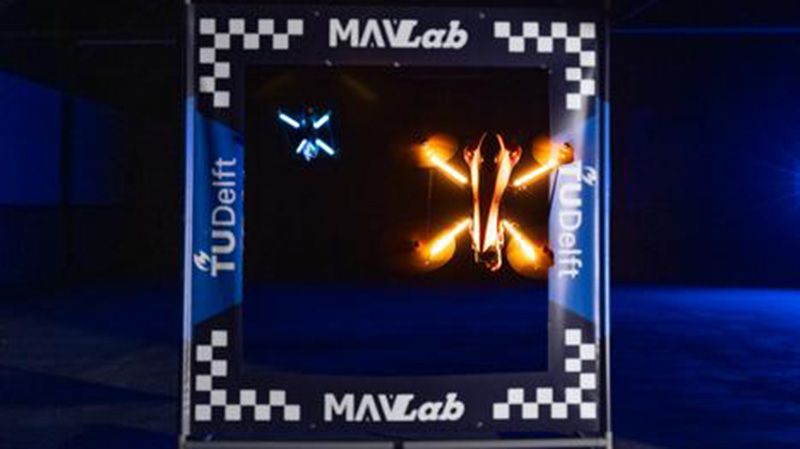
    A drone powered by artificial intelligence (AI) has completed a championship race course faster than some of the world’s best human drone pilots.

    In a study published Oct. 14 in the journal Science Robotics, scientists created an AI system capable of pushing a quadcopter through a demanding course at over 60 mph (100 km/h), using little more than a single forward-facing camera, an inertial measurement unit, and a tiny onboard computer.

    The system, called MonoRace, even won the 2025 Abu Dhabi Autonomous Racing League drone racing competition, outperforming every rival autonomous team and posting faster times than three former human world-champion drone pilots.

    MonoRace accomplished this without the aid of GPS, external motion-capture systems, stereo cameras, or a preloaded map of the course. The system is an onboard autonomous flight model created by researchers at the Delft University of Technology’s Micro Air Vehicles Lab in the Netherlands. Its name reflects its central design feature; “mono” refers to its monocular vision. The drone relies on a single rolling shutter camera and monitors its own motion with an internal measurement unit (IMU) that gauges acceleration and rotation.

    Flying at breakneck speeds

    The limited sensor package feeds a neural network, a machine-learning model that uses interconnected artificial neurons to learn patterns from data. This neural network identifies racing gates and estimates the drone’s position and motion to generate motor commands. Then, it sends the commands to the four propellers at a rate of 500 times per second through the drone’s flight controller.


    You may like

    The system fits a drone that weighs a mere 966 grams (2.13 pounds) and measures approximately 11.8 x 11 x 3.9 inches (30 x 28 x 10 centimeters). Because the MonoRace hardware was so compact, lightweight and computationally efficient, the team was able to operate it entirely aboard the drone.

    On the Abu Dhabi course, MonoRace completed two laps around 11 gates in 16.56 seconds, hitting a top speed of approximately 63 mph (102 km/h).

    Get the world’s most fascinating discoveries delivered straight to your inbox.

    A recently released video tracks MonoRace’s development and performance in the competition, with real flight sequences demonstrating how the drone banks sharply, accelerates through gates, and navigates a course without human assistance.

    However, some of the sequences are computer-generated. Study co-author Guido de Croon, a professor at the Delft University of Technology, said those are intentional visual effects. The only fully simulated imagery appears at about the two-minute mark, during the segment showing the training process.

    “Here we show the gates in a visual simulator for the video but the real training happened in a stripped-down, pure physics simulator that ran really fast,” de Croon told Live Science in an email. “Simulating vision was not done during training, as the control neural network receives an estimated state as input, which comes from a different perception and state estimation process.”


    What to read next

    The rest of the footage is real, although some shots include overlays showing how the drone interprets its camera feed. A convolutional neural network segments the white gates, sometimes displaying them as red in the normal camera image. Small circles mark detected gate corners, red lines indicate gate edges, and a blue overlay shows the portion of the image where the drone expects to find the next gate.

    How the AI learned to race

    Scientists trained the MonoRace model with reinforcement learning, a machine learning method in which an agent repeatedly attempts a task and receives feedback based on its success or failure.

    “The reinforcement learning ran in simulation, because it needs lots of trial and error — like millions of tries,” de Croon said. “It actually learns to fly from scratch.”

    The network learned to translate the drone’s position on the track, velocity and orientation directly into motor commands. According to de Croon, early training focused on the basics, like avoiding crashes and reaching the first gate. As the training progressed, the system learned to advance farther along the course and fly at higher speeds.

    The researchers didn’t train the system on a single aircraft. Instead, they varied dimensions such as weight, voltage, drag, sensor noise and propeller condition so the AI model could cope with real-world variations and imperfections.

    “That ensures that the trained network can control different drones,” de Croon said.

    MonoRace could become a training tool for human drone pilots, “a bit like powerful chess programs have also inspired humans playing the game,” de Croon said.

    Its broader significance lies in demonstrating advancements in physical AI, especially how a robot can perceive, decide and act at high speeds despite limited sensing and computing power. The control network runs on a microcontroller-class chip, meaning that sophisticated control doesn’t require a large computer.

    De Croon noted that a similarly sized network could optimize for minimal energy use rather than minimum lap time. Because most machines rely on small processors and conventional controllers, energy-optimal neural control could eventually reduce power consumption in everyday robotics, he said.

    Bahnam, S. A., Ferede, R., Blaha, T. M., Lang, A. E., Lucassen, E., Missinne, Q., Verraest, A. E. C., De Wagter, C., & De Croon, G. C. H. E. (2026). MonoRace: Robust monocular AI for champion-level drone racing. Science Robotics, 11(119). https://doi.org/10.1126/scirobotics.aee9250

    View Original Source Here

    Share. Facebook Twitter Pinterest LinkedIn Tumblr Email

    Related Posts

    Black Death had dramatic effect on species diversity as humans abandoned farmland, study finds

    October 19, 2026

    ‘A uniquely direct route that might cause damage’: Scientists uncover link between air pollution and eye diseases like glaucoma

    October 18, 2026

    The brain may have arisen from 2 separate nervous systems that got squished together, study suggests

    October 18, 2026

    California redwoods are struggling in the heat — and it’s not clear how much damage is being done

    October 17, 2026

    Archaeologists discover the oldest dwelling in the Western Hemisphere at a 13,800-year-old site in Alaska

    October 17, 2026

    Fossil of ‘unconquered female warrior’ dinosaur with long claws found in UK museum drawer after 100 years

    October 16, 2026
    popular posts

    Epic Worlds and Distant Stars: Fantasy & Sci-Fi Picks For You

    Parquet Courts Perform “Walking at a Downtown Pace” on Kimmel

    The Beauty at the Heart of a ‘Spooky’ Mystery

    Nomad Black Friday Sale 2024: Deals on Chargers, iPhone Cases

    Avatar: Fire and Ash review – another James…

    A Fashion Editor’s Favorite Expensive-Looking Basics

    J Balvin Is Unapologetically Breaking Free From Gender Norms Through

    Categories
    • Books (4,173)
    • Cover Story (27)
    • Events (29)
    • Fashion (2,938)
    • Interviews (63)
    • Movies (3,469)
    • Music (3,770)
    • News (188)
    • Politics (18)
    • Science (5,283)
    • Technology (3,465)
    • Television (4,200)
    • Uncategorized (933)
    Archives
    Facebook X (Twitter) Instagram Pinterest YouTube Reddit TikTok
    © 2026 Top Buzz Magazine. All rights reserved. All articles, images, product names, logos, and brands are property of their respective owners. All company, product and service names used in this website are for identification purposes only. Use of these names, logos, and brands does not imply endorsement unless specified. By using this site, you agree to the Terms of Use and Privacy Policy.

    Type above and press Enter to search. Press Esc to cancel.

    We use cookies on our website to give you the most relevant experience by remembering your preferences and repeat visits. By clicking “Accept”, you consent to the use of ALL the cookies.
    Do not sell my personal information.
    Cookie SettingsAccept
    Manage consent

    Privacy Overview

    This website uses cookies to improve your experience while you navigate through the website. Out of these, the cookies that are categorized as necessary are stored on your browser as they are essential for the working of basic functionalities of the website. We also use third-party cookies that help us analyze and understand how you use this website. These cookies will be stored in your browser only with your consent. You also have the option to opt-out of these cookies. But opting out of some of these cookies may affect your browsing experience.
    Necessary
    Always Enabled
    Necessary cookies are absolutely essential for the website to function properly. These cookies ensure basic functionalities and security features of the website, anonymously.
    CookieDurationDescription
    cookielawinfo-checkbox-analytics11 monthsThis cookie is set by GDPR Cookie Consent plugin. The cookie is used to store the user consent for the cookies in the category "Analytics".
    cookielawinfo-checkbox-functional11 monthsThe cookie is set by GDPR cookie consent to record the user consent for the cookies in the category "Functional".
    cookielawinfo-checkbox-necessary11 monthsThis cookie is set by GDPR Cookie Consent plugin. The cookies is used to store the user consent for the cookies in the category "Necessary".
    cookielawinfo-checkbox-others11 monthsThis cookie is set by GDPR Cookie Consent plugin. The cookie is used to store the user consent for the cookies in the category "Other.
    cookielawinfo-checkbox-performance11 monthsThis cookie is set by GDPR Cookie Consent plugin. The cookie is used to store the user consent for the cookies in the category "Performance".
    viewed_cookie_policy11 monthsThe cookie is set by the GDPR Cookie Consent plugin and is used to store whether or not user has consented to the use of cookies. It does not store any personal data.
    Functional
    Functional cookies help to perform certain functionalities like sharing the content of the website on social media platforms, collect feedbacks, and other third-party features.
    Performance
    Performance cookies are used to understand and analyze the key performance indexes of the website which helps in delivering a better user experience for the visitors.
    Analytics
    Analytical cookies are used to understand how visitors interact with the website. These cookies help provide information on metrics the number of visitors, bounce rate, traffic source, etc.
    Advertisement
    Advertisement cookies are used to provide visitors with relevant ads and marketing campaigns. These cookies track visitors across websites and collect information to provide customized ads.
    Others
    Other uncategorized cookies are those that are being analyzed and have not been classified into a category as yet.
    SAVE & ACCEPT