
Long-term memories may not “stick” in the brain for the reasons we thought, a study of mice in artificial hibernation reveals.
Instead of relying on many individual, strong links between neurons — which would typically be pared down during hibernation — long-lasting memories seem to require higher-level patterns in connectivity, the study found.
“This topological architecture of the broader network seems to be more important” than individual, sturdy connections, said study co-author Kazumasa Tanaka, head of the Memory Research Unit at the Okinawa Institute of Science and Technology.
The findings, published Thursday (Aug. 13) in the journal Science, may complicate the picture of how memory retention works.
Tanaka and colleagues used hibernation to study memory because past studies of hibernating animals have found that their brains shrink and pare down cell-to-cell connections during these extended periods of low metabolic activity. At the same time, the brain’s activity slows to a crawl, and the loss of connections is thought to be related to this energy-saving mechanism.
Despite this brain shrinkage, hibernating animals, such as alpine marmots (Marmota marmota) and European ground squirrels (Spermophilus citellus), still retain memories they formed before they went into hibernation. “Some studies report their memories are intact, even after, so they can remember conspecifics [members of the same species], like their friends, or they can remember the locations of their food,” Tanaka told Live Science.
The new study aimed to tackle the question of what allows those memories to stick around even after many connections between brain cells disappear.
Get the world’s most fascinating discoveries delivered straight to your inbox.
A “switch” in the brain to turn on hibernation
A central dogma of neuroscience holds that memories are made when connections between neurons grow stronger.
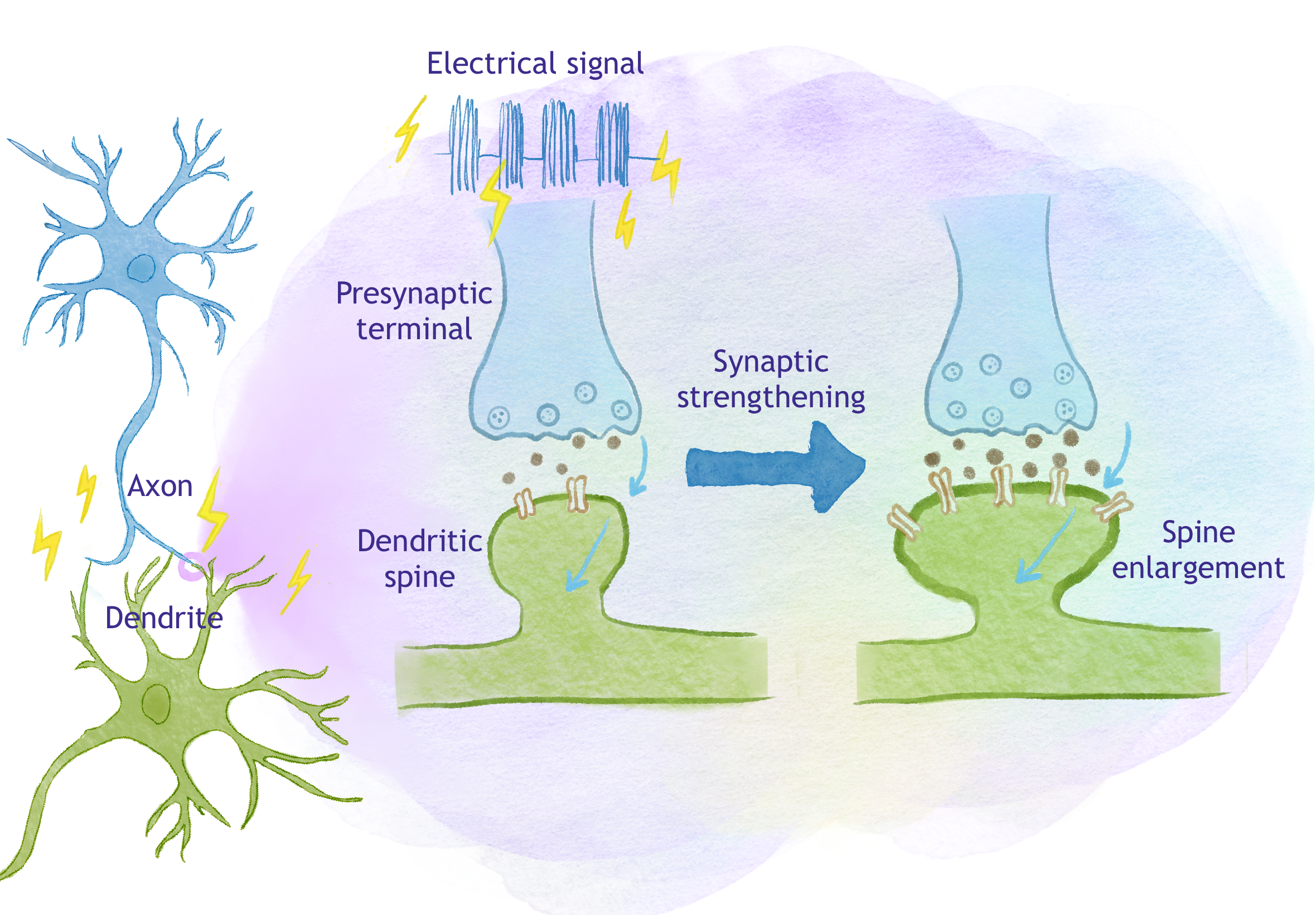
Through a process called long-term potentiation (LTP), neurons that send frequent chemical messages to their neighbors start to release more of those signals. In turn, their neighbors grow more sensitive to the signals by increasing their number of receptors and the size of their dendritic spines — the physical structures that receive inputs from other neurons. Ultimately, LTP forges a strong bond at the point where two neurons meet, called the synapse.
An old adage in neuroscience sums up the idea: “Neurons that fire together, wire together.”

A typical synapse (left) where one brain cell connects to another (the axon of one connecting to the dendrites of the other). Each dendrite is covered in tiny protrusions called dendritic spines, which detect signals released from axons. When a particular synapse is very active, it can lead to physical changes (right).
(Image credit: Luo-chu Yang)
“I don’t think our study argues against this LTP hypothesis,” Tanaka said, noting that many studies support the idea that LTP is critical for the brain to forge new memories. However, when it comes to holding on to memories over time, LTP may not be the most essential ingredient.
Recent studies have found that the structures of memories in the brain are actually very dynamic. Rather than relying on a strict and consistent set of connections between specific neurons, these physical traces of memories “drift” over time, within days, Tanaka noted. As a memory drifts, the original LTP-strengthened connections that made that memory can be lost — and yet, the memory persists.
The question is how.
The new study zoomed in on the hippocampus, a major memory processing hub in the brain. It focused on episodic memories, meaning those concerned with specific events and personal experiences. These memories are born in the hippocampus, remain there for a time, and then get transferred to other parts of the brain for super-long-term storage. That transfer can take weeks, months or more, and some neuroscientists think contextual details of the memories — such as the environment where they were formed — remain forever embedded in the hippocampus.
In this case, the researchers were interested in that initial period of memory storage in the hippocampus, so they ran lab mice through several experiments to imbue them with new memories. In one experiment, they’d been taught to associate a specific setting with a mild shock to their paws; in another, they’d learned the locations of sugar pellets placed within a maze.
Then, they pushed those mice into artificial hibernation for two days, by switching on a special set of neurons in the brain that had been identified in past work. In mere minutes, the mice’s brains started to change.
“We knew that some degree of the remodeling happens, but the degree was much bigger than what we expected,” Tanaka said. Within 30 minutes, the brain was already paring down synapses, and within 24 hours, they “found more than half of the synapses were already gone,” he said.
Completely intact memories
Despite this drastic change in the hippocampus, the mice remembered what they’d learned prior to hibernation. After hibernation, the mice froze in place when they were placed in the setting where they were shocked, and in the maze, they navigated to the food as easily as they did before hibernation — indications that they remembered both events.
“To compare the animals with or without hibernation, their behaviors are not different whatsoever,” Tanaka said.
To get to the bottom of how that could be possible, the team compared the hibernating mice to another set of lab mice, which were instead put under long-term anesthesia and treated with a molecule that blocks neurons from strengthening their synapses. The latter group of mice also saw dramatic synapse loss, but unlike the hibernating mice, their memories didn’t linger after the treatment. What made the difference?
Peering closer into both sets of brains, the scientists spotted a distinction: In the hibernating mice, certain clusters of synapses appeared to be resilient and survived the culling.
These spared connections tended to be hubs where a single neuron sending outgoing messages linked up with several neighboring cells, broadcasting its messages. They also appeared in places where many dendritic spines — the points where neurons receive messages — were bunched close together and received messages from multiple neurons at once.

This diagram shows two characteristic patterns found in the study. On the left, one neuron sends messages to multiple dendritic spines on different cells. On the right, we see “clustered engram patterns,” in which dendritic spines that all activate in relation to the same memory are located close together and connect to various axons. These two patterns were less likely to disappear during hibernation.
(Image credit: Luo-chu Yang)
“That unique structure is preserved during hibernation, Tanaka said. “Under anesthesia, we found they’re completely disrupted.”
The size of the dendritic spines didn’t seem to matter, he added. It was this clustering pattern that seemed to be key for memories’ survival.
Looking forward, there’s much more to learn about these clusters and their relationship to memory retention. The scientists are now working to characterize the clusters at a molecular level. Eventually, they hope to manipulate the clusters’ structure and formation to see what that does to memory. They are also running experiments to figure out how the brain preferentially spares these clusters while pruning away so many other connections in the hippocampus, Tanaka said.
Beyond neuroscience, the research could help engineers design better ways to store data in computer systems, he noted. But when it comes to the memory of living creatures, the study furthers scientists’ understanding of how the physical traces of memory in the brain can change so much without sacrificing the memories themselves.
“With this study,” Tanaka said, “we just opened up another door to tackle this problem.”
Lin, Y.J., Takahashi-Nakazato, A., Tsutsumi, K., Takahashi, T., et al. (2026). Artificial hibernation reveals synaptic engram architecture associated with memory retention. Science (393). https://doi.org/10.1126/science.aee7004