
The Nazis were far from completing a working reactor for their atomic bomb program, despite claims by the project’s leader that it was almost ready, a new study finds.
The German physicist Werner Heisenberg wrote in 1947 that the reactor for the “Nazi bomb” project — which culminated in Germany’s B8 nuclear reactor — was almost finished at the end of World War II.
Heisenberg, who led the reactor’s development, claimed the reactor was “just insufficient” to create a self-sustaining fission reaction and that it lacked only a “relatively small amount of uranium” to work.
Latest Videos FromLive Science
If it had worked, the B8 reactor would have confirmed that a fission chain reaction was possible, marking a key step toward the German development of an atomic bomb. It could have also spurred the development of specialized fission reactors used to create weapons-grade plutonium from uranium. Instead, the atomic bomb was developed first by the United States and was used to force the surrender of Japan in August 1945. (Germany had already surrendered in May 1945.)
The new study, published Sept. 29 in the journal PNAS Nexus, used historical documents and forensic investigations of two of the project’s surviving uranium cubes to refute Heisenberg’s claim. The new research indicates that the German B8 reactor had less than half the amount of “heavy water” and about half the amount of uranium it would have needed for a continuous chain reaction.
“My results argue that Heisenberg was off by roughly a factor of two,” said first author Patrick Park, a doctoral student at Princeton University who co-wrote the study while at Columbia University.
Park said Heisenberg’s mistake was understandable: His calculations were only approximate, and the project was relocated to a rock cellar in the town of Haigerloch, Germany, after Berlin was bombed.
Get the world’s most fascinating discoveries delivered straight to your inbox.
My results argue that Heisenberg was off by roughly a factor of two.
Patrick Park, doctoral student at Princeton University
“People were dying or starving and so these reactor calculations were not his first priority,” while many details of neutron physics were unknown at that time, Park told Live Science in an email. “Given these circumstances, I think he did the best he could.”
Heavy water
To answer the question of how far the reactor for the Nazi bomb project got, the scientists began by tracing archival records of hundreds of uranium cubes that had been used by German scientists. The B8 reactor consisted of five concentric circles of uranium cubes suspended on chains within the heavy water tank. The German scientists planned to place a radium-beryllium neutron source into the reactor’s core to kick-start the chain reaction with a flood of neutrons that would split the uranium nuclei and release more neutrons, furthering the chain reaction.
Heavy water is a form of water that contains the neutron-heavy hydrogen isotope deuterium. Like the mainly-graphite blocks and rods used in many reactors, it can be used to “moderate” or slow down fast neutrons created in a fission reaction so they trigger fission — and more neutrons — in nearby uranium atoms. The Germans also used small amounts of graphite in their reactor, but as a coating to reflect neutrons back into the chamber.
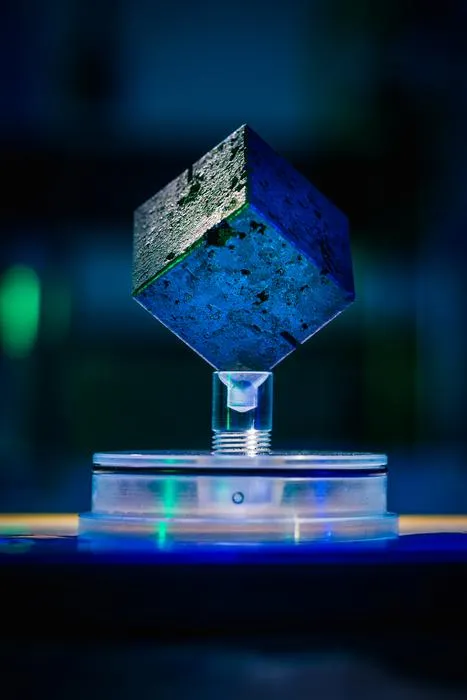
A cube of natural uranium from the German atomic bomb project.
(Image credit: John T. Consoli, University of Maryland College Park, MD.)
By combining the records of the cubes, heavy water and graphite used by the German scientists with measurements of the two surviving cubes, the study authors created a mathematical model of the reactor that agreed closely with historical measurements. This enabled them to establish that the heavy water reactor was far from achieving a stable reaction. The findings also helped them examine the suggestion that the Germans should have instead built a graphite-based reactor like the nuclear pile developed at the University of Chicago to build the American bomb.
But the study authors determined that a graphite-moderated reactor was unfeasible in wartime Germany because the local supply of coal available to create graphite contained high levels of neutron-absorbing boron, making it useless.
Instead, the heavy water used in the B8 reactor was produced at a single factory in Norway, which was occupied by Germany from April 1940 until May 1945. However, the reactor contained only about 370 gallons (1,400 liters) of heavy water, instead of the more than 780 gallons (roughly 3,000 liters) it would have needed, the researchers determined.
Heavy water makes up a tiny fraction of a percent of ordinary water, and extracting it by electrolysis in the Norwegian factory took extraordinary effort. The factory was producing as much heavy water as it could, but the B8 reactor would have needed more than twice the amount it produced during the entire war, the researchers wrote.
Another finding is that the B8 reactor had about half the amount of uranium it would have needed to sustain a fission chain reaction. The reactor contained a total of 664 cubes, each weighing about 5.11 pounds (2.32 kilograms), for a total of 3,390 pounds (1,540 kilograms) of uranium. Similar cubes were distributed among other experimental groups, giving a total inventory in wartime Germany of about 1,100 cubes of uranium.
But the researchers determined that the B8 reactor would have needed at least 1,200 cubes to work. Germany, therefore, was not about to develop a reactor for an atomic bomb in 1945. Contrary to Heisenberg’s claims, the heavy-water reactor was not nearly ready, and a working graphite reactor was impossible.
“We conclude Germany could not have built heavy water nor graphite reactors during World War II,” the researchers wrote.
Mark Walker, a historian at Union College in Schenectady, New York, who wasn’t involved in the study, said the findings explain Germany’s decision to develop a heavy-water reactor, since a graphite reactor was not feasible and they didn’t know at the time how much heavy water would be needed.
Walker is the author of “Hitler’s Atomic Bomb: History, Legend, and the Twin Legacies of Auschwitz and Hiroshima” (Cambridge University Press, 2024) and a noted expert on Germany’s wartime nuclear efforts. He agreed that Germany could not have made a graphite reactor during World War II.
“This paper argues that if the Germans had done something they did not do, then this would have failed,” he told Live Science in an email. “While this is counterfactual history, it is an interesting engineering analysis.”
Park, P. J., Robertson, B., Hiebert, M. E., Zhao, J., Sivels, C. B., & Koeth, T. W. (2026). Nuclear archaeology reassesses Heisenberg’s last reactor experiment. PNAS Nexus, 5(9). https://doi.org/10.1093/pnasnexus/pgag282