
Close Menu
    Facebook X (Twitter) Instagram Pinterest YouTube LinkedIn TikTok
    TopBuzzMagazine.com
    Facebook X (Twitter) Instagram Pinterest YouTube LinkedIn TikTok
    • Home
    • Movies
    • Television
    • Music
    • Fashion
    • Books
    • Science
    • Technology
    • Cover Story
    • Contact
      • About
      • Amazon Disclaimer
      • Terms and Conditions
      • Privacy Policy
      • DMCA / Copyrights Disclaimer
    TopBuzzMagazine.com
    Home»Science»Nazca infant had rare, fatal birth defect that left her with one central eye 1,600 years ago
    Science

    Nazca infant had rare, fatal birth defect that left her with one central eye 1,600 years ago

    By AdminNovember 9, 2026
    Facebook Twitter Pinterest LinkedIn Tumblr Email
    Nazca infant had rare, fatal birth defect that left her with one central eye 1,600 years ago


    Follow us

    Add us as a preferred source on Google


    Subscribe to our newsletter


    Archaeologists in Peru have discovered the skeleton of an infant with a rare birth defect that left only one central eye socket in the child’s skull. DNA analysis of the remains confirmed a chromosomal abnormality caused the deadly condition in the infant over 1,600 years ago, according to a new study.

    “We cannot really say how long this individual survived,” study co-author Lars Fehren-Schmitz, an anthropologist at the University of California, Santa Cruz, told Live Science in an email. But “the burial of this infant suggests that the Nasca treated this individual in death like most other infants.”

    The skeleton of this female infant was discovered alongside a second one inside a ceramic urn at the archaeological site of Jauranga in Peru’s Palpa Valley, where numerous geoglyphs known as the Nazca Lines have been found. Archaeologists uncovered several dozen other burials dated to the Middle Nazca (also spelled Nasca) period (A.D. 325 to 440) at the site, but one of the co-buried infants had an extremely rare condition, researchers wrote in a study published Monday (Nov. 9) in the journal PNAS.

    Latest Videos FromLive Science

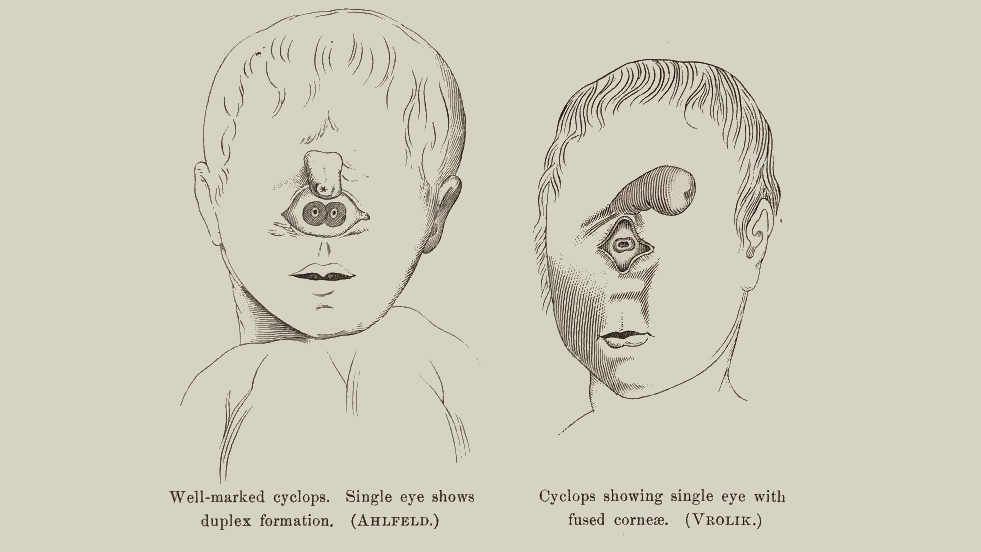
    The infant had a very small skull and a single eye socket in the middle of her face, along with other developmental issues of the cranial bones. These traits match modern clinical descriptions of cyclopia, a lethal condition that occurs when the front part of a fetus’s brain fails to divide into left and right hemispheres.

    This condition can also cause alterations in the nasal structures, resulting in a missing nose or a tube-like nose above the single eye.


    You may like

    a medical illustration of two fetuses with cyclopia

    A medical illustration from 1891 of two infants with cyclopia.

    (Image credit: Wikimedia Commons / Public Domain)

    “The cause of the malformation was present at fertilization, but manifestation occurs around the fourth to fifth week in utero [in the womb], when the frontal lobe of the brain has to divide,” study first author Elsa Tomasto-Cagigao, an archaeologist at the Pontifical Catholic University of Peru, told Live Science in an email.

    Cyclopia is a rare condition, occurring in about 1 out of every 100,000 births. To learn more about the infant’s short life, the researchers sequenced her genome. (DNA suggested the infant carried two X chromosomes, typical of a female.)

    Get the world’s most fascinating discoveries delivered straight to your inbox.

    The team detected an extra copy of chromosome 13, meaning the infant had a genetic condition called trisomy 13, or Patau syndrome. It’s known to be a major chromosomal cause of cyclopia; that said, only a small percentage of trisomy 13 cases involve cyclopia.

    While trisomy 13 is associated with advanced maternal age, it is not clear whether that was the case for this infant, Fehren-Schmitz said.

    “This condition has been documented in historic and modern anatomical collections, but to my knowledge this is the first archaeological example of this developmental abnormality,” Siân Halcrow, a bioarchaeologist at Durham University in the U.K. who was not involved in the study, told Live Science in an email.


    What to read next

    The researchers’ estimate of the infant’s age at death suggests she may have survived for several weeks or months after birth, Halcrow pointed out. “This raises important questions about how infants with profound congenital differences were cared for and treated in past societies,” she said.

    The infant was buried in a ceramic urn, the researchers noted in the study, which was a common burial method in the Nazca period, along with a second female infant who had no skeletal abnormalities. “The baby with cyclopia was at the bottom of the jar, while the other baby was on top. Nevertheless, it appears that they were interred in a single event,” Tomasto-Cagigao said. The genetic analysis showed that the two infants did not have the same mother.

    A burial of two infants in one urn is unusual for this culture, the researchers said, but there is not enough archaeological evidence to conclude that the infant with cyclopia was given a different type of burial.

    “The fact that the individual was buried with a ‘healthy’ individual in a regular cemetery, without any special grave goods, suggests that, to some extent, the individual was not treated differently in death, even though it had such a rare condition,” Fehren-Schmitz said. “It was neither ‘excluded’ because of it nor treated in a ‘special’ way.”

    In ancient Andean societies, some people with disabilities took on special societal roles, such as ones associated with religious practices. “If that reflects Nasca society as a whole, we can’t say based on one case,” Fehren-Schmitz said, “but it does reflect the community this infant was part of, even if only briefly.”

    Tomasto-Cagigao, E., Reindel, M., Isla Cuadrado, J., Lund Valle, M., Kassadjikova, K., Harkins, K., Fehren-Schmitz, L. (2026). A Nasca-period perinatal burial reveals cyclopia associated with trisomy 13 in southern Peru. Proceedings of the National Academy of Sciences. https://www.pnas.org/cgi/doi/10.1073/pnas.2625042123

    Original Source Link

    Share. Facebook Twitter Pinterest LinkedIn Tumblr Email

    Related Posts

    Gravity can reconnect like the sun's magnetic field, a fresh look at Einstein's equations reveals

    November 10, 2026

    ZWO Seestar S30 Plus review

    November 10, 2026

    'The first species we might be able to communicate with, interact with vocally, might be a bird': An animal researcher explains how she decoded birdsong

    November 10, 2026

    Highly active Russian volcano plays peek-a-boo with an astronaut

    November 10, 2026

    Iran war helps fuel global drop in fossil fuel emissions — but theres a catch

    November 10, 2026

    A 3,200-pound NASA spacecraft could fall to Earth any minute now

    November 4, 2026
    popular posts

    Everything we know so far about Wes Anderson’s Asteroid City

    Sources: Reddit banned r/WhitePeopleTwitter for 72 hours in February 2025 after Elon Musk messaged CEO Steve Huffman about users threatening DOGE staffers (Alex Heath/The Verge)

    Be Your Own Pet share new single “Goodtime!”: Stream

    OnePlus Nord 2T 5G India Launch Date Tipped: All Details

    Trump Media and Technology Group files an S-1 with the US SEC to launch a spot Bitcoin and Ethereum ETF, allocating 75% to bitcoin and 25% to ether (Oliver Knight/CoinDesk)

    Interview with Jolie Harris, Author of The Hopeless Romantic’s Guide

    Dua Lipa Covers Vogue in a Sheer Midi Dress and

    Categories
    • Books (4,203)
    • Cover Story (27)
    • Events (29)
    • Fashion (2,967)
    • Interviews (65)
    • Movies (3,505)
    • Music (3,805)
    • News (188)
    • Politics (18)
    • Science (5,328)
    • Technology (3,506)
    • Television (4,247)
    • Uncategorized (933)
    Archives
    Facebook X (Twitter) Instagram Pinterest YouTube Reddit TikTok
    © 2026 Top Buzz Magazine. All rights reserved. All articles, images, product names, logos, and brands are property of their respective owners. All company, product and service names used in this website are for identification purposes only. Use of these names, logos, and brands does not imply endorsement unless specified. By using this site, you agree to the Terms of Use and Privacy Policy.

    Type above and press Enter to search. Press Esc to cancel.

    We use cookies on our website to give you the most relevant experience by remembering your preferences and repeat visits. By clicking “Accept”, you consent to the use of ALL the cookies.
    Do not sell my personal information.
    Cookie SettingsAccept
    Manage consent

    Privacy Overview

    This website uses cookies to improve your experience while you navigate through the website. Out of these, the cookies that are categorized as necessary are stored on your browser as they are essential for the working of basic functionalities of the website. We also use third-party cookies that help us analyze and understand how you use this website. These cookies will be stored in your browser only with your consent. You also have the option to opt-out of these cookies. But opting out of some of these cookies may affect your browsing experience.
    Necessary
    Always Enabled
    Necessary cookies are absolutely essential for the website to function properly. These cookies ensure basic functionalities and security features of the website, anonymously.
    CookieDurationDescription
    cookielawinfo-checkbox-analytics11 monthsThis cookie is set by GDPR Cookie Consent plugin. The cookie is used to store the user consent for the cookies in the category "Analytics".
    cookielawinfo-checkbox-functional11 monthsThe cookie is set by GDPR cookie consent to record the user consent for the cookies in the category "Functional".
    cookielawinfo-checkbox-necessary11 monthsThis cookie is set by GDPR Cookie Consent plugin. The cookies is used to store the user consent for the cookies in the category "Necessary".
    cookielawinfo-checkbox-others11 monthsThis cookie is set by GDPR Cookie Consent plugin. The cookie is used to store the user consent for the cookies in the category "Other.
    cookielawinfo-checkbox-performance11 monthsThis cookie is set by GDPR Cookie Consent plugin. The cookie is used to store the user consent for the cookies in the category "Performance".
    viewed_cookie_policy11 monthsThe cookie is set by the GDPR Cookie Consent plugin and is used to store whether or not user has consented to the use of cookies. It does not store any personal data.
    Functional
    Functional cookies help to perform certain functionalities like sharing the content of the website on social media platforms, collect feedbacks, and other third-party features.
    Performance
    Performance cookies are used to understand and analyze the key performance indexes of the website which helps in delivering a better user experience for the visitors.
    Analytics
    Analytical cookies are used to understand how visitors interact with the website. These cookies help provide information on metrics the number of visitors, bounce rate, traffic source, etc.
    Advertisement
    Advertisement cookies are used to provide visitors with relevant ads and marketing campaigns. These cookies track visitors across websites and collect information to provide customized ads.
    Others
    Other uncategorized cookies are those that are being analyzed and have not been classified into a category as yet.
    SAVE & ACCEPT