
Close Menu
    Facebook X (Twitter) Instagram Pinterest YouTube LinkedIn TikTok
    TopBuzzMagazine.com
    Facebook X (Twitter) Instagram Pinterest YouTube LinkedIn TikTok
    • Home
    • Movies
    • Television
    • Music
    • Fashion
    • Books
    • Science
    • Technology
    • Cover Story
    • Contact
      • About
      • Amazon Disclaimer
      • Terms and Conditions
      • Privacy Policy
      • DMCA / Copyrights Disclaimer
    TopBuzzMagazine.com
    Home»Science»Examining how cooperation benefits from peer-punishment
    Science

    Examining how cooperation benefits from peer-punishment

    By AdminMay 15, 2023
    Facebook Twitter Pinterest LinkedIn Tumblr Email
    Examining how cooperation benefits from peer-punishment

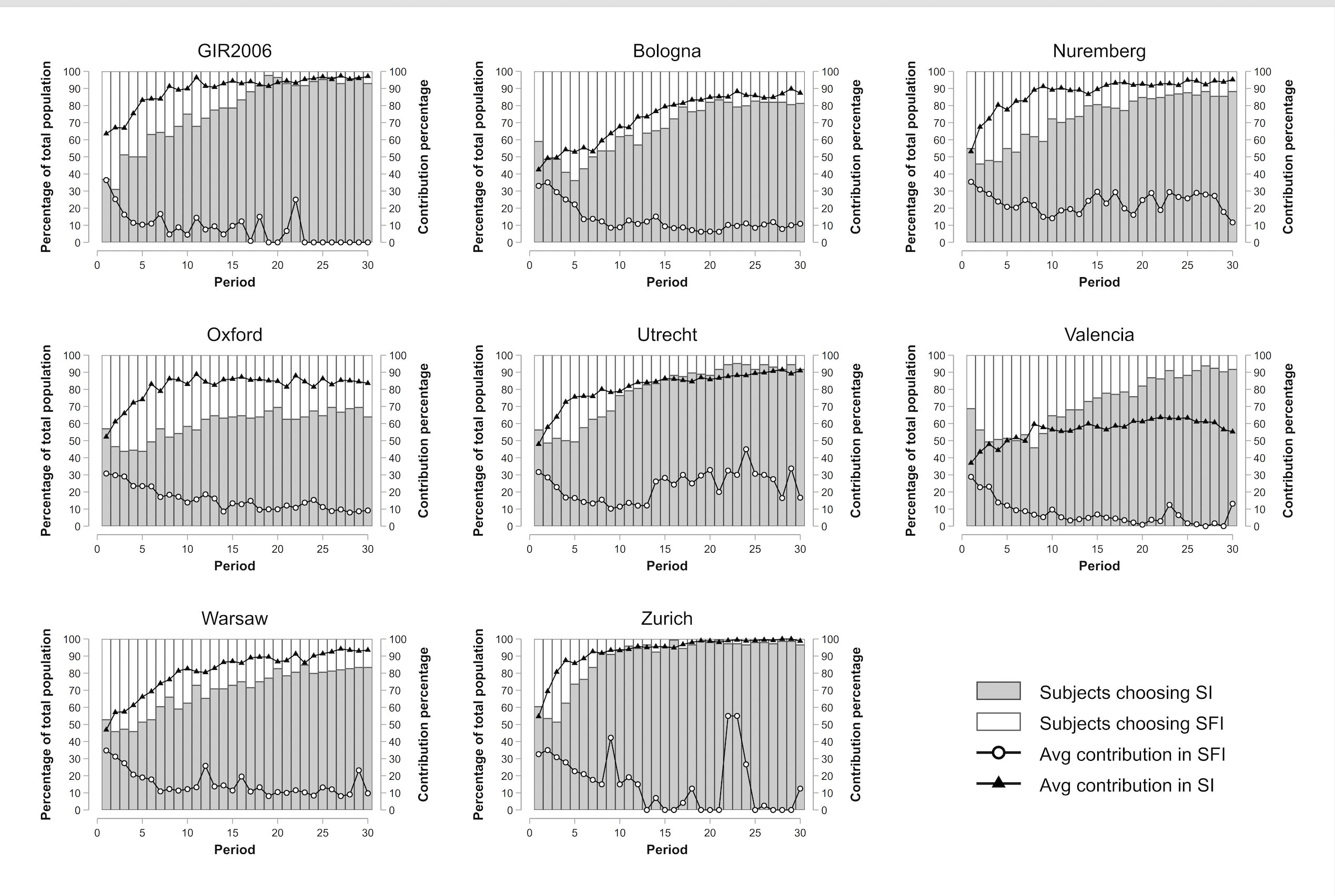
    Migration choices and contributions across rounds at each lab. Credit: Lo Iacono et al

    A multi-lab replication of a 2006 study supports the role of peer sanction in promoting human cooperation. Cooperation is imperative for society to successfully solve complex problems, including climate change. One approach many groups have adopted is a system of peer sanctions for noncooperators.

    Such a system incurs costs to participants, who must impose the sanctions, but can allow cooperators to feel more secure that their investments in the shared project will be matched by others. A 2006 study suggested that groups with peer sanctions outgrew and outperformed groups without a peer-sanctioning institution. In light of the current replication crisis in the social sciences,

    Sergio Lo Iacono and his colleagues attempted to replicate the 2006 study at seven sites in Europe. Each replication had 144 participants. Participants interacted anonymously in groups of 12 for 30 rounds. In each round, each participant could choose to join a sanctioning group or a non-sanctioning group. Next, each participant chose how many of 20 tokens to contribute to the collective. These tokens would be multiplied by 1.6 and divided equally among the group members.

    In groups with sanctioning institutions, there was a second stage of play, in which participants could “punish” participants who had not contributed adequately to the group project by taking away their tokens—but at a cost to themselves.

    In five out of the seven replications, the original pattern from the 2006 study held up: the majority of participants eventually chose to join groups with a sanctioning institution, and participants in sanctioning groups cooperated and profited more on average than participants in groups without a sanctioning institution. In the remaining two locations, results were weaker than in the original study yet still favored sanctioning institutions.

    Overall, these findings show that the emergence and persistence of sanctioning institutions to support cooperation in public goods dilemmas is a robust phenomenon within the European context, according to the authors. The paper is published in the journal PNAS Nexus.

    More information: Sergio Lo Iacono et al, The competitive advantage of sanctioning institutions revisited: A multilab replication, PNAS Nexus (2023). DOI: 10.1093/pnasnexus/pgad091

    Citation: Examining how cooperation benefits from peer-punishment (2023, May 3) retrieved 15 May 2023 from https://phys.org/news/2023-05-cooperation-benefits-peer-punishment.html

    This document is subject to copyright. Apart from any fair dealing for the purpose of private study or research, no part may be reproduced without the written permission. The content is provided for information purposes only.

    Read The Full Article Here

    Share. Facebook Twitter Pinterest LinkedIn Tumblr Email

    Related Posts

    Remote-controlled cockroach swarm can now breathe underwater

    June 29, 2026

    The oldest evidence of mourning rituals reveals Paleolithic communities grieved like we do

    June 29, 2026

    Computer scientists are rushing to tame tame AI’s voracious appetite for energy

    June 28, 2026

    I have a 100 per cent chance of getting cancer due to a rare gene

    June 28, 2026

    Saturday Citations: Predicting earthquakes; two types of water; observing event horizons

    June 27, 2026

    ‘It sounds so impossible’: Student studying fungus that makes users hallucinate tiny people may be on the verge of a scientific breakthrough

    June 27, 2026
    popular posts

    Splitsville review – lacking on romance and comedy

    Best Free People Gifts: Clothes, Beauty, and More

    Stopping Hamas’ Secret Weapon

    We Will Not Bow, Nor Be Silenced: 6 Dystopias About

    Q&A with Lyft CEO David Risher on the company’s turnaround, AI, paying drivers more, Uber, partnership with Tensor for autonomous vehicle tech, and more (Nilay Patel/The Verge)

    Believing in personal gut feelings and falling for conspiracy theories

    Illinois To Become First State to Ban Book Bans

    Categories
    • Books (3,948)
    • Cover Story (15)
    • Events (24)
    • Fashion (2,815)
    • Interviews (60)
    • Movies (3,244)
    • Music (3,538)
    • News (178)
    • Politics (13)
    • Science (5,099)
    • Technology (3,241)
    • Television (3,969)
    • Uncategorized (932)
    Archives
    Facebook X (Twitter) Instagram Pinterest YouTube Reddit TikTok
    © 2026 Top Buzz Magazine. All rights reserved. All articles, images, product names, logos, and brands are property of their respective owners. All company, product and service names used in this website are for identification purposes only. Use of these names, logos, and brands does not imply endorsement unless specified. By using this site, you agree to the Terms of Use and Privacy Policy.

    Type above and press Enter to search. Press Esc to cancel.

    We use cookies on our website to give you the most relevant experience by remembering your preferences and repeat visits. By clicking “Accept”, you consent to the use of ALL the cookies.
    Do not sell my personal information.
    Cookie SettingsAccept
    Manage consent

    Privacy Overview

    This website uses cookies to improve your experience while you navigate through the website. Out of these, the cookies that are categorized as necessary are stored on your browser as they are essential for the working of basic functionalities of the website. We also use third-party cookies that help us analyze and understand how you use this website. These cookies will be stored in your browser only with your consent. You also have the option to opt-out of these cookies. But opting out of some of these cookies may affect your browsing experience.
    Necessary
    Always Enabled
    Necessary cookies are absolutely essential for the website to function properly. These cookies ensure basic functionalities and security features of the website, anonymously.
    CookieDurationDescription
    cookielawinfo-checkbox-analytics11 monthsThis cookie is set by GDPR Cookie Consent plugin. The cookie is used to store the user consent for the cookies in the category "Analytics".
    cookielawinfo-checkbox-functional11 monthsThe cookie is set by GDPR cookie consent to record the user consent for the cookies in the category "Functional".
    cookielawinfo-checkbox-necessary11 monthsThis cookie is set by GDPR Cookie Consent plugin. The cookies is used to store the user consent for the cookies in the category "Necessary".
    cookielawinfo-checkbox-others11 monthsThis cookie is set by GDPR Cookie Consent plugin. The cookie is used to store the user consent for the cookies in the category "Other.
    cookielawinfo-checkbox-performance11 monthsThis cookie is set by GDPR Cookie Consent plugin. The cookie is used to store the user consent for the cookies in the category "Performance".
    viewed_cookie_policy11 monthsThe cookie is set by the GDPR Cookie Consent plugin and is used to store whether or not user has consented to the use of cookies. It does not store any personal data.
    Functional
    Functional cookies help to perform certain functionalities like sharing the content of the website on social media platforms, collect feedbacks, and other third-party features.
    Performance
    Performance cookies are used to understand and analyze the key performance indexes of the website which helps in delivering a better user experience for the visitors.
    Analytics
    Analytical cookies are used to understand how visitors interact with the website. These cookies help provide information on metrics the number of visitors, bounce rate, traffic source, etc.
    Advertisement
    Advertisement cookies are used to provide visitors with relevant ads and marketing campaigns. These cookies track visitors across websites and collect information to provide customized ads.
    Others
    Other uncategorized cookies are those that are being analyzed and have not been classified into a category as yet.
    SAVE & ACCEPT