
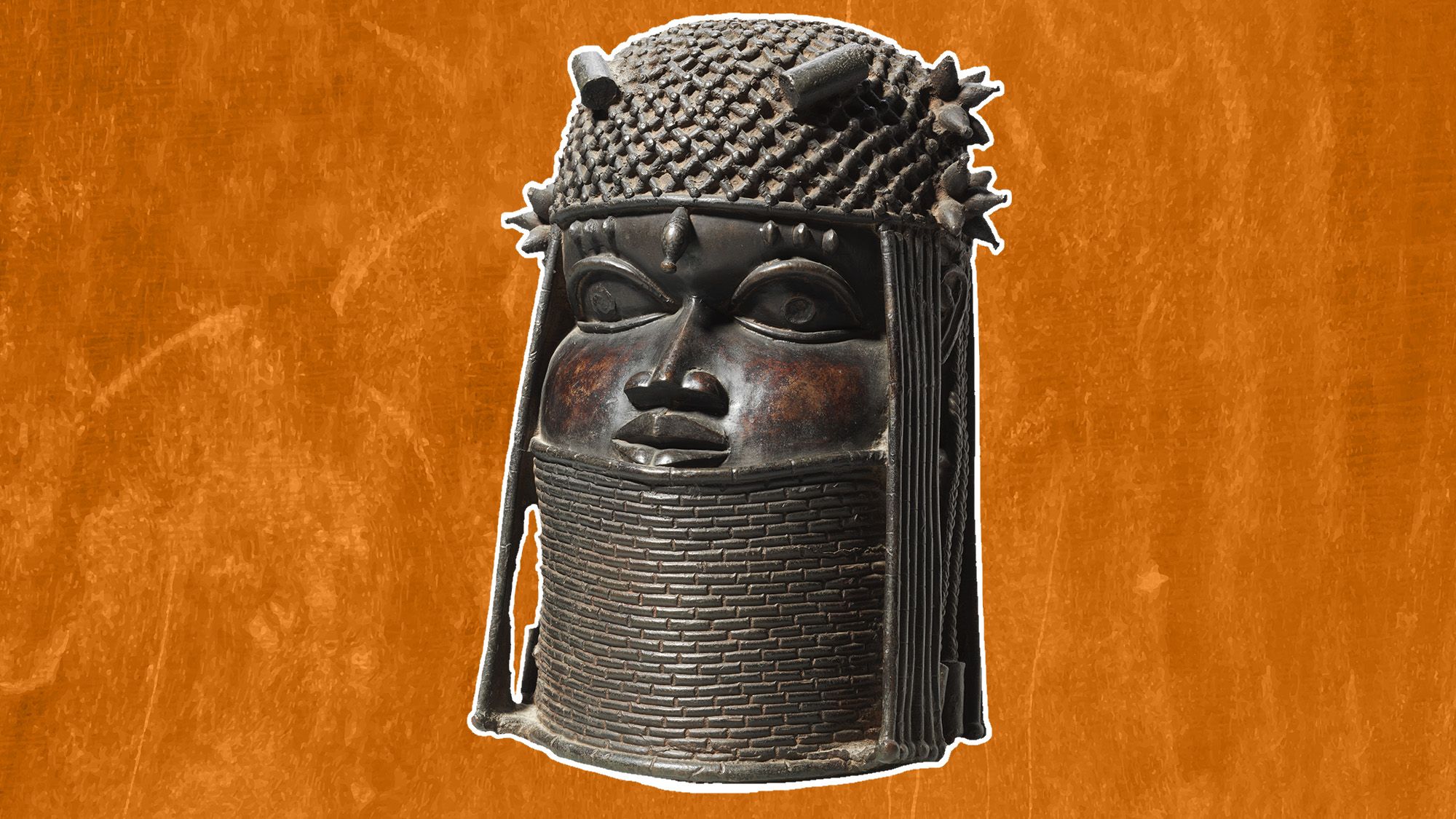

This brass head depicts an “oba,” or ruler of the Kingdom of Benin.
(Image credit: Cleveland Museum of Art (Public Domain))
Quick facts
Name: Ancestral commemorative head
What it is: A copper-alloy sculpture of an African ruler’s head
Where it is from: Edo, Nigeria
When it was made: Mid-1500s
In the Kingdom of Benin, one of the oldest monarchies in West Africa, a traditional ruler known as an oba would commission a brass or bronze bust of their predecessor upon taking the throne. The bust of the past oba would then be set on an ancestral altar in the palace. But when the British Empire annexed the Kingdom of Benin into colonial Nigeria in 1897, the British looted thousands of African artifacts spanning the kingdom’s seven-century history, and the country of Nigeria has asked that they be returned.
This particular bust is in the collection of the Cleveland Museum of Art (CMA), which acquired it from prominent French art dealer Louis Carré, who sold many of the artifacts looted from Benin to Western museums in the 1930s. This head of an oba ancestor, also known as “uhunmwun-elao” in the Edo language spoken in the historic Kingdom of Benin, is roughly 1 foot (30 centimeters) tall and was made from a copper alloy, using a lost-wax casting process that would produce one unique bust, then-CMA curator William Milliken wrote in a 1937 study.
Initially, CMA experts thought the ancestral head represented a princess, due to the layers of coral necklaces around the oba’s neck and the thin braids hanging from the individual’s temples. But the coral necklaces and the lattice-pattern beaded caps were actually potent representations of a ruler’s power. The top of the bust is partly open, and it would have supported an intricately carved elephant tusk that recorded the oba’s accomplishments and major life events.
Latest Videos FromLive Science
Many of the surviving ancestral commemorative heads were created in the 15th and 16th centuries by the Igun Eronmwon, a hereditary guild of brass and bronze artisans that made objects for royalty in the Kingdom of Benin. According to the CMA, Benin royalty prized brass because it does not corrode. Much of the African brass was imported from as far away as Germany.
When British forces invaded the Benin royal palace in 1897, they looted thousands of metal plaques, sculptures of humans and animal figures, and royal and personal ornaments that have come to be known as the Benin Bronzes, even though most of the objects are technically brass, an alloy of copper and zinc. The British Museum holds the world’s largest collection of Benin brass artifacts — over 900 objects — which Nigeria formally requested be returned in 2021.
Some institutions have begun repatriating this historic royal art back to its homeland. A group of German museums that collectively held over 1,100 of these objects transferred ownership of them to Nigeria in 2022. That same year, the Smithsonian’s National Museum of African Art transferred ownership of 29 Benin Bronzes to Nigeria. And, in 2025, the Netherlands returned 119 Benin Bronzes to Nigeria. To date, however, the British Museum has not officially returned any of the Benin Bronzes in its collection.
There is also controversy about who should have ownership of these artifacts. In 2025, the Museum of Fine Arts, Boston returned two Benin Bronzes to Oba Ewuare II, the great-great-grandson of the last oba before the 1897 British invasion. Oba Ewuare II is the Oba of Benin and custodian of Benin culture.
Get the world’s most fascinating discoveries delivered straight to your inbox.
A full catalog of royal artifacts looted from Benin in the late 19th century can be found on the Digital Benin project website.
For more stunning archaeological discoveries, check out our Astonishing Artifacts archives.
Can you put together last week’s Astonishing Artifact?
TOPICS