
Close Menu
    Facebook X (Twitter) Instagram Pinterest YouTube LinkedIn TikTok
    TopBuzzMagazine.com
    Facebook X (Twitter) Instagram Pinterest YouTube LinkedIn TikTok
    • Home
    • Movies
    • Television
    • Music
    • Fashion
    • Books
    • Science
    • Technology
    • Cover Story
    • Contact
      • About
      • Amazon Disclaimer
      • Terms and Conditions
      • Privacy Policy
      • DMCA / Copyrights Disclaimer
    TopBuzzMagazine.com
    Home»Science»‘Once we were like you’: Striking reconstructions reveal the faces of 16 people from Roman-era Hungary
    Science

    ‘Once we were like you’: Striking reconstructions reveal the faces of 16 people from Roman-era Hungary

    By AdminJuly 23, 2026
    Facebook Twitter Pinterest LinkedIn Tumblr Email
    ‘Once we were like you’: Striking reconstructions reveal the faces of 16 people from Roman-era Hungary


    The face of a young woman crowned with a laurel wreath, buried in elaborate clothing and unusual cork sandals, has appeared nearly 1,700 years after her death.

    She is one of 16 people from Aquincum, a Roman-era city in present-day Hungary, whose faces have been reconstructed for “Once We Were Like You,” a new exhibition at the Aquincum Museum in Budapest. The display pairs skulls excavated in and around the ancient city with scientifically informed approximations of how their owners may have looked in life.

    Six of the reconstructions are hyperrealistic silicone models, complete with artificial eyes, human hair, eyebrows, eyelashes and, in some cases, beards. The exhibition, which runs through Oct. 31, includes men, women and a child who lived during the region’s period of Roman rule.

    Latest Videos From

    “The face is the most important feature for recognizing a person,” Emese Gábor, a forensic facial reconstruction specialist who sculpted the silicone faces, told Live Science in an email. Although a skull cannot reveal every detail of a person’s appearance, reconstruction lets museum visitors encounter the faces as those of “a real human being rather than as skeletal remains,” she said.

    A glass display case is seen holding several skulls

    The entrance to the “Once We Were Like You” exhibit at the Aquincum Museum in Budapest.

    (Image credit: Gábor Lakos Aquincum Museum Budapest)

    Rebuilding a Roman face

    Aquincum stood on the Danube frontier of the Roman Empire in what is now Budapest. The city was home to a diverse population in the first through fourth centuries, and genetic and archaeological analyses of the individuals in the exhibition point to connections with regions including present-day Italy, Scotland and Syria, as well as Sarmatian groups from the Eurasian steppe and Celtic communities that lived in the region before Roman rule.


    You may like

    The remains of those who lived here have also been unearthed, and continue to be discovered today during the excavation of cemeteries,” according to a statement from the museum.

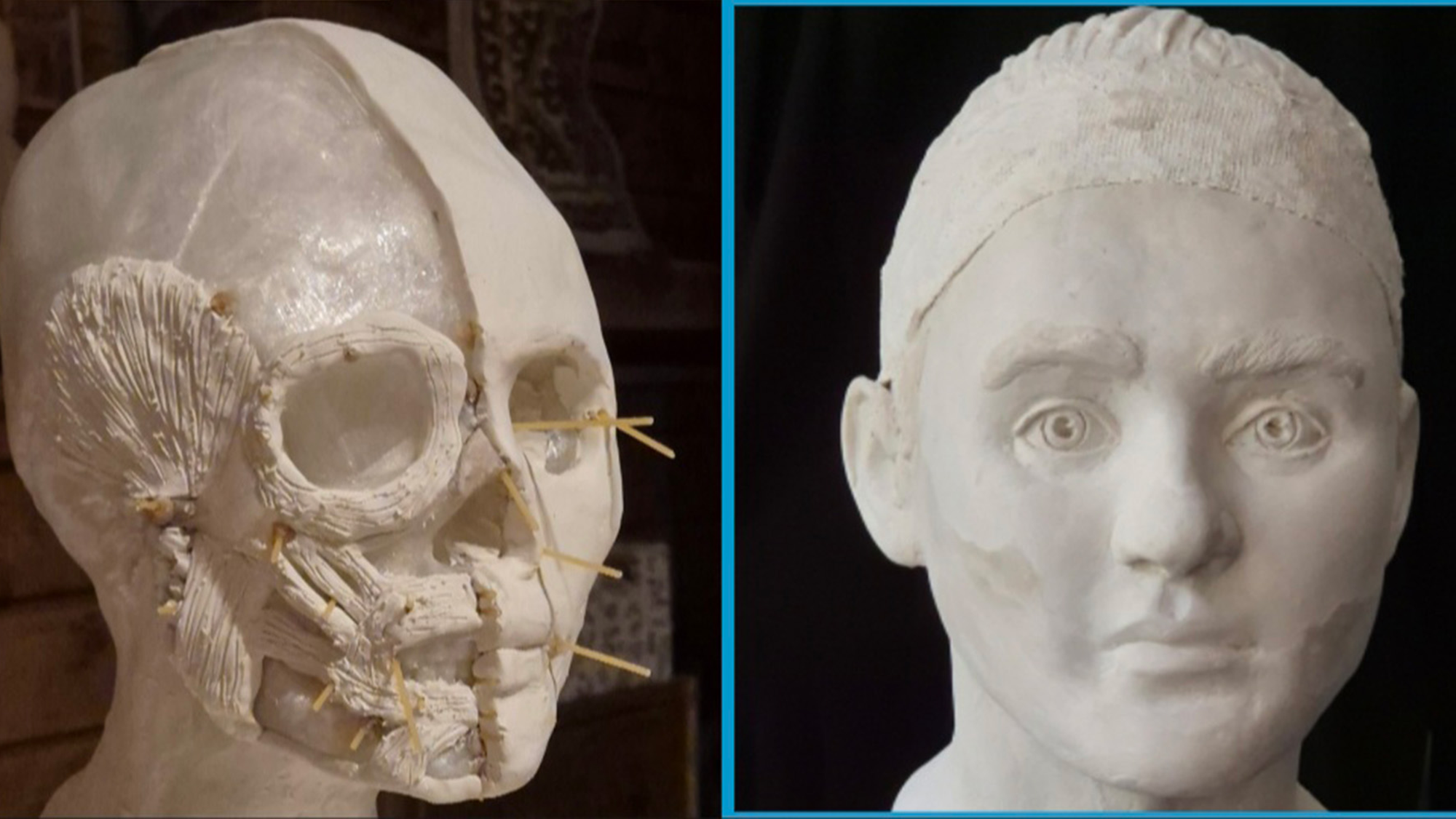
    Creating a reconstructed face begins with a high-resolution 3D CT scan of the original skull. Specialists then produce an exact 3D-printed replica, allowing experts like Gábor to work without repeatedly handling or disturbing the ancient remains.

    Get the world’s most fascinating discoveries delivered straight to your inbox.

    “The latest scientific advances — including 3D scanning, CT imaging, archaeogenetic (ancient DNA) analysis and facial approximation research — are incorporated whenever possible,” she said.

    “If a hyper-realistic reconstruction is required, I create a mould and cast the face in coloured silicone, finishing it with real human hair, eyebrows, eyelashes and, where appropriate, a beard,” she said.

    A series of images from the exhibit

    Image credit: ARC-heo art-REKO Studio

    These images show how Gábor brings to life the faces of Aquincum starting with a preserved skull.

    A series of images from the exhibit

    Image credit: ARC-heo art-REKO Studio

    Gábor uses over 60 different anatomical landmarks to recreate a face from a human skull.

    A series of images from the exhibit

    Image credit: ARC-heo art-REKO Studio

    Using 3D scans, Gábor is able to bring a face to life.

    A series of images from the exhibit

    Image credit: ARC-heo art-REKO Studio

    Ancient DNA helped inform some of the features in the reconstructions, such as hair and skin color.

    A series of images from the exhibit

    Image credit: ARC-heo art-REKO Studio

    This hyper-realistic reconstruction uses real human hair, eyebrows and eyelashes.


    Ancient DNA can sometimes provide additional clues about pigmentation, including probable eye, hair and skin color. But the results are still approximations, not portraits. For instance, hairstyle, expression and many details of the person’s appearance are usually more speculative.


    What to read next

    The woman with the laurel wreath

    Of all the people she reconstructed, Gábor said she found it especially difficult to forget the woman known as the Jablonka Road mummy.

    The woman’s skeleton was relatively well preserved, but the soft tissue on her face had decayed, leaving only the skull. A laurel wreath still rested on her head, and, according to Gábor, her burial contained fine clothing, a spindle for weaving, bird-shaped cork sandals and a painted male portrait that had been placed near her feet. Archaeologists have suggested that the portrait may have represented her husband or father, although his identity is unknown.

    A facial reconstruction of a man with gray hair and a beard wearing brown clothes

    The silicon reconstruction of an ancient construction worker.

    (Image credit: Gábor Lakos Aquincum Museum Budapest)

    “Based on these details, the archaeological context and the anthropological data, it was the archaeologists who pieced together her story while I reconstructed her face,” Gábor said. “That was very moving.”

    Other individuals selected for the exhibition include those of a young girl who died in childhood and a woman interpreted as a nurse or healer who was buried in a children’s cemetery. Some of the other reconstructions include a construction worker, a military officer and a blacksmith.

    Two women appear to have met particularly violent or punitive ends. They were buried face down with their legs bound together, Gábor said. The exhibition’s interpretation associates one woman with an accusation of witchcraft and the other with poisons, although such details are historical interpretations rather than evidence-based findings from the burials.

    A woman stands in front of a glass display case showing a young face and a skull in front of it

    Gábor stands in front of a display showing the reconstructed face of a child from Aquincum.

    (Image credit: Gábor Lakos Aquincum Museum Budapest)

    “Every reconstruction is a journey,” Gábor said. “As I shape each face, I find myself reflecting on that person’s life again and again, and by the end, they no longer feel like anonymous remains, but like real people.”

    Analyses of the skeletons suggest that many of the individuals endured strenuous physical labor, periods of hunger and chronic inflammation. This evidence led museum curators to conclude that many represented the less wealthy inhabitants of Roman society — people whose names and experiences were unlikely to appear in surviving written histories.

    For Gábor, the physical reconstructions offer something that a digital image cannot: Visitors can stand face-to-face with a life-size person, walk around the model and study it from different angles. Her hope is that this encounter encourages visitors to think beyond the scientific data and imagine the full lives that once surrounded the excavated bones.

    “When you see a face, you don’t just see bones in a display,” Gábor said. “You see a person — someone who was born, who grew up, who worked, who loved, who laughed, who struggled, who fought with challenges, who raised children. Some were sick. Not everyone died of illness. Some died in accidents. Some through violence. And eventually, all of them died. That sense of shared humanity helps spark empathy.”


    Can you match these historical maps to the empires that ruled them? Test your geography skills with our ancient empires quiz!

    View Original Source Here

    Share. Facebook Twitter Pinterest LinkedIn Tumblr Email

    Related Posts

    Removing 'forever chemicals' from farmlands—at a fraction of the cost

    July 22, 2026

    Greenland meltwater will drive a ‘strong weakening, but not a shutdown’ of key Atlantic currents, study finds

    July 22, 2026

    How community-led health and livelihood programs helped protect rainforests during the pandemic

    July 21, 2026

    Scientists find potential missing link between gum disease and worse heart health

    July 21, 2026

    Giving bees a probiotic diet could help protect them from extreme temperatures

    July 20, 2026

    Can Ozempic prevent or treat cancer? It’s way too soon to say, an expert cautions

    July 20, 2026
    popular posts

    6 Murder Mysteries to Keep You on Your Toes!

    Relics illuminate the wreck of HMS Gloucester, a 17th-century warship

    None of This is True: Ending & Explanations

    Brand-new class of antibiotic kills drug-resistant superbug

    Southern Sleuthing in the Big Easy: “The Lafitte Affair” Delivers

    Anthropic's Claude 3.7 Sonnet reportedly cost "a few tens of millions of dollars" to train, similar to Claude 3.5 and cheaper than GPT-4, which cost over $100M (Kyle Wiggers/TechCrunch)

    The Tallest Man on Earth Announces New Album Henry St

    Categories
    • Books (3,995)
    • Cover Story (18)
    • Events (25)
    • Fashion (2,841)
    • Interviews (61)
    • Movies (3,291)
    • Music (3,587)
    • News (181)
    • Politics (13)
    • Science (5,146)
    • Technology (3,288)
    • Television (4,019)
    • Uncategorized (932)
    Archives
    Facebook X (Twitter) Instagram Pinterest YouTube Reddit TikTok
    © 2026 Top Buzz Magazine. All rights reserved. All articles, images, product names, logos, and brands are property of their respective owners. All company, product and service names used in this website are for identification purposes only. Use of these names, logos, and brands does not imply endorsement unless specified. By using this site, you agree to the Terms of Use and Privacy Policy.

    Type above and press Enter to search. Press Esc to cancel.

    We use cookies on our website to give you the most relevant experience by remembering your preferences and repeat visits. By clicking “Accept”, you consent to the use of ALL the cookies.
    Do not sell my personal information.
    Cookie SettingsAccept
    Manage consent

    Privacy Overview

    This website uses cookies to improve your experience while you navigate through the website. Out of these, the cookies that are categorized as necessary are stored on your browser as they are essential for the working of basic functionalities of the website. We also use third-party cookies that help us analyze and understand how you use this website. These cookies will be stored in your browser only with your consent. You also have the option to opt-out of these cookies. But opting out of some of these cookies may affect your browsing experience.
    Necessary
    Always Enabled
    Necessary cookies are absolutely essential for the website to function properly. These cookies ensure basic functionalities and security features of the website, anonymously.
    CookieDurationDescription
    cookielawinfo-checkbox-analytics11 monthsThis cookie is set by GDPR Cookie Consent plugin. The cookie is used to store the user consent for the cookies in the category "Analytics".
    cookielawinfo-checkbox-functional11 monthsThe cookie is set by GDPR cookie consent to record the user consent for the cookies in the category "Functional".
    cookielawinfo-checkbox-necessary11 monthsThis cookie is set by GDPR Cookie Consent plugin. The cookies is used to store the user consent for the cookies in the category "Necessary".
    cookielawinfo-checkbox-others11 monthsThis cookie is set by GDPR Cookie Consent plugin. The cookie is used to store the user consent for the cookies in the category "Other.
    cookielawinfo-checkbox-performance11 monthsThis cookie is set by GDPR Cookie Consent plugin. The cookie is used to store the user consent for the cookies in the category "Performance".
    viewed_cookie_policy11 monthsThe cookie is set by the GDPR Cookie Consent plugin and is used to store whether or not user has consented to the use of cookies. It does not store any personal data.
    Functional
    Functional cookies help to perform certain functionalities like sharing the content of the website on social media platforms, collect feedbacks, and other third-party features.
    Performance
    Performance cookies are used to understand and analyze the key performance indexes of the website which helps in delivering a better user experience for the visitors.
    Analytics
    Analytical cookies are used to understand how visitors interact with the website. These cookies help provide information on metrics the number of visitors, bounce rate, traffic source, etc.
    Advertisement
    Advertisement cookies are used to provide visitors with relevant ads and marketing campaigns. These cookies track visitors across websites and collect information to provide customized ads.
    Others
    Other uncategorized cookies are those that are being analyzed and have not been classified into a category as yet.
    SAVE & ACCEPT