
Close Menu
    Facebook X (Twitter) Instagram Pinterest YouTube LinkedIn TikTok
    TopBuzzMagazine.com
    Facebook X (Twitter) Instagram Pinterest YouTube LinkedIn TikTok
    • Home
    • Movies
    • Television
    • Music
    • Fashion
    • Books
    • Science
    • Technology
    • Cover Story
    • Contact
      • About
      • Amazon Disclaimer
      • Terms and Conditions
      • Privacy Policy
      • DMCA / Copyrights Disclaimer
    TopBuzzMagazine.com
    Home»Science»This is SPARDA: A self-destruct, self-defense system in bacteria that could be a new biotech tool
    Science

    This is SPARDA: A self-destruct, self-defense system in bacteria that could be a new biotech tool

    By AdminJanuary 18, 2026
    Facebook Twitter Pinterest LinkedIn Tumblr Email
    This is SPARDA: A self-destruct, self-defense system in bacteria that could be a new biotech tool


    CRISPR kick-started a golden age of genetic research — but in nature, there are hundreds of similar systems with unexplored potential for gene editing. Now, scientists have made huge strides in explaining how an enigmatic system called SPARDA works.

    CRISPR systems have enabled scientists to edit genetic information more easily than ever before. Although it’s best known for its use in gene editing, CRISPR is actually an adapted bacterial immune defense system that was repurposed for human use.

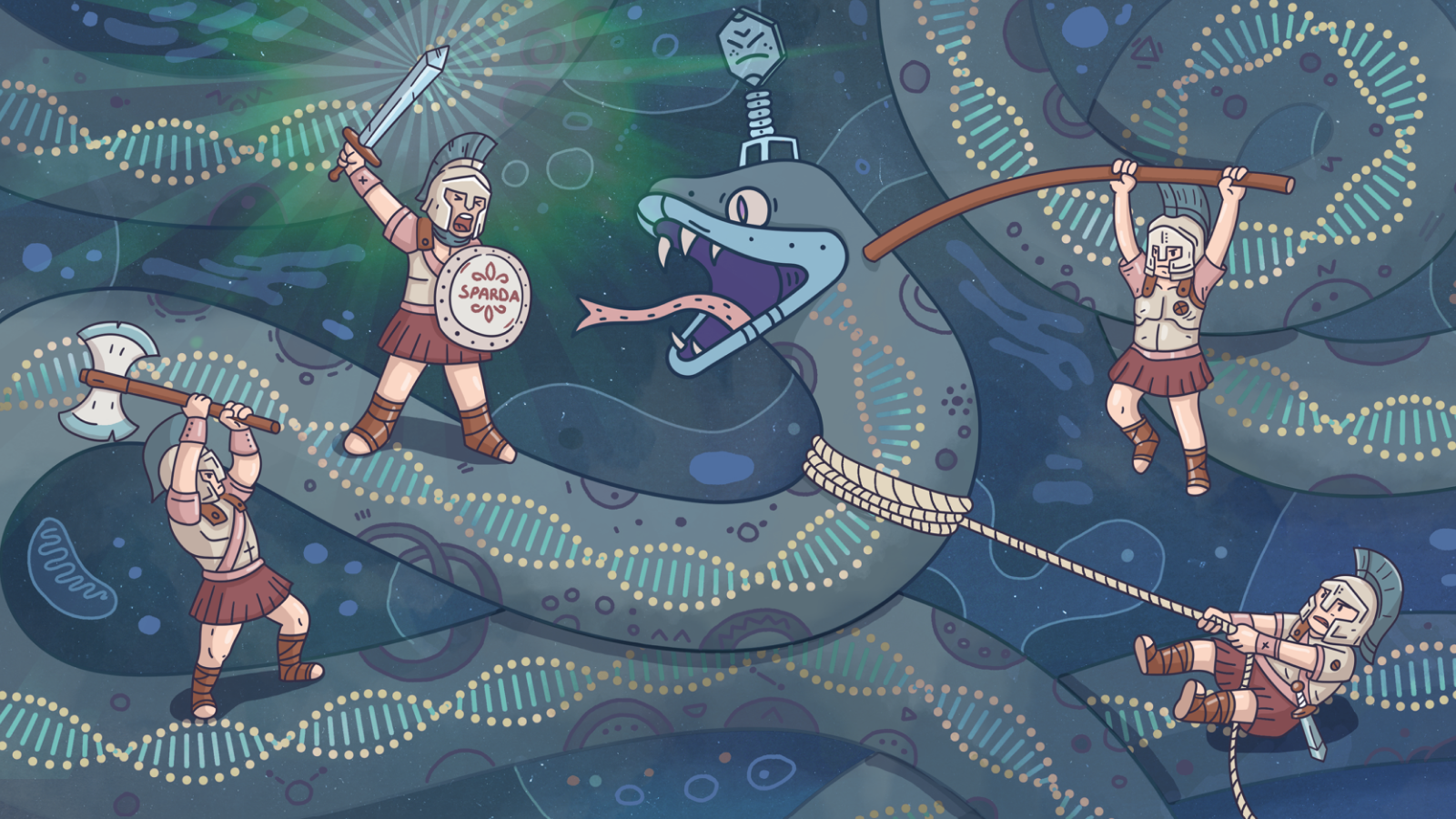
    A recent study in the journal Cell Research highlights another bacterial defense system, known as SPARDA (short prokaryotic Argonaute, DNase associated), and the advances raise the potential for SPARDA-derived biotechnology tools that could enhance diagnostics that currently use CRISPR.


    You may like

    Molecular argonautes

    Study co-author Mindaugas Zaremba, a biochemist at Vilnius University in Lithuania, told Live Science that before the new work, researchers had conducted only limited studies of SPARDA systems. They had established that the proteins that make up the system adopt a kamikaze-like approach to cell defense, guarding the wider population of bacteria against foreign DNA, including free-floating DNA called plasmids and viruses called phages.

    “SPARDA systems were demonstrated to protect bacteria from plasmids and phages by degrading the DNA of both infected cells and invaders, thereby killing the host cell but at the same time preventing further spread of the infection within the bacterial population,” Zaremba said.

    How SPARDA worked at a molecular level remained unclear, prompting Zaremba and his team to use the AI protein analysis tool AlphaFold, among a suite of other analysis techniques, to dig into SPARDA’s setup. AlphaFold uses machine learning to predict the 3D shape of proteins based on the sequence of their underlying building blocks.

    The SPARDA system is built from argonaute proteins, named for their resemblance to argonaut octopuses (Argonauta). The proteins were originally identified in plants, where seedlings affected by mutations in these proteins developed narrow leaves that reminded scientists of an octopus’s tentacles. These argonaute proteins are evolutionarily conserved and are present in cells across the three kingdoms of life.

    Get the world’s most fascinating discoveries delivered straight to your inbox.

    An argonaut octopus caught on camera while diving at night in Anilao, Philippines

    An argonaut octopus, for which argonaute proteins are named. (Image credit: atese/Getty Images)

    Zaremba’s analysis looked at SPARDA systems randomly selected from two different bacteria. The first, Xanthobacter autotrophicus, is a soil-dwelling microbe that shuns sunlight and builds its food from locally sourced nitrogen. The second, Enhydrobacter aerosaccus, was first found in Michigan’s Wintergreen Lake and has built-in airbags that help it float around watery environments.

    Zaremba’s team chopped the SPARDA systems out of these bacteria and placed them in the reliable model organism E. coli for study. A molecular analysis revealed that each of their argonaute proteins included a critical “activating region.” They called this area the beta-relay, because it resembled electrical relay switches that control machinery by flicking between “on” or “off” states.

    When the SPARDA systems detected external threats, these switches changed shape. The new shape enabled the proteins to form complexes with other activated argonaute proteins. When that happens, the proteins line up like soldiers on parade, forming long, spiraling chains. These chains chop up any surrounding DNA that they encounter in an extreme reaction that spares neither the host nor the invader. This stops the infection from spreading to other cells.


    You may like

    Zaremba’s team then used AlphaFold to scan for beta-relays in similar bacterial proteins. The same switches popped up repeatedly, suggesting that the relays are a universal feature of this protein type.

    SPARDA in diagnostics

    SPARDA is essential for bacterial defense, but Zaremba’s team argues that the system could also help humans.

    Activating SPARDA is a last-ditch maneuver for bacterial cells, to be used only when an infection is definitively present. Therefore, the system includes an incredibly accurate recognition system for spotting foreign DNA that would warrant self-destruction.

    Researchers could repurpose the system for diagnostics, Zaremba suggested. In that scenario, the beta-relay could be altered to be activated only when a genetic sequence of interest is identified — so it would react only to the genetic material of a flu virus or SARS-CoV-2, for instance. This mechanism underlies existing CRISPR-based diagnostic tools.

    The CRISPR diagnostics, however, are currently limited in their function — they recognize targets only when certain DNA sequences, called PAM sequences, flank them. These sequences are like the prongs on the end of a plug; if they don’t match a socket, the system will have no power. This means choosing the right CRISPR protein to match a particular target is essential.

    “We already know that SPARDA systems do not require a PAM sequence,” Zaremba said. This means they could act like a universal adapter, giving future DNA diagnostics more flexibility and ultimately making the tests better at detecting a range of germs.

    CRISPR research won a Nobel Prize and changed science forever. While SPARDA research is at a far earlier stage of research, its inner workings suggest that the design of tiny organisms could hold lessons for the biggest questions in science.

    View Original Source Here

    Share. Facebook Twitter Pinterest LinkedIn Tumblr Email

    Related Posts

    People, not glaciers, transported rocks to Stonehenge, study confirms

    January 24, 2026

    SpaceX’s Starlink dodged 300,000 satellite collisions in 2025

    January 23, 2026

    NASA head Isaacman tempers Artemis praise with ideas on the program's future

    January 23, 2026

    6 science-backed tips to kickstart your exercise routine and actually stick to it

    January 22, 2026

    Piercing crocodile close-up wins ecology photo competition

    January 22, 2026

    Olympic visitors to Milan get a rare chance to glimpse restoration of a long-hidden Leonardo gem

    January 21, 2026
    popular posts

    ‘The Completely Made-Up Adventures of Dick Turpin’ Renewed for Season

    Prison Phone Call Fees Are Out of Control

    Ozone hole continues shrinking in 2022, NASA and NOAA scientists

    Sam Raimi’s Spider-Man Trilogy Netflix Return Release Date Set

    Oregonians perceive greater risk than benefit from natural gas export

    ‘Dramatic revision of a basic chapter in algebra’: Mathematicians devise new way to solve devilishly difficult equations

    “Merry Christmas in Heaven” by Rob Alexander

    Categories
    • Books (3,673)
    • Cover Story (10)
    • Events (21)
    • Fashion (2,665)
    • Interviews (55)
    • Movies (2,972)
    • Music (3,260)
    • News (168)
    • Politics (7)
    • Science (4,825)
    • Technology (2,967)
    • Television (3,697)
    • Uncategorized (932)
    Archives
    Facebook X (Twitter) Instagram Pinterest YouTube Reddit TikTok
    © 2026 Top Buzz Magazine. All rights reserved. All articles, images, product names, logos, and brands are property of their respective owners. All company, product and service names used in this website are for identification purposes only. Use of these names, logos, and brands does not imply endorsement unless specified. By using this site, you agree to the Terms of Use and Privacy Policy.

    Type above and press Enter to search. Press Esc to cancel.

    We use cookies on our website to give you the most relevant experience by remembering your preferences and repeat visits. By clicking “Accept”, you consent to the use of ALL the cookies.
    Do not sell my personal information.
    Cookie SettingsAccept
    Manage consent

    Privacy Overview

    This website uses cookies to improve your experience while you navigate through the website. Out of these, the cookies that are categorized as necessary are stored on your browser as they are essential for the working of basic functionalities of the website. We also use third-party cookies that help us analyze and understand how you use this website. These cookies will be stored in your browser only with your consent. You also have the option to opt-out of these cookies. But opting out of some of these cookies may affect your browsing experience.
    Necessary
    Always Enabled
    Necessary cookies are absolutely essential for the website to function properly. These cookies ensure basic functionalities and security features of the website, anonymously.
    CookieDurationDescription
    cookielawinfo-checkbox-analytics11 monthsThis cookie is set by GDPR Cookie Consent plugin. The cookie is used to store the user consent for the cookies in the category "Analytics".
    cookielawinfo-checkbox-functional11 monthsThe cookie is set by GDPR cookie consent to record the user consent for the cookies in the category "Functional".
    cookielawinfo-checkbox-necessary11 monthsThis cookie is set by GDPR Cookie Consent plugin. The cookies is used to store the user consent for the cookies in the category "Necessary".
    cookielawinfo-checkbox-others11 monthsThis cookie is set by GDPR Cookie Consent plugin. The cookie is used to store the user consent for the cookies in the category "Other.
    cookielawinfo-checkbox-performance11 monthsThis cookie is set by GDPR Cookie Consent plugin. The cookie is used to store the user consent for the cookies in the category "Performance".
    viewed_cookie_policy11 monthsThe cookie is set by the GDPR Cookie Consent plugin and is used to store whether or not user has consented to the use of cookies. It does not store any personal data.
    Functional
    Functional cookies help to perform certain functionalities like sharing the content of the website on social media platforms, collect feedbacks, and other third-party features.
    Performance
    Performance cookies are used to understand and analyze the key performance indexes of the website which helps in delivering a better user experience for the visitors.
    Analytics
    Analytical cookies are used to understand how visitors interact with the website. These cookies help provide information on metrics the number of visitors, bounce rate, traffic source, etc.
    Advertisement
    Advertisement cookies are used to provide visitors with relevant ads and marketing campaigns. These cookies track visitors across websites and collect information to provide customized ads.
    Others
    Other uncategorized cookies are those that are being analyzed and have not been classified into a category as yet.
    SAVE & ACCEPT