
Close Menu
    Facebook X (Twitter) Instagram Pinterest YouTube LinkedIn TikTok
    TopBuzzMagazine.com
    Facebook X (Twitter) Instagram Pinterest YouTube LinkedIn TikTok
    • Home
    • Movies
    • Television
    • Music
    • Fashion
    • Books
    • Science
    • Technology
    • Cover Story
    • Contact
      • About
      • Amazon Disclaimer
      • Terms and Conditions
      • Privacy Policy
      • DMCA / Copyrights Disclaimer
    TopBuzzMagazine.com
    Home»Science»Astronomers spotted a pair of monster black holes that could collide in just 100 years — and Earth will feel it
    Science

    Astronomers spotted a pair of monster black holes that could collide in just 100 years — and Earth will feel it

    By AdminApril 17, 2026
    Facebook Twitter Pinterest LinkedIn Tumblr Email
    Astronomers spotted a pair of monster black holes that could collide in just 100 years — and Earth will feel it


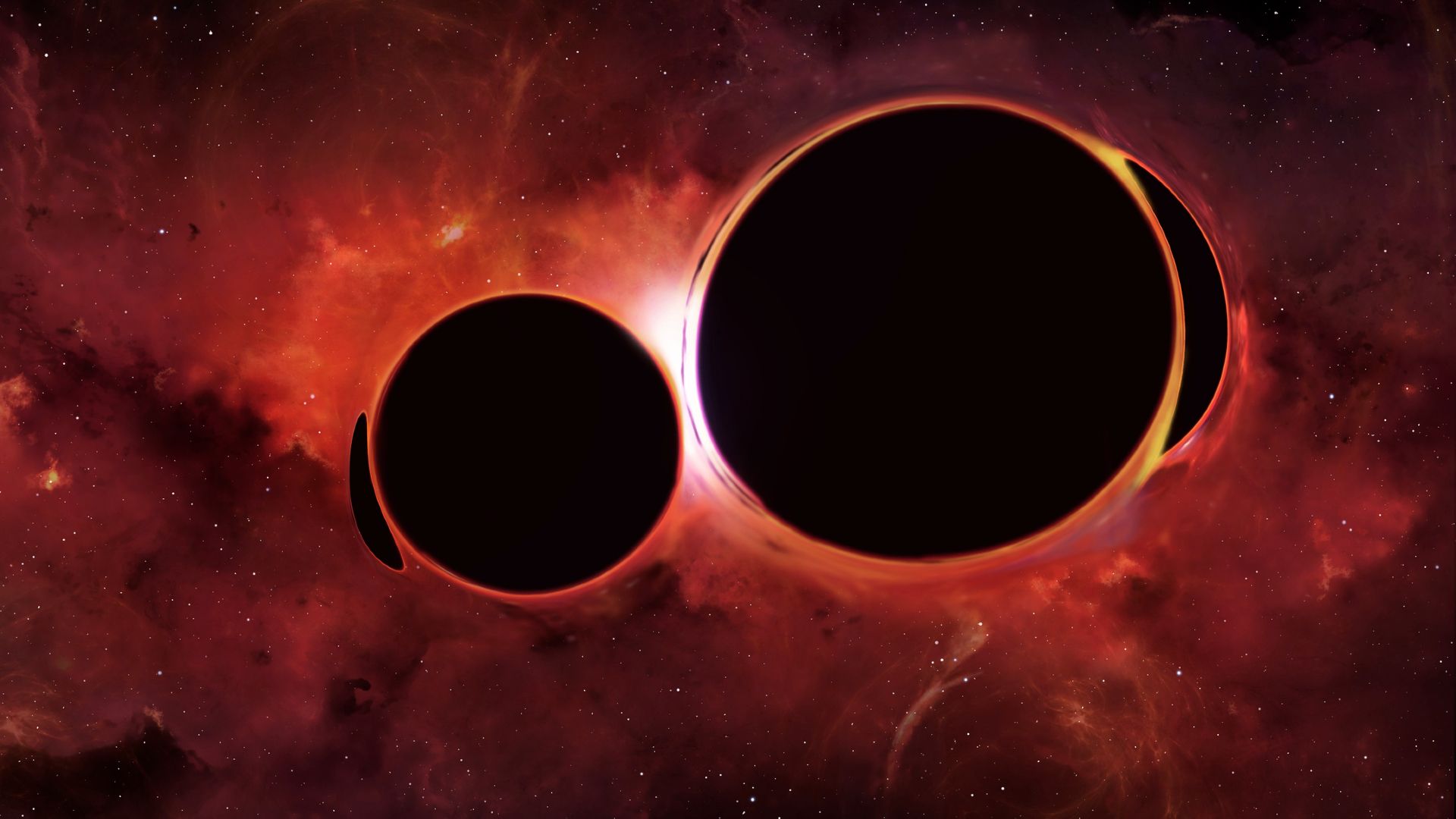
    Astronomers may have discovered an extreme pair of light-spewing black holes that are spiraling toward an enormous collision — the effects of which could be felt in the next century.

    Using decades of radio telescope observations, the astronomers studied an ultrabright object that was previously thought to be a blazar — a glowing core of a galaxy usually powered by a black hole — some 500 million light-years from our solar system. The observations revealed a hidden jet of energy that suggests the intensely bright object is actually two black holes on the verge of colliding, perhaps less than 100 years from now.

    “We expect one (merged) black hole to remain,” study co-author Silke Britzen, an astronomer at the Max-Planck Institute for Radio Astronomy, told BBC Science Focus. “I am really curious to observe how this ‘dance’ will continue.”


    You may like

    The findings were published March 27 in the journal Monthly Notices of the Royal Astronomical Society.

    Finding two black holes

    Blazars are some of the most luminous objects in the universe. They’re classified as active galactic nuclei — actively feeding objects at the centers of galaxies, usually powered by supermassive black holes — and typically shoot jets of high-energy radiation toward Earth. Usually, a central black hole is the source for this jet, but in the case of the blazar in the galaxy Markarian 501, something didn’t quite add up.

    For years, astronomers had observed different orientations of the jet using radio telescope data, making it difficult to determine if its core really did harbor a supermassive black hole. To answer this question, the researchers analyzed over 83 datasets from the Very Long Baseline Array, an international network of 10 radio telescopes.

    The results revealed that, instead of one large jet, there was also a second jet looping counterclockwise around the blazar’s center. The team believes each of these jets is powered by a supermassive black hole, each weighing between 100 million and a billion times the sun’s mass.

    Get the world’s most fascinating discoveries delivered straight to your inbox.

    “Realising that [there] was a second jet was awesome,” Britzen told BBC Science Focus. “For me it was like: that’s how it works? I was so amazed and overwhelmed — and wanted to tell everybody what we just found.”

    In June 2022, the two black holes lined up perfectly so that the primary black hole’s gravity bent the light emitted by the second jet into a near-perfect circle known as an Einstein ring. Thanks to a phenomenon called gravitational lensing — a sort of natural magnifying glass created by intense gravitational forces — this finding adds further evidence to the idea that the blazar is powered by a pair of supermassive black holes.

    “Since these jets are directed towards us, an Einstein ring supports the scenario,” Britzen said.

    The two black holes are thought to circle each other clockwise about once every 121 days and are separated by only 250 to 540 times the distance between Earth and the sun — relatively close in the world of astronomy. Gradually, this distance will close until the two objects ultimately merge.

    The researchers think that when the doomed black holes do inevitably collide, they will release gravitational waves — ripples in the fabric of space-time unleashed by the most intense events in the universe — that could be more powerful than those from previously studied black hole mergers. If that’s the case, gravitational wave detectors on Earth will pick up the signal, offering new clues about the properties of the original black hole pair.

    Britzen, S., Olivares, H., Gopal-Krishna, Jaron, F., Pashchenko, I. N., Kun, E., Schinzel, F. K., González, J. B., Paneque, D., & MacDonald, N. R. (2026). Detection of a second jet within the nuclear core of Mrk 501. Monthly Notices of the Royal Astronomical Society. https://doi.org/10.1093/mnras/stag291


    How much do you know about black holes? Try our black hole quiz!

    View Original Source Here

    Share. Facebook Twitter Pinterest LinkedIn Tumblr Email

    Related Posts

    Our dreams become more emotive and symbolic as we approach death

    April 16, 2026

    Ancient viruses serve as gene delivery couriers to help bacteria resist antibiotics

    April 16, 2026

    ‘Something’s missing’: Most thorough-ever study of the cosmos proves we still can’t explain how the universe is expanding

    April 15, 2026

    Is a super El Niño imminent, and what could the impacts be?

    April 15, 2026

    A simpler way to count cool roofs' climate payoff could reshape local carbon planning

    April 14, 2026

    Physicists just witnessed pinpricks of darkness moving faster than the speed of light ‪—‬ without breaking the laws of relativity

    April 14, 2026
    popular posts

    The ‘Jeopardy!’ Champion Once Worked at a Popular New York Bakery

    “Elevation” by John Dorsch

    Best iPad to Buy (and Some to Avoid) in 2024

    Chappell Roan’s “The Giver” Is Our Song of the Week

    ‘Cultural continuity’ hypothesis suggests we’re all wired to keep traditions alive

    Instagram Blend Feature With Personalised Content Suggestions Launched: How it Works

    How to Get Started on Hive Social

    Categories
    • Books (3,802)
    • Cover Story (14)
    • Events (23)
    • Fashion (2,735)
    • Interviews (57)
    • Movies (3,098)
    • Music (3,389)
    • News (173)
    • Politics (10)
    • Science (4,953)
    • Technology (3,094)
    • Television (3,823)
    • Uncategorized (932)
    Archives
    Facebook X (Twitter) Instagram Pinterest YouTube Reddit TikTok
    © 2026 Top Buzz Magazine. All rights reserved. All articles, images, product names, logos, and brands are property of their respective owners. All company, product and service names used in this website are for identification purposes only. Use of these names, logos, and brands does not imply endorsement unless specified. By using this site, you agree to the Terms of Use and Privacy Policy.

    Type above and press Enter to search. Press Esc to cancel.

    We use cookies on our website to give you the most relevant experience by remembering your preferences and repeat visits. By clicking “Accept”, you consent to the use of ALL the cookies.
    Do not sell my personal information.
    Cookie SettingsAccept
    Manage consent

    Privacy Overview

    This website uses cookies to improve your experience while you navigate through the website. Out of these, the cookies that are categorized as necessary are stored on your browser as they are essential for the working of basic functionalities of the website. We also use third-party cookies that help us analyze and understand how you use this website. These cookies will be stored in your browser only with your consent. You also have the option to opt-out of these cookies. But opting out of some of these cookies may affect your browsing experience.
    Necessary
    Always Enabled
    Necessary cookies are absolutely essential for the website to function properly. These cookies ensure basic functionalities and security features of the website, anonymously.
    CookieDurationDescription
    cookielawinfo-checkbox-analytics11 monthsThis cookie is set by GDPR Cookie Consent plugin. The cookie is used to store the user consent for the cookies in the category "Analytics".
    cookielawinfo-checkbox-functional11 monthsThe cookie is set by GDPR cookie consent to record the user consent for the cookies in the category "Functional".
    cookielawinfo-checkbox-necessary11 monthsThis cookie is set by GDPR Cookie Consent plugin. The cookies is used to store the user consent for the cookies in the category "Necessary".
    cookielawinfo-checkbox-others11 monthsThis cookie is set by GDPR Cookie Consent plugin. The cookie is used to store the user consent for the cookies in the category "Other.
    cookielawinfo-checkbox-performance11 monthsThis cookie is set by GDPR Cookie Consent plugin. The cookie is used to store the user consent for the cookies in the category "Performance".
    viewed_cookie_policy11 monthsThe cookie is set by the GDPR Cookie Consent plugin and is used to store whether or not user has consented to the use of cookies. It does not store any personal data.
    Functional
    Functional cookies help to perform certain functionalities like sharing the content of the website on social media platforms, collect feedbacks, and other third-party features.
    Performance
    Performance cookies are used to understand and analyze the key performance indexes of the website which helps in delivering a better user experience for the visitors.
    Analytics
    Analytical cookies are used to understand how visitors interact with the website. These cookies help provide information on metrics the number of visitors, bounce rate, traffic source, etc.
    Advertisement
    Advertisement cookies are used to provide visitors with relevant ads and marketing campaigns. These cookies track visitors across websites and collect information to provide customized ads.
    Others
    Other uncategorized cookies are those that are being analyzed and have not been classified into a category as yet.
    SAVE & ACCEPT