
Close Menu
    Facebook X (Twitter) Instagram Pinterest YouTube LinkedIn TikTok
    TopBuzzMagazine.com
    Facebook X (Twitter) Instagram Pinterest YouTube LinkedIn TikTok
    • Home
    • Movies
    • Television
    • Music
    • Fashion
    • Books
    • Science
    • Technology
    • Cover Story
    • Contact
      • About
      • Amazon Disclaimer
      • Terms and Conditions
      • Privacy Policy
      • DMCA / Copyrights Disclaimer
    TopBuzzMagazine.com
    Home»Science»5,300-year-old kidney stone found in burial of Bronze Age man buried near the Black Sea
    Science

    5,300-year-old kidney stone found in burial of Bronze Age man buried near the Black Sea

    By AdminNovember 3, 2026
    Facebook Twitter Pinterest LinkedIn Tumblr Email
    5,300-year-old kidney stone found in burial of Bronze Age man buried near the Black Sea


    Follow us

    Add us as a preferred source on Google


    Subscribe to our newsletter


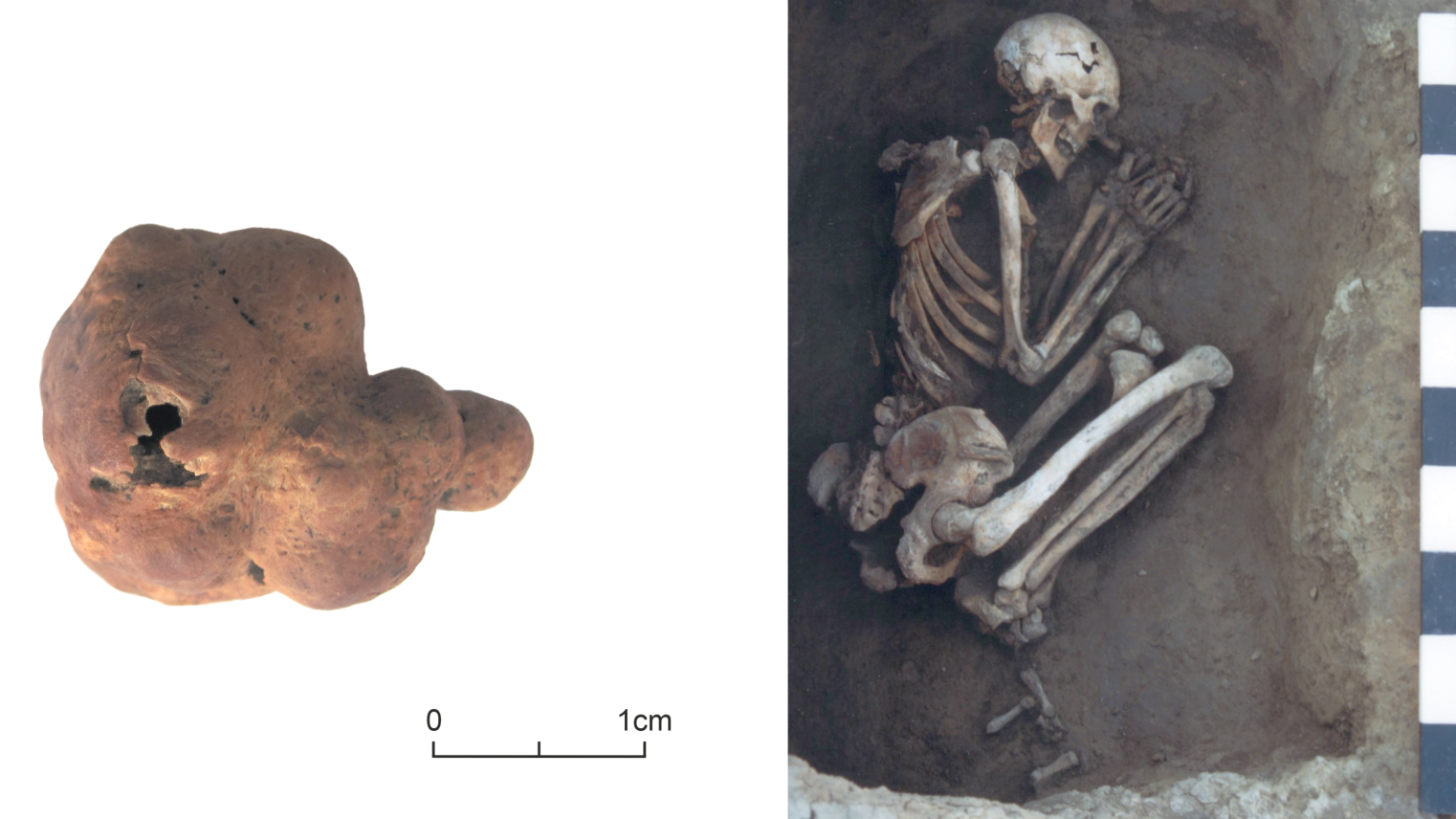
    A Bronze Age man buried in a monumental tomb near the Black Sea may have died from complications of a urinary tract infection (UTI) more than five millennia ago, according to a new study. Archaeologists identified a grape-size object consistent with a kidney or bladder stone in the man’s burial.

    “He lived with a chronic urogenital infection,” study lead author Natalia Berezina, an anthropologist at Lomonosov Moscow State University in Russia, told Live Science in an email.

    “It was not a brief episode,” she said. “His last years were probably marked by considerable and more or less constant pain.”

    Latest Videos FromLive Science

    Berezina and colleagues investigated a small, stone-like object found in an Early Bronze Age burial in the Stavropol Upland region of southwestern Russia. They published their findings Sept. 30 in the journal Archaeological and Anthropological Sciences.

    The burial was part of a kurgan cemetery, an ancient steppe funeral tradition that involved constructing a large mound of dirt over a grave. Archaeologists discovered a catacomb when they excavated the mound, and inside was the skeleton of a man who was in his 40s when he died around 5,300 years ago. The researchers found a flint arrowhead near the man’s pelvis.


    You may like

    But during a laboratory analysis after the skeleton was excavated, researchers noticed an odd stone-like object in the collection of hand bones. The brownish object was round with several protrusions and measured about 0.8 inches (2.1 centimeters) in diameter, or roughly the size of a grape. A small crack in the object showed a crystal-like structure inside.

    To learn more, the researchers used several analytical methods to determine what the tiny object was made of. First, X-ray fluorescence analysis revealed that the main components of the object were calcium and phosphorus. Then, they used X-ray powder diffraction analysis to identify the crystal structures.

    Get the world’s most fascinating discoveries delivered straight to your inbox.

    In addition to common minerals, the researchers discovered the presence of whitlockite, a rare calcium salt that is known to occur in kidney, bladder and prostate stones. These “stones,” collectively called calculi, are hard masses of minerals, such as calcium-containing salts. They differ in terms of the organ they form within, the exact mechanism of how they form, and their chemical makeup, although kidney and bladder stones tend to contain very similar compounds.

    Whitlockite is strongly associated with bacterial infections in the human body, which suggests that the Bronze Age man had a chronic infection that resulted in the stone, the scientists concluded.

    “On the balance of the available evidence, we regard a renal [kidney] stone secondary to chronic upper urinary tract infection as the most probable origin,” the researchers wrote. That is, the man dealt with chronic or recurrent UTIs, which led to the formation of the stone and likely caused him considerable discomfort. UTIs can contribute to the formation of kidney stones by altering the acidity of urine and making minerals more likely to accumulate.


    What to read next

    The researchers aren’t sure why the man had urinary tract issues or whether it contributed to his death.

    Notably, kidney stones can sometimes travel to the bladder, so it’s unclear exactly where the stone was in the man’s body when he died. If the stone had obstructed the man’s ureter ‪—‬ one of the two long tubes that connect the kidneys to the bladder ‪—‬ it may have caused kidney swelling, a secondary infection or sepsis. These conditions were frequently fatal prior to the invention of antibiotics.

    Other possibilities for what caused the stone include a bacterial infection of the man’s prostate gland or even a sexually transmitted infection.

    The man was likely on the move frequently within this Early Bronze Age steppe society, and other injuries to his skeleton suggested he had a physically demanding life, the researchers wrote. His bones showed that he was well muscled but was also dealing with degenerative joint disease in his spine, shoulders, hips, hands and feet. He had a series of healed fractures in his right shoulder, ribs and forearm.

    “These were people who worked with cattle and heavy wagons on the open steppe,” Berezina said, “and the injuries that follow from that are the injuries we find.” In a previous study at a nearby cemetery, Berezina and colleagues found the skeleton of a man who was injured when a wagon ran over him, several years before his death. “Against that background, four healed fractures in our man look unremarkable,” she said.

    But the urinary tract stone would have made the man’s life difficult, the researchers noted. “This individual suffered from a painful and debilitating chronic urogenital infection, a condition that would have significantly impacted his quality of life,” they wrote.

    Berezina, N. Ya., Statkus, M. A., Kalmykov, A. A., Abdrashitova, I. V., Kolesnik, I. V., Platonov, V. B., Shashurin, D. A., Garmay, A. V., Korobkova, V. V., Ryleeva, V. S., & Gresky, J. (2026). Urolithiasis in the Early Bronze Age of the North Caucasus: A paleopathological case study and insights into ancient lifeways. Archaeological and Anthropological Sciences, 18(10), 209. https://doi.org/10.1007/s12520-026-02574-7


    What do you know about the bones in your body? Test your knowledge with our human skeleton quiz.

    Original Source Link

    Share. Facebook Twitter Pinterest LinkedIn Tumblr Email

    Related Posts

    A 3,200-pound NASA spacecraft could fall to Earth any minute now

    November 4, 2026

    When dinosaurs are sold to the highest bidder, we all lose

    November 4, 2026

    Mom experienced extreme unhappiness only when she breastfed — Diagnostic dilemma

    November 4, 2026

    Would you risk your health to visit Mars?

    November 4, 2026

    ‘Quite a light show’: NASA astronaut snaps atmospheric fireball as Russian rocket explodes over West Africa — Earth from space

    November 3, 2026

    Mars-bound astronauts could face years of heart scarring, rat study hints

    November 3, 2026
    popular posts

    Lacey Chabert & Andrew Walker Hallmark Christmas Movie Date, Trailer

    DMX Gets His Own Street in Yonkers

    Thrilling Mysteries You Won’t Want to Miss!

    Ukraine Asks Tim Cook to Cut Apple Supplies, App Store

    American Intolerance and Book Bans: Book Censorship News, February 2,

    Nikki Glaser Told Us 3 No-Fail Tricks for an Instant Glow-Up

    Famke Janssen Wasn’t Asked to Return as Jean Grey for ‘Doomsday’

    Categories
    • Books (4,191)
    • Cover Story (27)
    • Events (29)
    • Fashion (2,959)
    • Interviews (65)
    • Movies (3,496)
    • Music (3,796)
    • News (188)
    • Politics (18)
    • Science (5,317)
    • Technology (3,497)
    • Television (4,236)
    • Uncategorized (933)
    Archives
    Facebook X (Twitter) Instagram Pinterest YouTube Reddit TikTok
    © 2026 Top Buzz Magazine. All rights reserved. All articles, images, product names, logos, and brands are property of their respective owners. All company, product and service names used in this website are for identification purposes only. Use of these names, logos, and brands does not imply endorsement unless specified. By using this site, you agree to the Terms of Use and Privacy Policy.

    Type above and press Enter to search. Press Esc to cancel.

    We use cookies on our website to give you the most relevant experience by remembering your preferences and repeat visits. By clicking “Accept”, you consent to the use of ALL the cookies.
    Do not sell my personal information.
    Cookie SettingsAccept
    Manage consent

    Privacy Overview

    This website uses cookies to improve your experience while you navigate through the website. Out of these, the cookies that are categorized as necessary are stored on your browser as they are essential for the working of basic functionalities of the website. We also use third-party cookies that help us analyze and understand how you use this website. These cookies will be stored in your browser only with your consent. You also have the option to opt-out of these cookies. But opting out of some of these cookies may affect your browsing experience.
    Necessary
    Always Enabled
    Necessary cookies are absolutely essential for the website to function properly. These cookies ensure basic functionalities and security features of the website, anonymously.
    CookieDurationDescription
    cookielawinfo-checkbox-analytics11 monthsThis cookie is set by GDPR Cookie Consent plugin. The cookie is used to store the user consent for the cookies in the category "Analytics".
    cookielawinfo-checkbox-functional11 monthsThe cookie is set by GDPR cookie consent to record the user consent for the cookies in the category "Functional".
    cookielawinfo-checkbox-necessary11 monthsThis cookie is set by GDPR Cookie Consent plugin. The cookies is used to store the user consent for the cookies in the category "Necessary".
    cookielawinfo-checkbox-others11 monthsThis cookie is set by GDPR Cookie Consent plugin. The cookie is used to store the user consent for the cookies in the category "Other.
    cookielawinfo-checkbox-performance11 monthsThis cookie is set by GDPR Cookie Consent plugin. The cookie is used to store the user consent for the cookies in the category "Performance".
    viewed_cookie_policy11 monthsThe cookie is set by the GDPR Cookie Consent plugin and is used to store whether or not user has consented to the use of cookies. It does not store any personal data.
    Functional
    Functional cookies help to perform certain functionalities like sharing the content of the website on social media platforms, collect feedbacks, and other third-party features.
    Performance
    Performance cookies are used to understand and analyze the key performance indexes of the website which helps in delivering a better user experience for the visitors.
    Analytics
    Analytical cookies are used to understand how visitors interact with the website. These cookies help provide information on metrics the number of visitors, bounce rate, traffic source, etc.
    Advertisement
    Advertisement cookies are used to provide visitors with relevant ads and marketing campaigns. These cookies track visitors across websites and collect information to provide customized ads.
    Others
    Other uncategorized cookies are those that are being analyzed and have not been classified into a category as yet.
    SAVE & ACCEPT