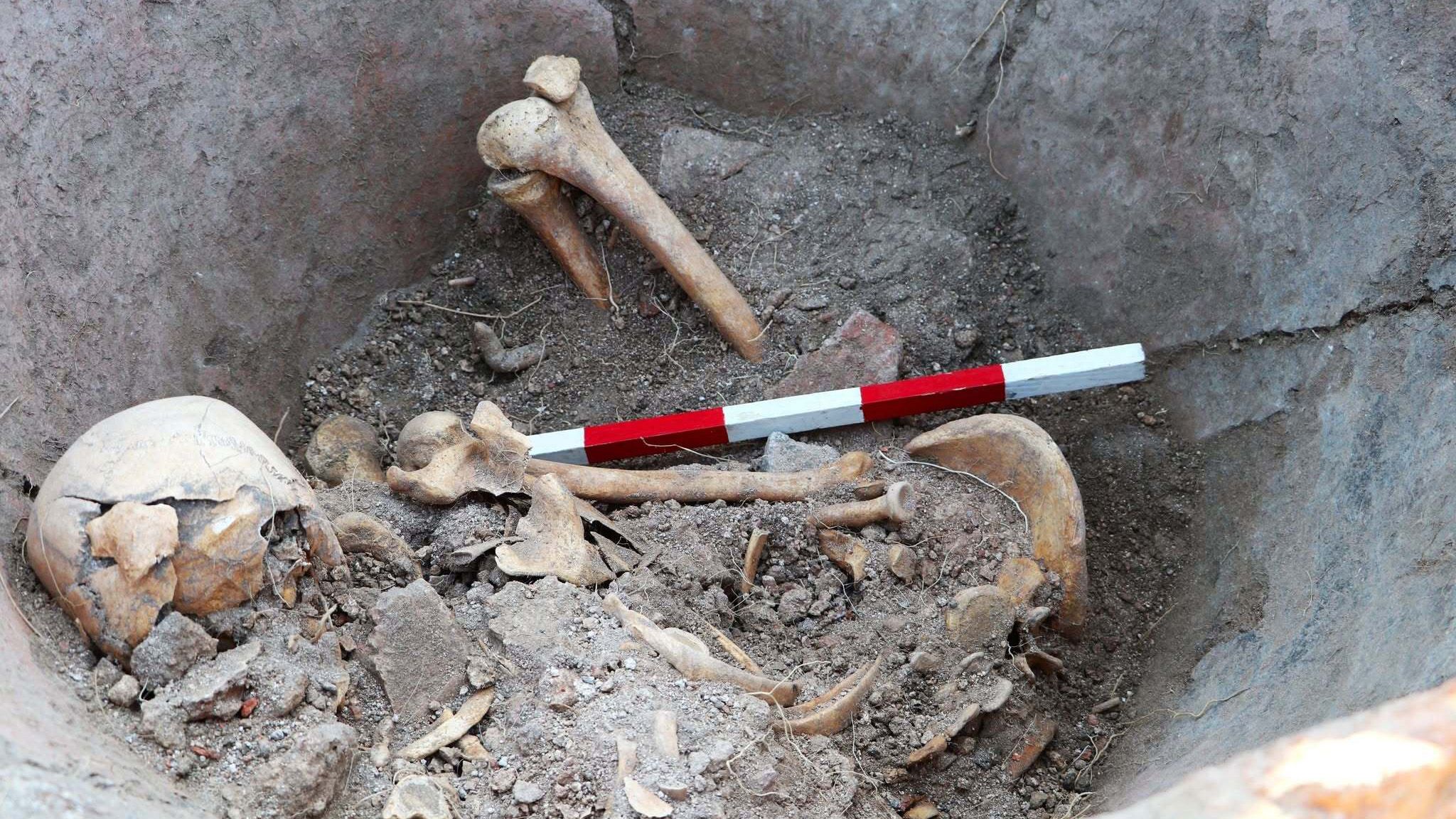
Archaeologists in Bulgaria have discovered a human skeleton inside a giant Roman jar. It’s likely that the individual sought shelter in the vessel during an enemy attack over 1,600 years ago but died as a fire swept through the area.
The team unearthed the gigantic jar in a Late Roman turret, or small tower, in the Roman colony of Deultum on Aug. 10. It’s unclear which battle led to the individual’s death, but Deultum faced many attacks from East Germanic tribes and Huns in the fourth and fifth centuries, lead excavator Lyudmil Vagalinski, an archaeologist at the Bulgarian Academy of Sciences, told Live Science in an email.
The individual’s remains were found with two iron knives and a belt inside the container, a type of jar known as a dolium. These huge vessels were the largest type of pottery in antiquity (from roughly the eighth century B.C. to the fifth century A.D.) and were used to store goods such as olive oil and wine. The largest dolia could hold more than 260 gallons (1,000 liters), although the surviving lower part of the newfound dolium was smaller, measuring approximately 3 feet (1 meter) in diameter, Vagalinski said.
Latest Videos FromLive Science
Even though Vagalinski and his colleagues had been excavating the turret, which is the northern turret of Deultum’s western Roman gate, they weren’t expecting to find human remains there, according to Standart News, the Bulgarian outlet that first covered the finding.
“We were surprised,” Vagalinski said in an email. It’s very rare for archaeologists to discover human remains inside the cities of antiquity except in the case of “extraordinary circumstances” — like earthquakes, enemy attacks or volcanic eruptions, he said. Even in these cases, survivors would search for their dead to bury them beyond the city walls, but they often didn’t know that there were dead bodies under the ruins.
The recent discovery seems to represent one of those “extraordinary circumstances,” Vagalinski said. The team found a significant amount of burned materials around the dolium, including ashes and coals; broken bricks, tiles and shards; blackened walls; melted glass fragments; and bones from domestic animals. The likely scenario is that, upon hearing of an imminent attack, people brought their livestock into the fortress. The archaeologists also found many bronze coins that were probably lost in the chaos.
The individual, presumably a young man, was likely part of this tumult and climbed into the dolium to hide or seek shelter, Vagalinski said. And while it’s unknown how the fire started, the presence of ashes under the skeleton in the dolium indicates that the individual went inside after the fire had already begun, Vagalinski said.
Sign up for the Live Science daily newsletter now
Get the world’s most fascinating discoveries delivered straight to your inbox.
The individual climbed inside the giant vessel with two knives around 1,600 years ago.
(Image credit: Archaeologia Bulgarica)
The team’s preliminary analysis dates the event to approximately A.D. 400, though they’ll have a more precise date after they process the rest of their field data, according to Vagalinski.
The young man was likely hiding from the raging fire in the empty dolium and held an iron knife between his legs to defend himself in case the attackers found him, Vagalinski explained. He had a second knife in his belt.
“In any case, he made no attempt to get out of the ceramic vessel,” Vagalinski said. The team determined this based on the individual’s position, similar to that of a sleeping man. “After the attack, the inhabitants of the city leveled the ruins of the tower and covered them with a new, higher floor.” They did not know that a fellow citizen was lying at the bottom of the dolium.
The skeletal remains have been moved to Sofia, the capital of Bulgaria, where they will be analyzed by a physical anthropologist, according to Vagalinski. Next summer, the team will head back to Deultum to try to unearth the entire western Late Roman gate, which dates to approximately A.D. 300. The researchers are “eager to reveal its whole plan and proper chronology,” Vagalinski said. They also aim to complete the investigation of the gate’s northern turret, where they found the dolium.
Earlier this year, the team discovered an older latrina, the Latin word for toilet, dating to between the second and third centuries, near the gate.
From Augustus to Nero, see how much you know about ancient Rome’s famous leaders with our Roman emperor quiz!
We use cookies on our website to give you the most relevant experience by remembering your preferences and repeat visits. By clicking “Accept”, you consent to the use of ALL the cookies.
This website uses cookies to improve your experience while you navigate through the website. Out of these, the cookies that are categorized as necessary are stored on your browser as they are essential for the working of basic functionalities of the website. We also use third-party cookies that help us analyze and understand how you use this website. These cookies will be stored in your browser only with your consent. You also have the option to opt-out of these cookies. But opting out of some of these cookies may affect your browsing experience.
Necessary cookies are absolutely essential for the website to function properly. These cookies ensure basic functionalities and security features of the website, anonymously.
Cookie
Duration
Description
cookielawinfo-checkbox-analytics
11 months
This cookie is set by GDPR Cookie Consent plugin. The cookie is used to store the user consent for the cookies in the category "Analytics".
cookielawinfo-checkbox-functional
11 months
The cookie is set by GDPR cookie consent to record the user consent for the cookies in the category "Functional".
cookielawinfo-checkbox-necessary
11 months
This cookie is set by GDPR Cookie Consent plugin. The cookies is used to store the user consent for the cookies in the category "Necessary".
cookielawinfo-checkbox-others
11 months
This cookie is set by GDPR Cookie Consent plugin. The cookie is used to store the user consent for the cookies in the category "Other.
cookielawinfo-checkbox-performance
11 months
This cookie is set by GDPR Cookie Consent plugin. The cookie is used to store the user consent for the cookies in the category "Performance".
viewed_cookie_policy
11 months
The cookie is set by the GDPR Cookie Consent plugin and is used to store whether or not user has consented to the use of cookies. It does not store any personal data.
Functional cookies help to perform certain functionalities like sharing the content of the website on social media platforms, collect feedbacks, and other third-party features.
Performance cookies are used to understand and analyze the key performance indexes of the website which helps in delivering a better user experience for the visitors.
Analytical cookies are used to understand how visitors interact with the website. These cookies help provide information on metrics the number of visitors, bounce rate, traffic source, etc.
Advertisement cookies are used to provide visitors with relevant ads and marketing campaigns. These cookies track visitors across websites and collect information to provide customized ads.