
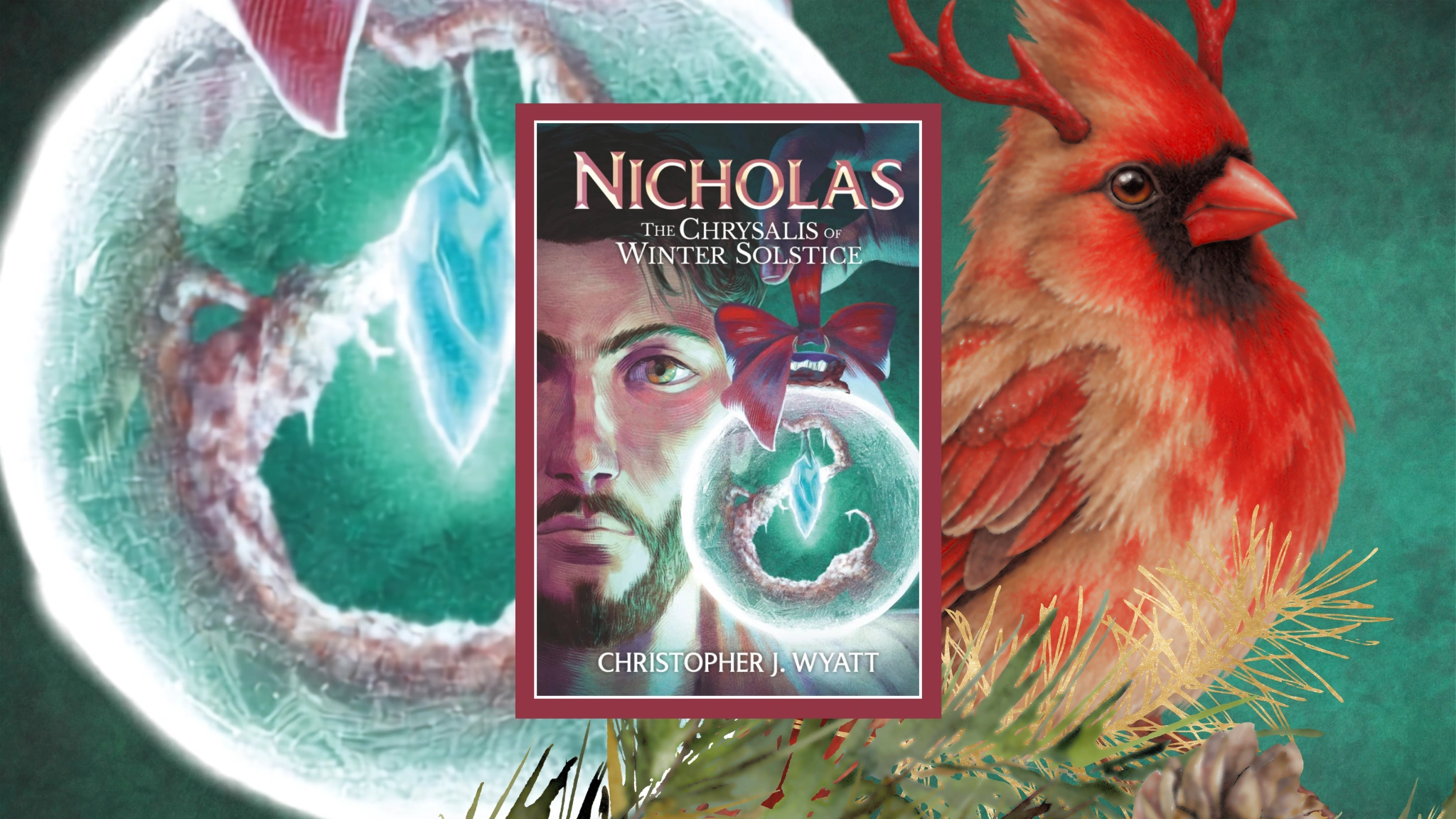
Nicholas: The Chrysalis of Winter Solstice by Christopher J. Wyatt
In building a fantasy mythology around Saint Nicholas, Wyatt gives the familiar gift-bringer a much stranger, rougher and more adventurous road to becoming himself.
Long before the red suit, the reindeer and the yearly journey around the world, there was Nicholas: a young man shaped by faith, generosity, grief and the example of parents who taught him to care for others. Christopher J. Wyatt takes that familiar foundation and sends it in an unexpected direction in Nicholas: The Chrysalis of Winter Solstice, a sprawling fantasy adventure that imagines how Nicholas might have grown into the figure who would one day become legend.
The story begins in Patara, Lycia, where Nicholas is born to the wealthy but charitable Theopanes and Nonna. His mother teaches him to swim by telling him to “pull the sea,” advice that becomes both a survival technique and life philosophy. When an epidemic claims both parents, Nicholas inherits their wealth and their example of generosity. A mysterious calling eventually sends him toward the Holy Land aboard a ship named for his mother — until an unnatural storm, a frozen sea and a magical rescue carry him (and us) somewhere else entirely.
A Saint Steps Into a Fantasy World
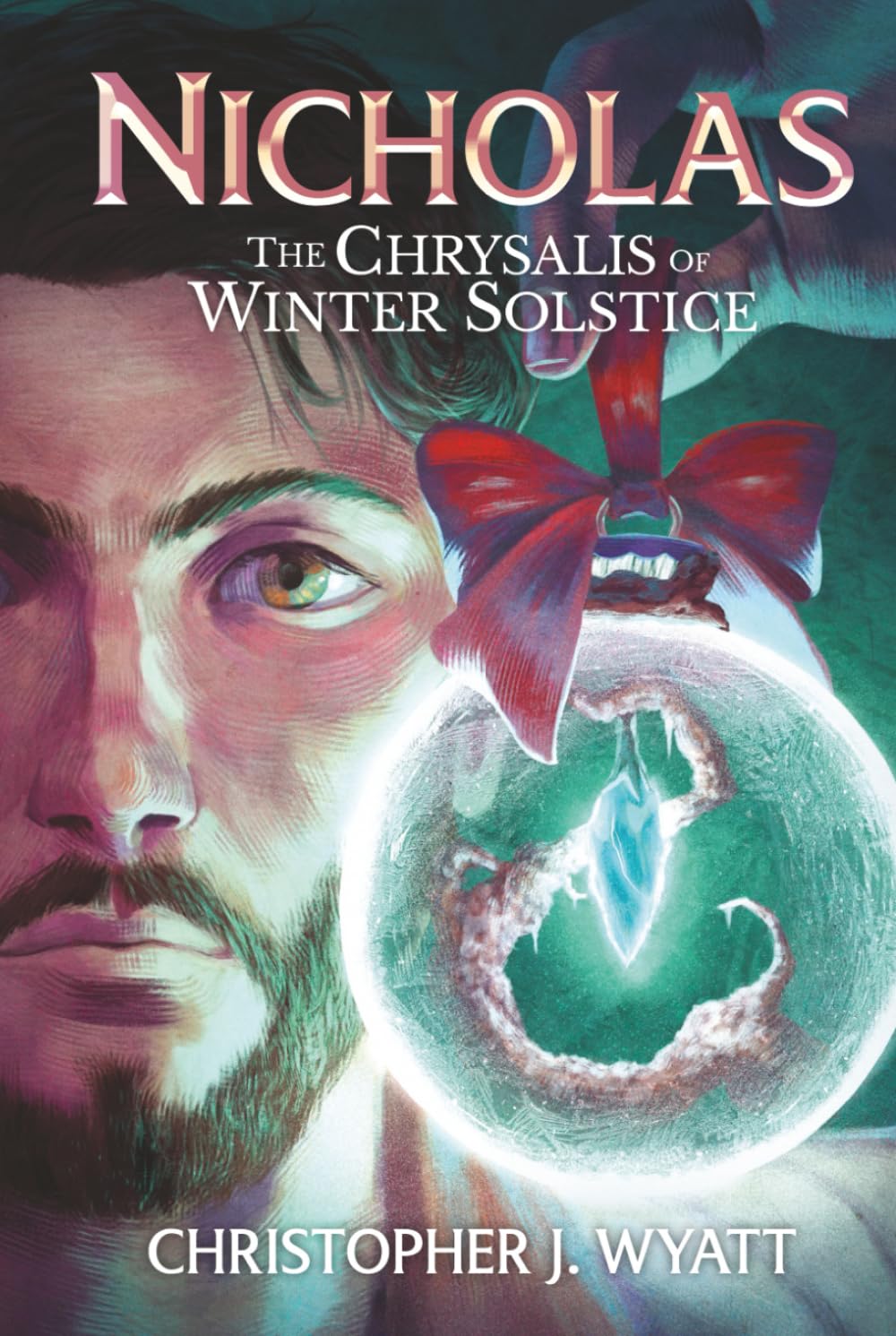
That somewhere is Degomble, part of a remote winter world crowded with warriors, healers, artificers, magical animals and communities threatened by the Bacillus as it approaches Winter Solstice. Nicholas is soon identified as the “Restorer of Goodness,” a role tied to powers he does not yet understand. His quest eventually centers on the Chrysalis of Winter Solstice (a frozen bauble containing a cocoon-like form) and a sick, antlered creature known as the Foredoomed Fallow, whom he must heal.
Wyatt has built this world down to the smallest details. Degomble and its protect realm, Ethereal, have their own customs, military strategies, magical systems, professions and terminology. Readers encounter embedapists and malificus, crimson mimicry, the Faithlife of Kindness, enchanted cardinals, magical caribou, gashgobs and a steady procession of inventions that make the setting feel fully inhabited.
Gandomine is one of the more memorable characters: a primordial cardinal whose feathers combine the bright red associated with males and the brown of females. Gandomine speaks in both male and female voices, occasionally arguing with themself, and even sports a pair of small crimson antlers.
Goodness as a Superpower
Balancing these flights of fancy is Nicholas himself. He sees himself as an ordinary man despite his extraordinary abilities, chief among them the power to heal and restore.
A good example of this is his relationship with the Foredoomed Fallow, later called Xalibu. Nicholas sees the animal suffering and approaches her gently, rather than treating her as a beast to be subdued. When he finally heals her, her broken, diseased antlers become crimson, and the corrupted forest around them begins to recover as well. The scene captures the book’s central idea: goodness has value not only because it opposes destruction, but because it can mend what has been damaged.
The novel also gives these themes some weight. Characters are injured and lost, and Nicholas repeatedly questions why he has been given such responsibility when he still feels like an ordinary man trying to do what is right. His grief, doubt and sense of obligation keep the story grounded even when the surroundings become increasingly fantastical.
A Highly Detailed, Visually Rich World
Wyatt’s prose is highly visual and often lavishly detailed. He lingers over armor, weapons, creatures, buildings, magical processes and battle action. The book’s illustrations, maps and charts are especially welcome when a strange creature or piece of magical machinery enters the story. Together, prose and artwork give the novel the feel of an old-fashioned illustrated adventure crossed with modern fantasy worldbuilding. Wyatt also peppers the story with clever terminology and playful linguistic flourishes, from words with ancient-language roots to whimsical coinages that wouldn’t feel out of place in a Harry Potter novel.
Nicholas: The Chrysalis of Winter Solstice is packed with ideas, creatures, rituals and a memorable cast of characters, yet its simplest elements are the ones that carry the most powerful emotional weight: a mother telling her son to “pull the sea,” a frightened creature allowing itself to be healed, and a young man learning that generosity may be more effective than force. In building a fantasy mythology around Saint Nicholas, Wyatt gives the familiar gift-bringer a much stranger, rougher and more adventurous road to becoming himself.
 Christopher is a new novelist, but a lifelong “wordwright” with stories and an imagination that refused to stay silent. His written words, born from the raw edges of hope, resilience and purpose, have grown restless. Bellowing and booming, they have escaped from confinement, hoping to find readers who might reflect on their own struggles and triumphs within.
Every journey begins somehow, and for Christopher, it begins here — with stories meant not just to entertain, but to enlighten and stay with you long after the final page.
Living in the northwestern woods, Christopher spends his days training dragons and taming his beast of imagination, which insists on scribbling odd stories and breathing life into new characters.
Publish Date: October 26, 2025
Genre: Fantasy, Fiction
Author: Christopher J. Wyatt
Page Count: 507 pages
Publisher: Wordwright Works
ISBN: 9798992521252