
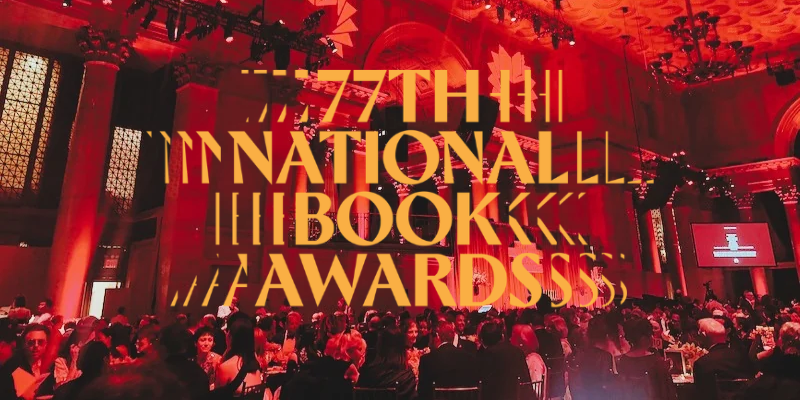
The 77th Annual National Book Awards were announced last night at Cipriani’s Wall Street, a cavernous grey banquet hall that calls Gilded Age villains to mind. I had the good fortune to bear witness to this social event of the season for American letters. What follows is a report from the press table, where I hoovered mac n’ cheese and yearned for opera glasses.
The ceremony kicked off with a performance by Michelle Zauner of Japanese Breakfast, who wooed the crowd in a radiant emerald sheath dress. Accompanied by a cellist and keyboard player, Zauner sang her hit “Be Sweet,” and brought some welcome ethereality into the space, which had previously been feeling a little eerie under a dozen red gel lights.
The Red Room motif was a better thematic fit for our host, Special Agent Dale Cooper. But his human avatar Kyle MacLachlan was more inclined to folksy welcome than fever dream. MacLachlan kicked us off with a dramatic reading from the “classic children’s adventure,” Paddle to the Sea. Be sweet, indeed.
After outing himself as a Big Ole Nerd (first favorite books being Dune, The Hobbit), MacLachlan turned to the publishing landscape and its many concurrent plagues. With the industry facing everything from supply chain issues to ongoing Anthropic lawsuits (first AI mention of many, this night), it was crucial that we gather to celebrate the “irreplaceable power” of storytelling. And so we did.
*
Author Jason Reynolds presented the Literarian Award for Outstanding Service. He also served the secondlook of the night, in a chic textured white tunic. Armed with charming props—stethoscope and picture book—Dr. Perri Klass of Reach out and Read accepted the accolade for her many years of service as a pediatrician and nonprofit leader.
The novelist Kiran Desai rejected the teleprompter’s advances when presenting the lifetime achievement award to Salman Rushdie. Which kicked off a cranky runner re: the superiority of good old paper.
In a rapturous introduction, Desai lauded Rushdie’s moral courage and political rigor. She likened the current student-led Cockroach movement in India to the grandchildren of Rushdie’s Midnight’s Children. Then Rushdie—who admitted on the plinth that he “really wanted to be an actor” back in the day—gave a gracious acceptance speech.
The literary icon insisted on sharing his accolade with a friend, Don DeLillo, who apparently has a birthday this week. He also thanked the late Ursula K. LeGuin, his fellow nominees, and his “longest relationship”—the agent Andrew Wylie.
Around this time, my colleague Oliver Scialdone and I had finished pawing our buffet pasta and started the hard work ofwho-all’s-here.But there was no break in the action for we peeping paddlers.
After some National Book Foundation promotion, Zauner played us back into the main event with another literary leitmotif: her acoustic ballad, “Magic Mountain.”
At this year’s ceremony, much fanfare was made of celebrity guest announcerswho listed the finalists in voiceover but did not appear in person. Our first bait and switch came care of Mychal Threets, the current host of Reading Rainbow. When Threets began to read the finalists for Young Adult Literature someone actually screamed in the press box. Then we all craned our foolish necks for a sighting, to no avail.
Brandy Colbert, committee chair, announced the first big winners: Gabriel Duckels and Dave Levithan, authors of The Fight of Our Lives: AIDS in America, the winners. Their history about “an epidemic whose legacy young people deserve to understand,” looks at the past, present, and future of HIV/AIDS.
The co-authors gave the first truly rousing remarks of the night, and were unflinching about the powers of both of queer storytelling, and a publishing industry that has sometimes been timid about ongoing threats to our civil liberties.
Levithan and Duckels also made first mention (that I caught) of Abdelrahman ElGendy, the nonfiction nominee who was refused entry to the States for this ceremony. “We stand in solidarity with any author who is kept from being here tonight.” Chin chin, from the press box.
Simone Ashley—in voice, not flesh—introduced the finalists in translated literature. Committee chair Christopher Merrill alluded to a crowded field, and mentioned that the prize had “still felt open” as late in the day as that afternoon. Rahul Bery and Vicente Luis Mora, winning for the madcap odyssey Centroeuropa, offered some fine words on the world-connecting power of translation.
I was sad to miss a sighting of Karl Ove’s glorious white mane, but delighted to add this Bellevue title to my TBR pile.
Noname—in voice, not flesh—introduced the poets. In a fabulous purple lip, the poet Aracelis Girmay announced the winner: Brenda Hillman’s Still House in the Desert: An eco-contemplation. Walked to the podium on the arm of her Wesleyan University Press editor of 33 years, Hillman thanked everyone in the room who had ever written a poem, then chided us in the press corner for short-shrifting poetry on our year end best book round-ups. (Which? Heard!)
Other thank-yous included the workers behind our meal, the Nordstrom Rack dress whose “zipper did not give way” as feared, and Hillman’s husband of decades, the poet Robert Hass. “My ocean and my rock.” It seems the power couple will have two NBAs on the mantel. I caught some shiny eyes under those red lights.
If you start to wonder where Kyle MacLachlan went for this portion of the evening, you’re not alone, friendo. I had my theories—pulling quarters from behind the ears of wayward children?—but more than that, I had a craving.
Though I know the run-of-show for these ceremonies is a precarious Jenga tower, I couldn’t help but wish this night had one more bit.
Alas, no joy in Mudville. These are serious people and serious times. Robert Warrior introduced the nonfiction prize, noting another wildly crowded field (“700 nominated books”). He thanked the named and unnamed thousands who supported all these titles to publication, then announced ElGendy’s Huna: A Memoir of Revolution, Prison, and Becoming the winner.
As he was still being barred from the country, ElGendy’s editor, Helen Thomaides, accepted by proxy.
In a vulnerable speech that spared no anger for the dream-crushing state, ElGendy recalled a childhood wish to write. Then he pivoted to the ramparts. “Whatever attention this moment draws, I wish to redirect it,” his proxy offered, calling up the ongoing genocide in Palestine, Egypt’s prisons, and the ICE detention centers.
Perhaps predictably, this was the most overtly political moment in the evening. But painful, too, for the absence of its architect. You could feel the crowd struggling to hold the contradiction. (Perhaps in part because the coverage and fallout around ElGendy’s “eligibility” has been bizarre.)
As dessert plates were scraped and sly preparations for a dance floor commenced above the stage, the voice—NOT FLESH—of John Mulaney announced the fiction finalists. Hannah Lillith Assadi, author of Paradiso 17,took the prize. In an emotional speech, Assadi conjured her late father, and ruminated on the story of Palestine. To the judges, she was kindest. “I could kiss you.”
Just as the vibes threatened to tip full blue, here was Special Agent again. America’s twinkly-eyed uncle capped the evening with a tender, neutral note, having committed hard to the first bit of the evening.
We got another passage from Paddle to the Sea. Then Oli and I swayed toward the dance floor, where a very good deejay played TLC as mini-tiramisus circulated.
Till next year, NBA.