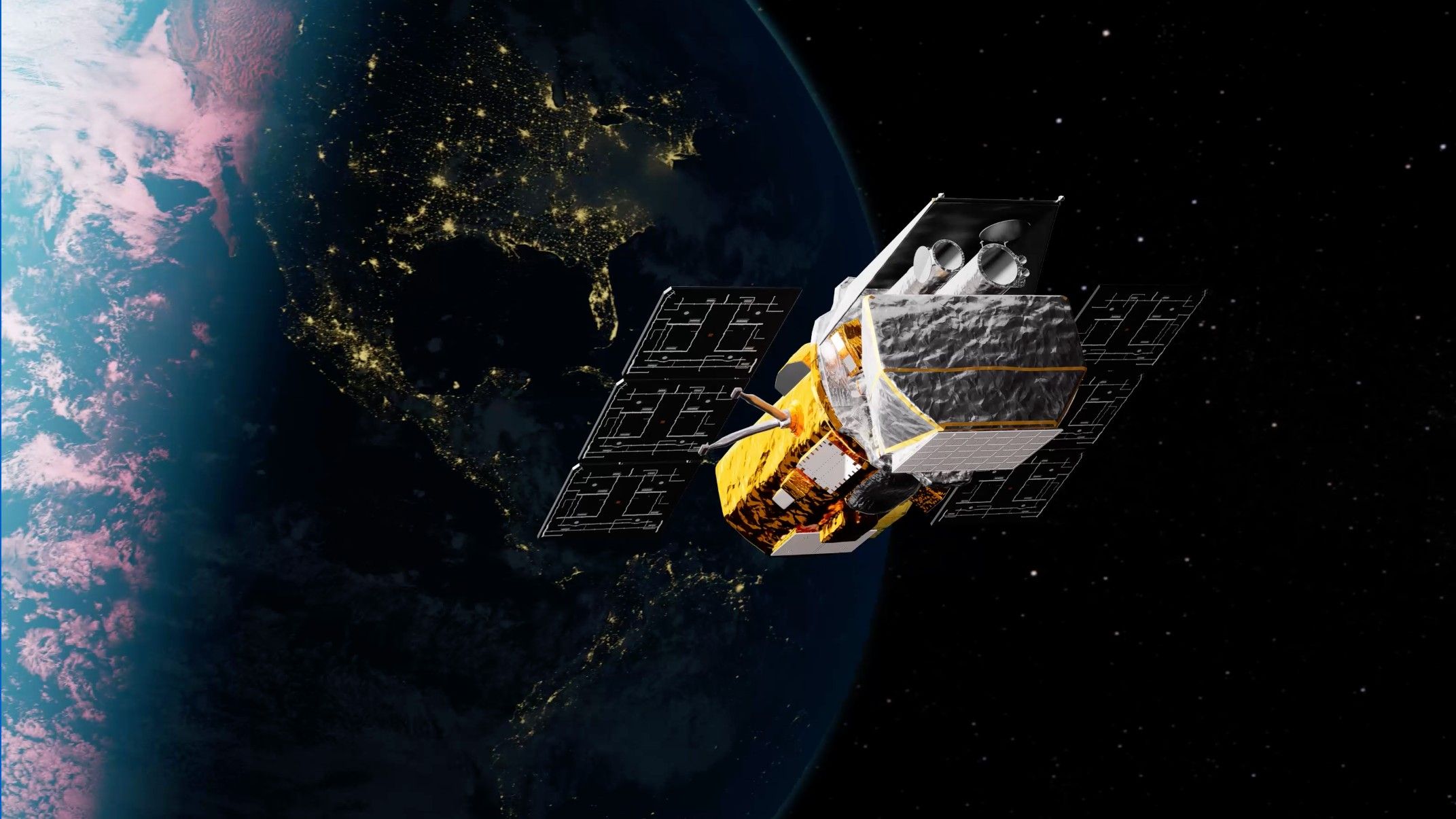
It’s the end of an era: NASA‘s Swift telescope has reached the conclusion of its nearly 22-year mission, burning up in Earth’s atmosphere after studying some of the universe’s most powerful and mysterious events.
According to NASA, the spacecraft reentered the atmosphere at “7:39 a.m. EST Wednesday over the North Sumatra region of Indonesia, at approximately 3.4 degrees north latitude and 98.6 degrees east longitude.” NASA expected most of the telescope’s structure to burn up during its passage through Earth’s atmosphere, estimating a 1-in-2,100 chance of any surviving debris falling over a populated area. No damage or injuries have been reported.
Weighing approximately 3,200 pounds (1,450 kilograms), the Neil Gehrels Swift Observatory was initially designed for a two-year mission, but it far exceeded expectations. Over two decades, Swift became an important tool in the study of gamma-ray bursts, supernovas, black holes and other cosmic phenomena.
Latest Videos FromLive Science
Exceeding expectations
Launched in November 2004, Swift was designed to detect gamma-ray bursts, powerful explosions that occur throughout the universe. Its three onboard telescopes let scientists observe cosmic events across different wavelengths, including ultraviolet, optical and X-ray light. The telescope could swivel to focus on different sky targets in a matter of minutes, allowing it to rapidly follow up on sudden events like supernova explosions.
NASA estimates that Swift’s scientific observations have contributed to approximately 7,000 research papers, leaving behind an extensive collection that scientists can continue studying for years.
Why did Swift’s mission end?
Swift’s return was driven by atmospheric drag, which eventually slowed the spacecraft and caused its orbit to decay. Increased solar activity intensified the drag, thus accelerating the space telescope’s descent toward Earth.
Earlier this year, NASA explored an ambitious rescue mission to extend Swift’s operational life. In August 2026, a privately developed robotic spacecraft built by Katalyst Space Technologies was intended to rendezvous with Swift and boost it into a higher orbit. However, the mission failed after launching, leaving the observatory on its path toward reentry.
Sign up for the Live Science daily newsletter now
Get the world’s most fascinating discoveries delivered straight to your inbox.
NASA officially ended Swift’s scientific operations on Oct. 20 after its declining altitude made observations too difficult. For NASA and the broader astronomy community, Swift’s story is a reminder that even missions designed to last just a few years can fundamentally change our understanding of our universe.
We use cookies on our website to give you the most relevant experience by remembering your preferences and repeat visits. By clicking “Accept”, you consent to the use of ALL the cookies.
This website uses cookies to improve your experience while you navigate through the website. Out of these, the cookies that are categorized as necessary are stored on your browser as they are essential for the working of basic functionalities of the website. We also use third-party cookies that help us analyze and understand how you use this website. These cookies will be stored in your browser only with your consent. You also have the option to opt-out of these cookies. But opting out of some of these cookies may affect your browsing experience.
Necessary cookies are absolutely essential for the website to function properly. These cookies ensure basic functionalities and security features of the website, anonymously.
Cookie
Duration
Description
cookielawinfo-checkbox-analytics
11 months
This cookie is set by GDPR Cookie Consent plugin. The cookie is used to store the user consent for the cookies in the category "Analytics".
cookielawinfo-checkbox-functional
11 months
The cookie is set by GDPR cookie consent to record the user consent for the cookies in the category "Functional".
cookielawinfo-checkbox-necessary
11 months
This cookie is set by GDPR Cookie Consent plugin. The cookies is used to store the user consent for the cookies in the category "Necessary".
cookielawinfo-checkbox-others
11 months
This cookie is set by GDPR Cookie Consent plugin. The cookie is used to store the user consent for the cookies in the category "Other.
cookielawinfo-checkbox-performance
11 months
This cookie is set by GDPR Cookie Consent plugin. The cookie is used to store the user consent for the cookies in the category "Performance".
viewed_cookie_policy
11 months
The cookie is set by the GDPR Cookie Consent plugin and is used to store whether or not user has consented to the use of cookies. It does not store any personal data.
Functional cookies help to perform certain functionalities like sharing the content of the website on social media platforms, collect feedbacks, and other third-party features.
Performance cookies are used to understand and analyze the key performance indexes of the website which helps in delivering a better user experience for the visitors.
Analytical cookies are used to understand how visitors interact with the website. These cookies help provide information on metrics the number of visitors, bounce rate, traffic source, etc.
Advertisement cookies are used to provide visitors with relevant ads and marketing campaigns. These cookies track visitors across websites and collect information to provide customized ads.