
Close Menu
    Facebook X (Twitter) Instagram Pinterest YouTube LinkedIn TikTok
    TopBuzzMagazine.com
    Facebook X (Twitter) Instagram Pinterest YouTube LinkedIn TikTok
    • Home
    • Movies
    • Television
    • Music
    • Fashion
    • Books
    • Science
    • Technology
    • Cover Story
    • Contact
      • About
      • Amazon Disclaimer
      • Terms and Conditions
      • Privacy Policy
      • DMCA / Copyrights Disclaimer
    TopBuzzMagazine.com
    Home»Science»First moments of a supernova explosion captured in the most detailed observations of their kind
    Science

    First moments of a supernova explosion captured in the most detailed observations of their kind

    By AdminAugust 6, 2026
    Facebook Twitter Pinterest LinkedIn Tumblr Email
    First moments of a supernova explosion captured in the most detailed observations of their kind


    A fleet of telescopes around the world just captured the first shocking moments of a supernova explosion in the most detailed-ever observations of their kind.

    The explosive event was first spotted by China‘s Einstein Probe space telescope as a flash of X-rays in March. Ground-based telescopes jumped in within the hour and quickly identified the flash as a supernova, a powerful explosion of a massive dying star. Before long, a big team of observatories was on the job, including the wide-field Vera C. Rubin Observatory, which began its ambitious 10-year survey of the sky in late June.

    With this fleet of telescopes, astronomers charted how the light of the supernova, located 500 million light-years away, changed over time. They reported their results in two papers published July 14 in The Astrophysical Journal Letters.

    Latest Videos FromLive Science

    Each science team verified the “shock breakout” ‪—‬ the point when a supernova emits its first light from the explosion as a huge shock wave. The recently detected supernova is only the second stellar explosion in the past 20 years in which a shock wave was observed, because these events tend to be short — only seconds to hours, the researchers noted.

    They classified the stellar explosion as a Type Ic broad-lined (Ic-BL) supernova, meaning that the blast included jets with material moving close to light speed. This type of supernova is often associated with gamma-ray bursts, which are extremely powerful flashes of high-energy radiation from space. However, the recently detected supernova presented some surprises: Its shock breakout was the faintest seen in an Ic-BL supernova, and no gamma-ray bursts were observed.


    You may like

    “Follow-up observations using the most sensitive facilities found no evidence” of the gamma-ray bursts, Brendan O’Connor, an astrophysicist at Carnegie Mellon University and co-author on one of the studies, said in a statement. “One possibility is that the jet was ‘choked,’ either by the surface of the star or by circumstellar material surrounding the star.”

    Telescopes of the world unite

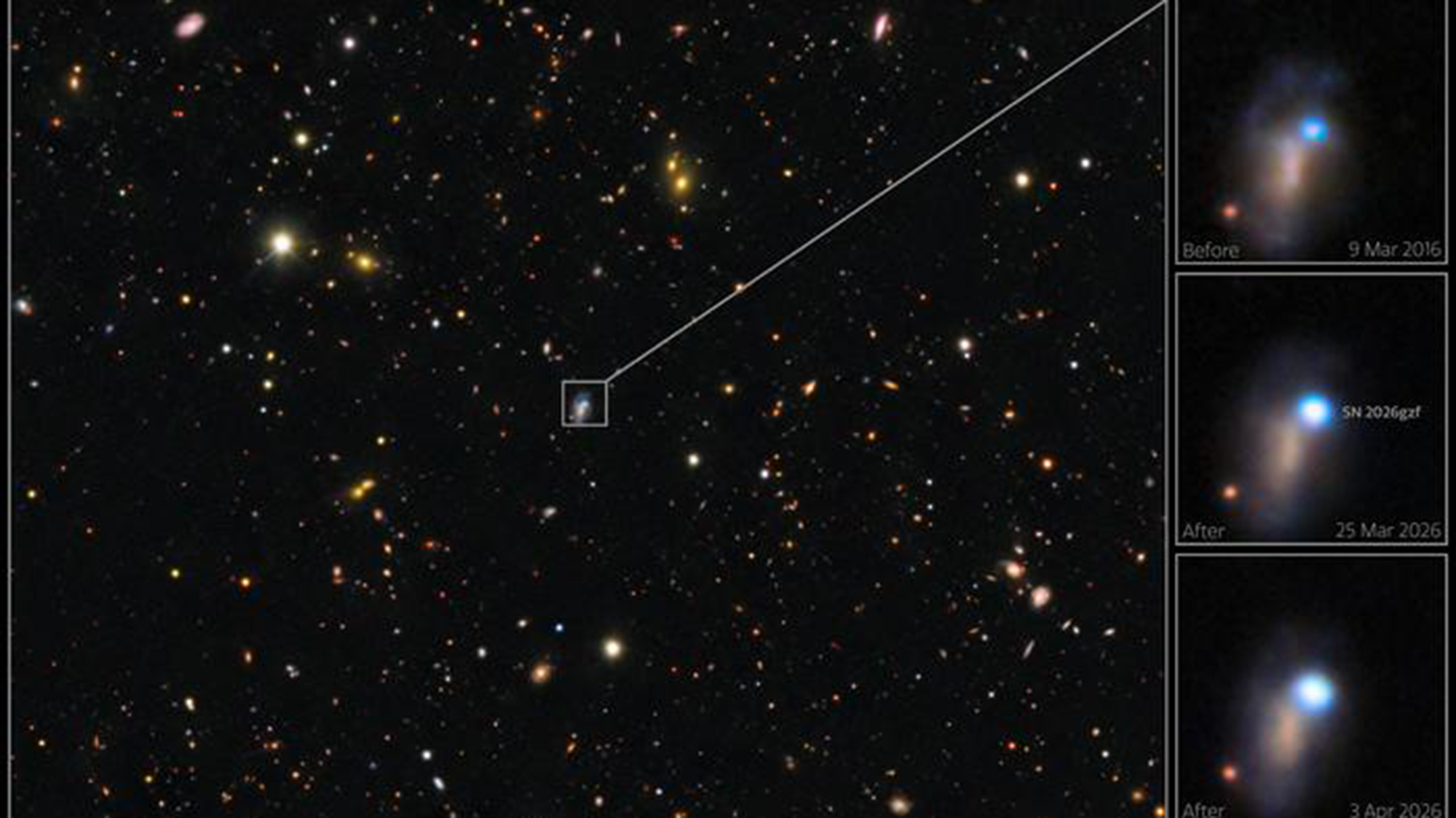
    A deep space image with four vertical boxouts to the right showing smudges of color where a supernova happened

    The Vera C. Rubin Observatory happened to be monitoring the area (left) when the supernova erupted. Rubin and Dark Energy Camera images of the blast are shown in boxes to the right.

    (Image credit: NSF–DOE Vera C. Rubin Observatory/NOIRLab/SLAC/AURA)

    The Rubin telescope, located in Chile, happened to spot the explosion because it was viewing that particular patch of the sky at the time, known as the COSMOS Deep Drilling Field.

    “Thanks to Rubin’s rapid cadence and unprecedented sensitivity, continued observations are expected to provide detailed, long-term records of the supernova as it evolves for years to come,” the science teams said in the statement. The Rubin Observatory will spend the next decade mapping the entire southern sky many times over, creating a time-lapse movie of the cosmos expected to reveal millions of supernovas, asteroids, comets, and other transient events.

    As Rubin spots events in the sky, the Dark Energy Spectroscopic Instrument on the National Science Foundation’s Nicholas U. Mayall 4-meter Telescope at Kitt Peak National Observatory in Arizona is tasked with springing into action for follow-up observations. The instrument confirmed the recently detected explosion as an Ic-BL supernova.

    When the scientists dove into 10 years of data from the 570-megapixel Department of Energy Dark Energy Camera on the National Science Foundation’s Víctor M. Blanco 4-meter Telescope in Chile, they found a “blue source” just where the supernova later occurred, revealing clues about what the star system and its environment looked like before it exploded.


    What to read next

    Meanwhile, a team led by Jillian Rastinejad, an astronomer at the University of Maryland, College Park and co-author of the second study, used the Gemini Multi-Object Spectrographs on two telescopes — Gemini North in Hawaii and Gemini South in Chile — to investigate the explosion, among other observatories. Those telescopes also confirmed the explosion as an Ic-BL supernova, without the jets, and the astronomers obtained archival details on the star’s structure and environment before their demise.

    “Our observations allowed us to study the physics of three pieces of this explosion: the X-ray shock breakout, the accompanying supernova, and the interaction of the supernova with material previously cast out by the dying star,” Rastinejad explained in the statement. “With this information we were able to map out the structure of the material surrounding the star and understand the star’s violent lifestyle before it collapsed.”

    The star was about 20 times the mass of the sun and was classified as a Wolf-Rayet — a star that used up most of its hydrogen early in its life. Just before the star exploded, it periodically ejected massive chunks of hydrogen and helium, leaving behind only carbon and oxygen. These chunks of material generated shells that were visible in telescopes as individual events, including the first X-ray shock.

    “This is the first time we’ve mapped out the pre-explosion environment of a star that has been stripped of hydrogen and helium,” said Gokul Srinivasaragavan, an astronomer on Rastinejad’s team who was a doctoral student at the University of Maryland at the time of the study. “Going forward, I’m excited to observe more shock breakout events in similar detail to test if all stripped stars have a similar ‘lifestyle’ prior to collapse and what, if any, differences we see.”

    View Original Source Here

    Share. Facebook Twitter Pinterest LinkedIn Tumblr Email

    Related Posts

    Act now on microplastic risks, businesses urged

    August 5, 2026

    Physicists find a way to control heat in a way once thought impossible

    August 5, 2026

    New approach to cleaning the inner walls of a fusion system removes another obstacle to near-endless energy

    August 4, 2026

    First deaths from Cyclospora outbreak reported in Michigan

    August 4, 2026

    Study lays groundwork for classifying lunar soil

    August 3, 2026

    Hubble telescope takes one of the most detailed looks at neighboring Andromeda galaxy ever — Space photo of the week

    August 3, 2026
    popular posts

    Why Meghan Markle and Prince Harry’s King Charles Coronation Attendance

    Dr. Romano’s ER Death By Helicopter Was Designed To Be Extra Shocking

    The 3 Cult Accessories That Are Taking Over the Streets

    MTV VMAs 2025 Performers: Sabrina Carpenter, Ricky Martin, Busta Rhymes, and More

    Our dreams become more emotive and symbolic as we approach death

    Would Sepultura Welcome Back Cavalera Brothers for Final Show?

    Grammys, Pedro Pascal on ‘SNL’ and ‘Last of Us,’ ‘Titanic’

    Categories
    • Books (4,023)
    • Cover Story (18)
    • Events (25)
    • Fashion (2,855)
    • Interviews (61)
    • Movies (3,319)
    • Music (3,615)
    • News (181)
    • Politics (14)
    • Science (5,174)
    • Technology (3,316)
    • Television (4,047)
    • Uncategorized (932)
    Archives
    Facebook X (Twitter) Instagram Pinterest YouTube Reddit TikTok
    © 2026 Top Buzz Magazine. All rights reserved. All articles, images, product names, logos, and brands are property of their respective owners. All company, product and service names used in this website are for identification purposes only. Use of these names, logos, and brands does not imply endorsement unless specified. By using this site, you agree to the Terms of Use and Privacy Policy.

    Type above and press Enter to search. Press Esc to cancel.

    We use cookies on our website to give you the most relevant experience by remembering your preferences and repeat visits. By clicking “Accept”, you consent to the use of ALL the cookies.
    Do not sell my personal information.
    Cookie SettingsAccept
    Manage consent

    Privacy Overview

    This website uses cookies to improve your experience while you navigate through the website. Out of these, the cookies that are categorized as necessary are stored on your browser as they are essential for the working of basic functionalities of the website. We also use third-party cookies that help us analyze and understand how you use this website. These cookies will be stored in your browser only with your consent. You also have the option to opt-out of these cookies. But opting out of some of these cookies may affect your browsing experience.
    Necessary
    Always Enabled
    Necessary cookies are absolutely essential for the website to function properly. These cookies ensure basic functionalities and security features of the website, anonymously.
    CookieDurationDescription
    cookielawinfo-checkbox-analytics11 monthsThis cookie is set by GDPR Cookie Consent plugin. The cookie is used to store the user consent for the cookies in the category "Analytics".
    cookielawinfo-checkbox-functional11 monthsThe cookie is set by GDPR cookie consent to record the user consent for the cookies in the category "Functional".
    cookielawinfo-checkbox-necessary11 monthsThis cookie is set by GDPR Cookie Consent plugin. The cookies is used to store the user consent for the cookies in the category "Necessary".
    cookielawinfo-checkbox-others11 monthsThis cookie is set by GDPR Cookie Consent plugin. The cookie is used to store the user consent for the cookies in the category "Other.
    cookielawinfo-checkbox-performance11 monthsThis cookie is set by GDPR Cookie Consent plugin. The cookie is used to store the user consent for the cookies in the category "Performance".
    viewed_cookie_policy11 monthsThe cookie is set by the GDPR Cookie Consent plugin and is used to store whether or not user has consented to the use of cookies. It does not store any personal data.
    Functional
    Functional cookies help to perform certain functionalities like sharing the content of the website on social media platforms, collect feedbacks, and other third-party features.
    Performance
    Performance cookies are used to understand and analyze the key performance indexes of the website which helps in delivering a better user experience for the visitors.
    Analytics
    Analytical cookies are used to understand how visitors interact with the website. These cookies help provide information on metrics the number of visitors, bounce rate, traffic source, etc.
    Advertisement
    Advertisement cookies are used to provide visitors with relevant ads and marketing campaigns. These cookies track visitors across websites and collect information to provide customized ads.
    Others
    Other uncategorized cookies are those that are being analyzed and have not been classified into a category as yet.
    SAVE & ACCEPT