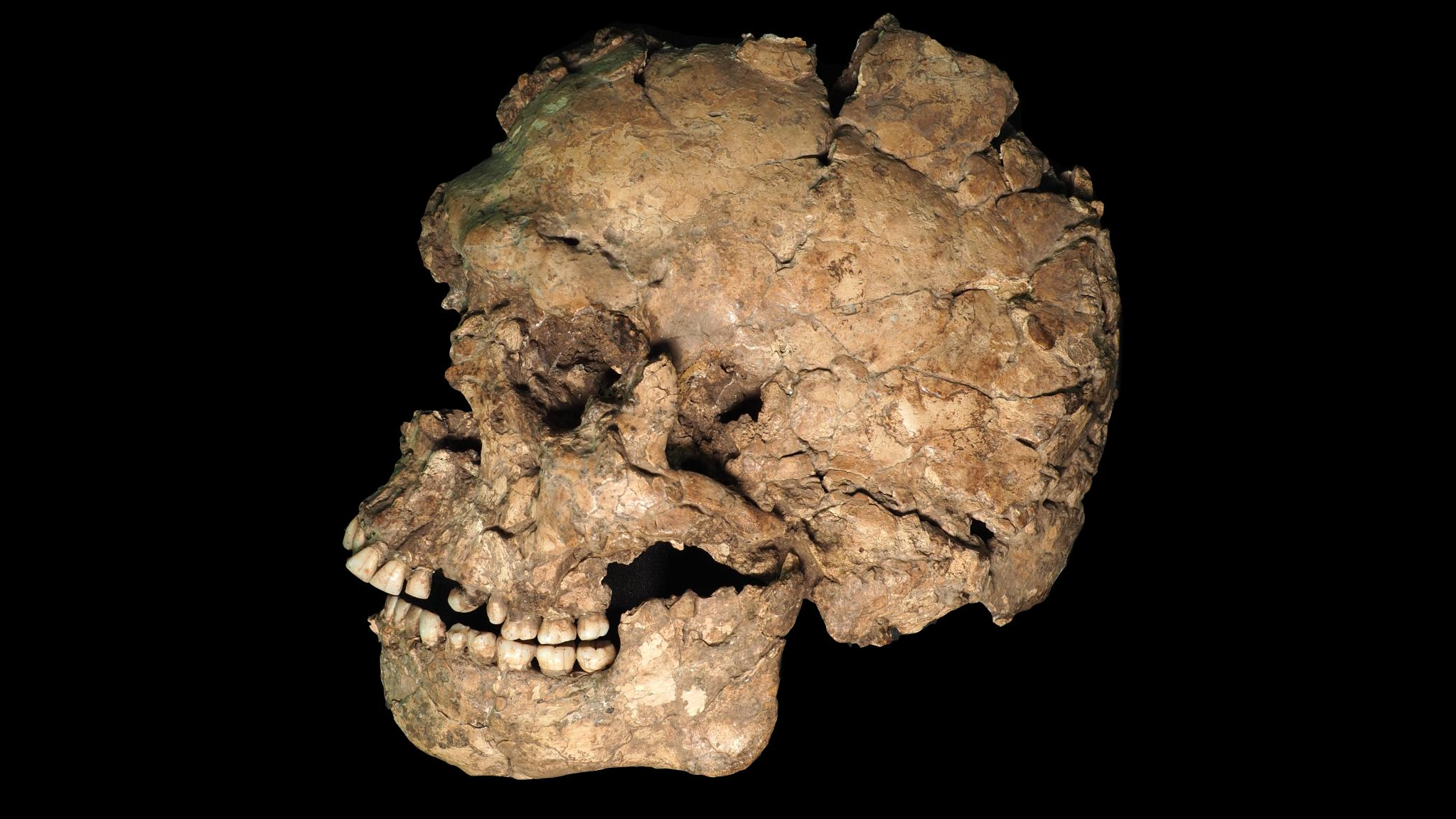
Around 100,000 years ago, an early Homo sapiens man was probably stabbed in the face with a sharp stone tool and later buried in a cave in what is now Israel, archaeologists have determined. The Stone Age cold case appears to be the earliest evidence of this kind of interpersonal violence, according to the research team.
In a study published June 30 in the journal Scientific Reports, the international team of researchers closely examined the skull and lower jaw of a person who was deliberately buried in Qafzeh cave in Israel during the Middle Paleolithic period.
At least 27 people were buried in Qafzeh cave between about 145,000 and 92,000 years ago, making them some of the earliest members of our species to be found outside Africa. Previous analysis of the skeletons, which were excavated between the 1930s and 1970s, revealed that two people had head injuries resulting from blunt trauma.
But the new analysis, which employed microscopic and micro-CT scanning techniques, revealed that Qafzeh 25, an adult male, had a cut mark across his lower left jaw that affected one of his bicuspids and part of his upper jaw. The jawbone showed signs of healing, suggesting that the man lived for a significant amount of time after being injured, the researchers wrote in the study.
Archaeologists had previously identified only a few cases of trauma caused by sharp weapons or projectiles in Middle Paleolithic skeletons. Although these injuries could have resulted from hunting accidents, the researchers wrote, they have generally been interpreted as evidence of interpersonal violence.
The cut mark on the jaw of Qafzeh 25 was found on the left side of his face, lending further support to the idea that the injury was not an accident.
A close-up of the left side of the lower jaw, showing a cut mark near a bicuspid.
(Image credit: Ana Pantoja et al.)
It’s not clear what kind of tool made the cut mark, but stone tools found at Qafzeh included flint scrapers and sharp points that could have been fashioned into spear tips.
Get the world’s most fascinating discoveries delivered straight to your inbox.
“Forensic studies of modern human populations have reported that craniofacial injuries resulting from blows are more frequently observed on the left side of the skull, a distribution commonly attributed to the predominance of right-handed assailants in face-to-face confrontations,” the researchers wrote.
If the researchers’ interpretation of the cut mark is correct, it “would represent the earliest documented case of sharp force trauma in the archaeological record,” they wrote.
Qafzeh cave is already well known within archaeology for its clear evidence that early humans buried their dead. The new discovery confirms that the earliest human groups left Africa with a complex culture.
“These results provide new data to the debate on the origin of complex behaviors such as interpersonal violence, the care of injured or sick individuals and funeral practices,” study first author Ana Pantoja Pérez, a paleoanthropologist at Spain’s National Research Center for Human Evolution, said in a statement.
Pantoja-Pérez, A., Martín-Francés, L., May, H., Hershkovitz, I., Sala, N. (2026). A taphonomic reassessment of Qafzeh 25 and its implications for violence, health and funerary practices. Scientific Reports. https://doi.org/10.1038/s41598-026-58670-0
We use cookies on our website to give you the most relevant experience by remembering your preferences and repeat visits. By clicking “Accept”, you consent to the use of ALL the cookies.
This website uses cookies to improve your experience while you navigate through the website. Out of these, the cookies that are categorized as necessary are stored on your browser as they are essential for the working of basic functionalities of the website. We also use third-party cookies that help us analyze and understand how you use this website. These cookies will be stored in your browser only with your consent. You also have the option to opt-out of these cookies. But opting out of some of these cookies may affect your browsing experience.
Necessary cookies are absolutely essential for the website to function properly. These cookies ensure basic functionalities and security features of the website, anonymously.
Cookie
Duration
Description
cookielawinfo-checkbox-analytics
11 months
This cookie is set by GDPR Cookie Consent plugin. The cookie is used to store the user consent for the cookies in the category "Analytics".
cookielawinfo-checkbox-functional
11 months
The cookie is set by GDPR cookie consent to record the user consent for the cookies in the category "Functional".
cookielawinfo-checkbox-necessary
11 months
This cookie is set by GDPR Cookie Consent plugin. The cookies is used to store the user consent for the cookies in the category "Necessary".
cookielawinfo-checkbox-others
11 months
This cookie is set by GDPR Cookie Consent plugin. The cookie is used to store the user consent for the cookies in the category "Other.
cookielawinfo-checkbox-performance
11 months
This cookie is set by GDPR Cookie Consent plugin. The cookie is used to store the user consent for the cookies in the category "Performance".
viewed_cookie_policy
11 months
The cookie is set by the GDPR Cookie Consent plugin and is used to store whether or not user has consented to the use of cookies. It does not store any personal data.
Functional cookies help to perform certain functionalities like sharing the content of the website on social media platforms, collect feedbacks, and other third-party features.
Performance cookies are used to understand and analyze the key performance indexes of the website which helps in delivering a better user experience for the visitors.
Analytical cookies are used to understand how visitors interact with the website. These cookies help provide information on metrics the number of visitors, bounce rate, traffic source, etc.
Advertisement cookies are used to provide visitors with relevant ads and marketing campaigns. These cookies track visitors across websites and collect information to provide customized ads.