
Close Menu
    Facebook X (Twitter) Instagram Pinterest YouTube LinkedIn TikTok
    TopBuzzMagazine.com
    Facebook X (Twitter) Instagram Pinterest YouTube LinkedIn TikTok
    • Home
    • Movies
    • Television
    • Music
    • Fashion
    • Books
    • Science
    • Technology
    • Cover Story
    • Contact
      • About
      • Amazon Disclaimer
      • Terms and Conditions
      • Privacy Policy
      • DMCA / Copyrights Disclaimer
    TopBuzzMagazine.com
    Home»Science»We sharpened the James Webb telescope’s vision from a million miles away. Here’s how.
    Science

    We sharpened the James Webb telescope’s vision from a million miles away. Here’s how.

    By AdminNovember 2, 2025
    Facebook Twitter Pinterest LinkedIn Tumblr Email
    We sharpened the James Webb telescope’s vision from a million miles away. Here’s how.


    After Christmas dinner in 2021, our family was glued to the television, watching the nail-biting launch of NASA‘s $10 billion James Webb Space Telescope. There had not been such a leap forward in telescope technology since Hubble was launched in 1990.

    En route to its deployment, Webb had to successfully navigate 344 potential points of failure. Thankfully, the launch went better than expected, and we could finally breathe again.

    Six months later, Webb’s first images were revealed, of the most distant galaxies yet seen. However, for our team in Australia, the work was only beginning.


    You may like

    We would be using Webb’s highest-resolution mode, called the aperture masking interferometer or AMI for short. It’s a tiny piece of precisely machined metal that slots into one of the telescope’s cameras, enhancing its resolution.

    Our results on painstakingly testing and enhancing AMI are now released on the open-access archive arXiv in a pair of papers. We can finally present its first successful observations of stars, planets, moons and even black hole jets.

    Working with an instrument a million miles away

    Hubble started its life seeing out of focus — its mirror had been ground precisely, but incorrectly. By looking at known stars and comparing the ideal and measured images (exactly like what optometrists do), it was possible to figure out a “prescription” for this optical error and design a lens to compensate.

    The correction required seven astronauts to fly up on the Space Shuttle Endeavor in 1993 to install the new optics. Hubble orbits Earth just a few hundred miles above the surface, and can be reached by astronauts.

    Get the world’s most fascinating discoveries delivered straight to your inbox.

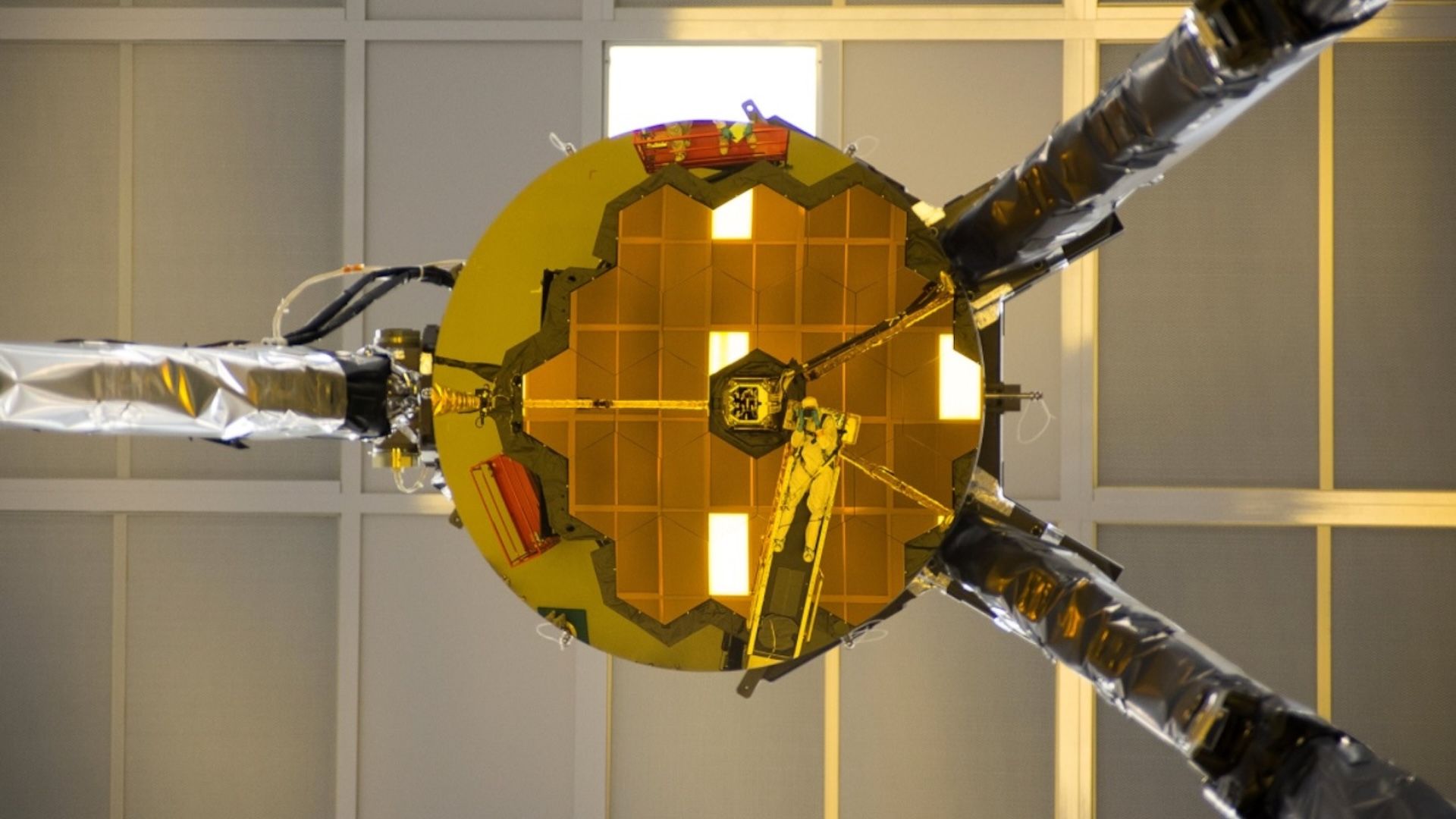
    a close-up of the mirror of JWST

    The primary mirror of the Webb telescope consists of 18 precisely ground hexagonal segments. (Image credit: NASA/Chris Gunn)

    By contrast, Webb is roughly 1 million miles (1.5 million km) away — we can’t visit and service it, and need to be able to fix issues without changing any hardware.

    This is where AMI comes in. This is the only Australian hardware on board, designed by astronomer Peter Tuthill.

    It was put on Webb to diagnose and measure any blur in its images. Even nanometers of distortion in Webb’s 18 hexagonal primary mirrors and many internal surfaces will blur the images enough to hinder the study of planets or black holes, where sensitivity and resolution are key.


    You may like

    AMI filters the light with a carefully structured pattern of holes in a simple metal plate, to make it much easier to tell if there are any optical misalignments.

    an illustration of the AMI system

    AMI allows for a precise test pattern that can help correct any issues with JWST’s focus. (Image credit: Anand Sivaramakrishnan/STScI)

    Hunting blurry pixels

    We wanted to use this mode to observe the birth places of planets, as well as material being sucked into black holes. But before any of this, AMI showed Webb wasn’t working entirely as hoped.

    At very fine resolution — at the level of individual pixels — all the images were slightly blurry due to an electronic effect: brighter pixels leaking into their darker neighbors.

    This is not a mistake or flaw, but a fundamental feature of infrared cameras that turned out to be unexpectedly serious for Webb.

    This was a dealbreaker for seeing distant planets many thousands of times fainter than their stars a few pixels away: my colleagues quickly showed that its limits were more than ten times worse than hoped.

    So, we set out to correct it.

    How we sharpened Webb’s vision

    In a new paper led by University of Sydney PhD student Louis Desdoigts, we looked at stars with AMI to learn and correct the optical and electronic distortions simultaneously.

    We built a computer model to simulate AMI’s optical physics, with flexibility about the shapes of the mirrors and apertures and about the colours of the stars.

    We connected this to a machine learning model to represent the electronics with an “effective detector model” — where we only care about how well it can reproduce the data, not about why.

    After training and validation on some test stars, this setup allowed us to calculate and undo the blur in other data, restoring AMI to full function. It doesn’t change what Webb does in space, but rather corrects the data during processing.

    It worked beautifully — the star HD 206893 hosts a faint planet and the reddest-known brown dwarf (an object between a star and a planet). They were known but out of reach with Webb before applying this correction. Now, both little dots popped out clearly in our new maps of the system.

    This correction has opened the door to using AMI to prospect for unknown planets at previously impossible resolutions and sensitivities.

    It works not just on dots

    In a companion paper by University of Sydney PhD student Max Charles, we applied this to looking not just at dots — even if these dots are planets — but forming complex images at the highest resolution made with Webb. We revisited well-studied targets that push the limits of the telescope, testing its performance.

    With the new correction, we brought Jupiter’s moon Io into focus, clearly tracking its volcanoes as it rotates over an hour-long timelapse.

    As seen by AMI, the jet launched from the black hole at the centre of the galaxy NGC 1068 closely matched images from much-larger telescopes.

    Finally, AMI can sharply resolve a ribbon of dust around a pair of stars called WR 137, a faint cousin of the spectacular Apep system, lining up with theory.

    The code built for AMI is a demo for much more complex cameras on Webb and its follow-up, Roman space telescope. These tools demand an optical calibration so fine, it’s just a fraction of a nanometre — beyond the capacity of any known materials.

    Our work shows that if we can measure, control, and correct the materials we do have to work with, we can still hope to find Earth-like planets in the far reaches of our galaxy.

    This edited article is republished from The Conversation under a Creative Commons license. Read the original article.

    View Original Source Here

    Share. Facebook Twitter Pinterest LinkedIn Tumblr Email

    Related Posts

    Crash clock says satellites in orbit are three days from disaster

    December 16, 2025

    Nepal starts tiger census to track recovery

    December 16, 2025

    30 models of the universe proved wrong by final data from groundbreaking cosmology telescope

    December 15, 2025

    Mars may once have had a much larger moon

    December 15, 2025

    A new five-year survey of the Magellanic Clouds will answer some questions about our neighbors

    December 14, 2025

    Strange burst of energy traveling at 99% the speed of light is unlike anything scientists have seen — Space photo of the week

    December 14, 2025
    popular posts

    Ice Spice Shares New Video for “Deli”

    Taylor Swift Kicks Off “The Eras Tour” with Massive 44-Song,

    Don’t Blame AI

    New Jane Austen Covers, Books Save Lives Act, “American Fiction”

    The Eye Shadow Apocalypse Is Over—Maximalist Eyes Are Trending

    Xiaomi 15 Ultra, Xiaomi 15 India Launch Confirmed for March 11

    ABC Releases 2024 Fall Schedule, Disappointing Will Trent & The

    Categories
    • Books (3,596)
    • Cover Story (8)
    • Events (20)
    • Fashion (2,627)
    • Interviews (52)
    • Movies (2,896)
    • Music (3,183)
    • News (166)
    • Politics (6)
    • Science (4,749)
    • Technology (2,891)
    • Television (3,621)
    • Uncategorized (932)
    Archives
    Facebook X (Twitter) Instagram Pinterest YouTube Reddit TikTok
    © 2025 Top Buzz Magazine. All rights reserved. All articles, images, product names, logos, and brands are property of their respective owners. All company, product and service names used in this website are for identification purposes only. Use of these names, logos, and brands does not imply endorsement unless specified. By using this site, you agree to the Terms of Use and Privacy Policy.

    Type above and press Enter to search. Press Esc to cancel.

    We use cookies on our website to give you the most relevant experience by remembering your preferences and repeat visits. By clicking “Accept”, you consent to the use of ALL the cookies.
    Do not sell my personal information.
    Cookie SettingsAccept
    Manage consent

    Privacy Overview

    This website uses cookies to improve your experience while you navigate through the website. Out of these, the cookies that are categorized as necessary are stored on your browser as they are essential for the working of basic functionalities of the website. We also use third-party cookies that help us analyze and understand how you use this website. These cookies will be stored in your browser only with your consent. You also have the option to opt-out of these cookies. But opting out of some of these cookies may affect your browsing experience.
    Necessary
    Always Enabled
    Necessary cookies are absolutely essential for the website to function properly. These cookies ensure basic functionalities and security features of the website, anonymously.
    CookieDurationDescription
    cookielawinfo-checkbox-analytics11 monthsThis cookie is set by GDPR Cookie Consent plugin. The cookie is used to store the user consent for the cookies in the category "Analytics".
    cookielawinfo-checkbox-functional11 monthsThe cookie is set by GDPR cookie consent to record the user consent for the cookies in the category "Functional".
    cookielawinfo-checkbox-necessary11 monthsThis cookie is set by GDPR Cookie Consent plugin. The cookies is used to store the user consent for the cookies in the category "Necessary".
    cookielawinfo-checkbox-others11 monthsThis cookie is set by GDPR Cookie Consent plugin. The cookie is used to store the user consent for the cookies in the category "Other.
    cookielawinfo-checkbox-performance11 monthsThis cookie is set by GDPR Cookie Consent plugin. The cookie is used to store the user consent for the cookies in the category "Performance".
    viewed_cookie_policy11 monthsThe cookie is set by the GDPR Cookie Consent plugin and is used to store whether or not user has consented to the use of cookies. It does not store any personal data.
    Functional
    Functional cookies help to perform certain functionalities like sharing the content of the website on social media platforms, collect feedbacks, and other third-party features.
    Performance
    Performance cookies are used to understand and analyze the key performance indexes of the website which helps in delivering a better user experience for the visitors.
    Analytics
    Analytical cookies are used to understand how visitors interact with the website. These cookies help provide information on metrics the number of visitors, bounce rate, traffic source, etc.
    Advertisement
    Advertisement cookies are used to provide visitors with relevant ads and marketing campaigns. These cookies track visitors across websites and collect information to provide customized ads.
    Others
    Other uncategorized cookies are those that are being analyzed and have not been classified into a category as yet.
    SAVE & ACCEPT