
Close Menu
    Facebook X (Twitter) Instagram Pinterest YouTube LinkedIn TikTok
    TopBuzzMagazine.com
    Facebook X (Twitter) Instagram Pinterest YouTube LinkedIn TikTok
    • Home
    • Movies
    • Television
    • Music
    • Fashion
    • Books
    • Science
    • Technology
    • Cover Story
    • Contact
      • About
      • Amazon Disclaimer
      • Terms and Conditions
      • Privacy Policy
      • DMCA / Copyrights Disclaimer
    TopBuzzMagazine.com
    Home»Science»Science news this week: A runaway black hole, a human ancestor discovered in Casablanca cave, and vaccine schedule slashed
    Science

    Science news this week: A runaway black hole, a human ancestor discovered in Casablanca cave, and vaccine schedule slashed

    By AdminJanuary 10, 2026
    Facebook Twitter Pinterest LinkedIn Tumblr Email
    Science news this week: A runaway black hole, a human ancestor discovered in Casablanca cave, and vaccine schedule slashed


    This week’s science news was all about discoveries made by the world’s best telescopes, as the James Webb Space Telescope verified the existence of a runaway supermassive black hole escaping its host galaxy at 2.2 million miles per hour (3.6 million km/h).

    The black hole, which is leaving behind a stunning contrail of stars in its wake, confirms more than five decades of research. And it’s not the only celestial object offering evidence for long-standing astronomical theories this week — there was also Cloud-9, a failed galaxy discovered by the Hubble telescope, that appears to be held together by dark matter.

    Meanwhile, NASA‘s SPHEREx (short for Spectro-Photometer for the History of the Universe, Epoch of Reionization, and Ices Explorer) unveiled its first complete, all-sky mosaic of the universe; Chile’s ALMA telescope discovered a set of galaxies so hot they shouldn’t exist; and the first images from the fledgling Vera C. Rubin Observatory revealed an enormous asteroid spinning at a record-breaking speed.

    Human and Neanderthal ancestor found in Casablanca
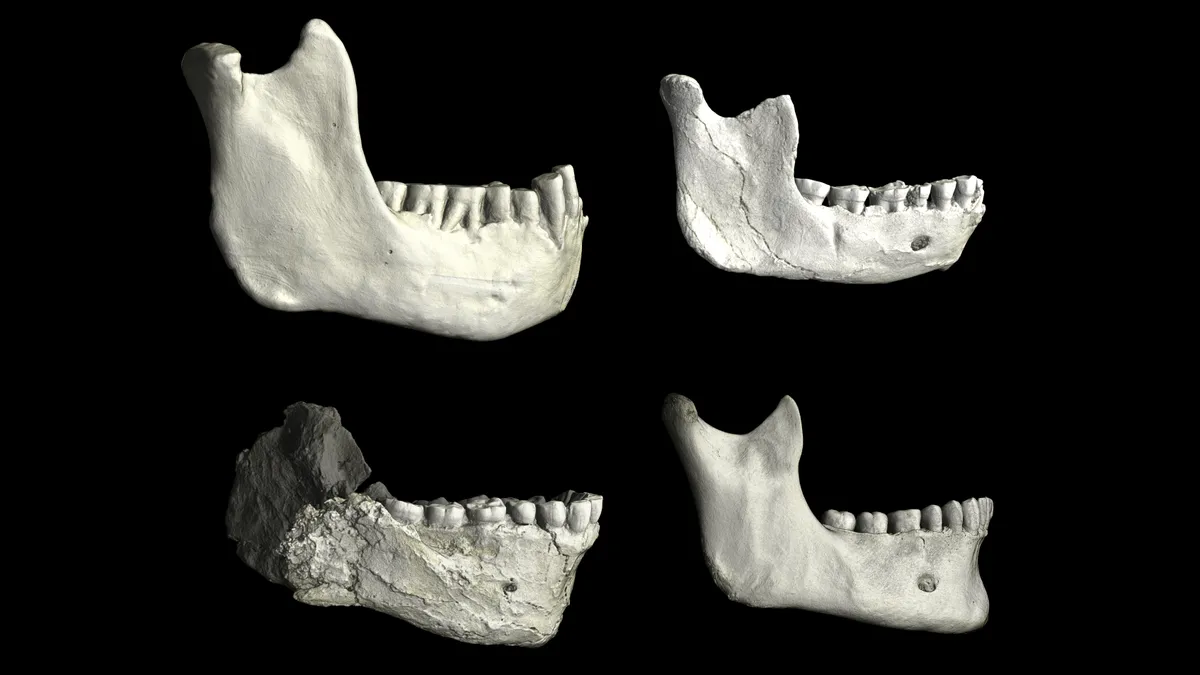
    a series of four lower jaws from ancient and modern humans against a black background

    A discovery inside a Morroccan cave has shifted the potential origins story of humanity. (Image credit: Philipp Gunz/Max Planck Institute for Evolutionary Anthropology)

    A collection of 773,000-year-old bones found inside a Moroccan cave shifted the potential origins of modern humans from East to West Africa this week.

    There are a lot of fossil hominins in Africa — at least until about a million years ago and again after 500,000 years ago — but a gap exists between these two time points that makes tracking the evolutionary history of humanity difficult.

    That’s what makes the discovery of the new fossils, found inside Casablanca’s Grotte à Hominidés, a very exciting development for paleoanthropologists, with the remains believed to come from the last common ancestor to modern humans, Neanderthals and Denisovans.

    Discover more archaeology news:

    Get the world’s most fascinating discoveries delivered straight to your inbox.

    —One of the last Siberian shamans was an 18th-century woman whose parents were related, DNA study reveals

    —60,000-year-old poison arrows from South Africa are the oldest poison weapons ever discovered

    —Tiny bump on 7 million-year-old fossil suggests ancient ape walked upright — and might even be a human ancestor

    Life’s Little Mysteries

    A very nice wild red and white maine coon cat sitting on the pine tree in the winter snowy forest.

    Did any of the known feline breeds emerge naturally? (Image credit: Sergei Ginak/Getty Images)

    There are more than 600 million cats around the world, but did any of the roughly 10% that are purebred evolve naturally? Or are they all the result of human selection? The answer is more complicated than it first seems.

    —If you enjoyed this, sign up for our Life’s Little Mysteries newsletter

    US government slashes childhood vaccine schedule

    A young girl receives the flu vaccine

    Officials claim the move aligns the U.S. with other developed countries, but experts say it will lead to more sick children. (Image credit: Europa Press News via Getty Images)

    Federal health officials announced an unprecedented shift in the childhood vaccine schedule this week, reducing the number of shots universally recommended to kids 18 and under from around 17 to 11.

    The unilateral decision is a step toward the longtime goal of Health and Human Services Secretary Robert F. Kennedy Jr. and other vaccine skeptics to reduce the number of vaccines given to children. While officials claim the move will more closely align the U.S. with other developed countries, experts say the decision lacks scientific backing and will lead to more sick children.

    Discover more health news:

    —New US food pyramid recommends very high protein diet, beef tallow as healthy fat option, and full-fat dairy

    —Leonardo da Vinci’s DNA may be embedded in his art — and scientists think they’ve managed to extract some

    —‘Mitochondrial transfer’ into nerves could relieve chronic pain, early study hints

    Also in science news this week

    —Huge ice dome in Greenland vanished 7,000 years ago — melting at temperatures we’re racing toward today

    —Rare 2,000-year-old war trumpet, possibly linked to Celtic queen Boudica, discovered in England

    —Orbiting satellites could start crashing into one another in less than 3 days, theoretical new ‘CRASH Clock’ reveals

    —Hundreds of iceberg earthquakes are shaking the crumbling end of Antarctica’s Doomsday Glacier

    Something for the weekend

    If you’re looking for something a little longer to read over the weekend, here are some of the best science histories, skywatching guides and quizzes published this week.

    —Sophie Germain, first woman to win France’s prestigious ‘Grand Mathematics Prize’ is snubbed when tickets to award ceremony are ‘lost in the mail’ — Jan. 9, 1816 [Science history]

    —Jupiter will outshine every star in the sky this weekend — how to see the ‘king of planets’ at opposition [Skywatching]

    —How much do you really know about T. rex, the king of the dinosaurs? [Quiz]

    Science in pictures

    Wolf moon rising next to Corno Grande and Pizzo Cefalone peaks in Italy.

    The Wolf moon rises next to Corno Grande and Pizzo Cefalone peaks in Italy. (Image credit: Lorenzo Di Cola/NurPhoto via Getty Images)

    The first full moon of 2026, called the Wolf Moon, shone brightly in the Northern Hemisphere’s skies at the start of this week. It will be the biggest and brightest full moon of the year until November, but if you missed the spectacle we compiled this handy gallery of lunar shots from around the world.

    Follow Live Science on social media

    Want more science news? Follow our Live Science WhatsApp Channel for the latest discoveries as they happen. It’s the best way to get our expert reporting on the go, but if you don’t use WhatsApp we’re also on Facebook, X (formerly Twitter), Flipboard, Instagram, TikTok, Bluesky and LinkedIn.

    View Original Source Here

    Share. Facebook Twitter Pinterest LinkedIn Tumblr Email

    Related Posts

    NASA head Isaacman tempers Artemis praise with ideas on the program's future

    January 23, 2026

    6 science-backed tips to kickstart your exercise routine and actually stick to it

    January 22, 2026

    Piercing crocodile close-up wins ecology photo competition

    January 22, 2026

    Olympic visitors to Milan get a rare chance to glimpse restoration of a long-hidden Leonardo gem

    January 21, 2026

    Why gut pain may be more severe in women than in men, according to a preclinical study

    January 21, 2026

    Sunscreens made from ground-up wood reach an SPF of over 180

    January 20, 2026
    popular posts

    The Naked Gun review – not just more rebooted IP…

    Is Cosmology Broken? This Map May Be a Crucial Puzzle

    BookTrib’s Bites: Four Great Last-Minute Ideas for Holiday Gifts

    Watch Sister Wives Online: Season 18 Episode 13

    The Hunger Games Special Screenings Announced Ahead of The Ballad

    Twinkling stars fuel interstellar dust: Stars with variable luminosity found

    The Best Documentaries to Watch on Netflix If You’ve Binged

    Categories
    • Books (3,671)
    • Cover Story (10)
    • Events (21)
    • Fashion (2,664)
    • Interviews (55)
    • Movies (2,970)
    • Music (3,258)
    • News (168)
    • Politics (7)
    • Science (4,823)
    • Technology (2,965)
    • Television (3,695)
    • Uncategorized (932)
    Archives
    Facebook X (Twitter) Instagram Pinterest YouTube Reddit TikTok
    © 2026 Top Buzz Magazine. All rights reserved. All articles, images, product names, logos, and brands are property of their respective owners. All company, product and service names used in this website are for identification purposes only. Use of these names, logos, and brands does not imply endorsement unless specified. By using this site, you agree to the Terms of Use and Privacy Policy.

    Type above and press Enter to search. Press Esc to cancel.

    We use cookies on our website to give you the most relevant experience by remembering your preferences and repeat visits. By clicking “Accept”, you consent to the use of ALL the cookies.
    Do not sell my personal information.
    Cookie SettingsAccept
    Manage consent

    Privacy Overview

    This website uses cookies to improve your experience while you navigate through the website. Out of these, the cookies that are categorized as necessary are stored on your browser as they are essential for the working of basic functionalities of the website. We also use third-party cookies that help us analyze and understand how you use this website. These cookies will be stored in your browser only with your consent. You also have the option to opt-out of these cookies. But opting out of some of these cookies may affect your browsing experience.
    Necessary
    Always Enabled
    Necessary cookies are absolutely essential for the website to function properly. These cookies ensure basic functionalities and security features of the website, anonymously.
    CookieDurationDescription
    cookielawinfo-checkbox-analytics11 monthsThis cookie is set by GDPR Cookie Consent plugin. The cookie is used to store the user consent for the cookies in the category "Analytics".
    cookielawinfo-checkbox-functional11 monthsThe cookie is set by GDPR cookie consent to record the user consent for the cookies in the category "Functional".
    cookielawinfo-checkbox-necessary11 monthsThis cookie is set by GDPR Cookie Consent plugin. The cookies is used to store the user consent for the cookies in the category "Necessary".
    cookielawinfo-checkbox-others11 monthsThis cookie is set by GDPR Cookie Consent plugin. The cookie is used to store the user consent for the cookies in the category "Other.
    cookielawinfo-checkbox-performance11 monthsThis cookie is set by GDPR Cookie Consent plugin. The cookie is used to store the user consent for the cookies in the category "Performance".
    viewed_cookie_policy11 monthsThe cookie is set by the GDPR Cookie Consent plugin and is used to store whether or not user has consented to the use of cookies. It does not store any personal data.
    Functional
    Functional cookies help to perform certain functionalities like sharing the content of the website on social media platforms, collect feedbacks, and other third-party features.
    Performance
    Performance cookies are used to understand and analyze the key performance indexes of the website which helps in delivering a better user experience for the visitors.
    Analytics
    Analytical cookies are used to understand how visitors interact with the website. These cookies help provide information on metrics the number of visitors, bounce rate, traffic source, etc.
    Advertisement
    Advertisement cookies are used to provide visitors with relevant ads and marketing campaigns. These cookies track visitors across websites and collect information to provide customized ads.
    Others
    Other uncategorized cookies are those that are being analyzed and have not been classified into a category as yet.
    SAVE & ACCEPT