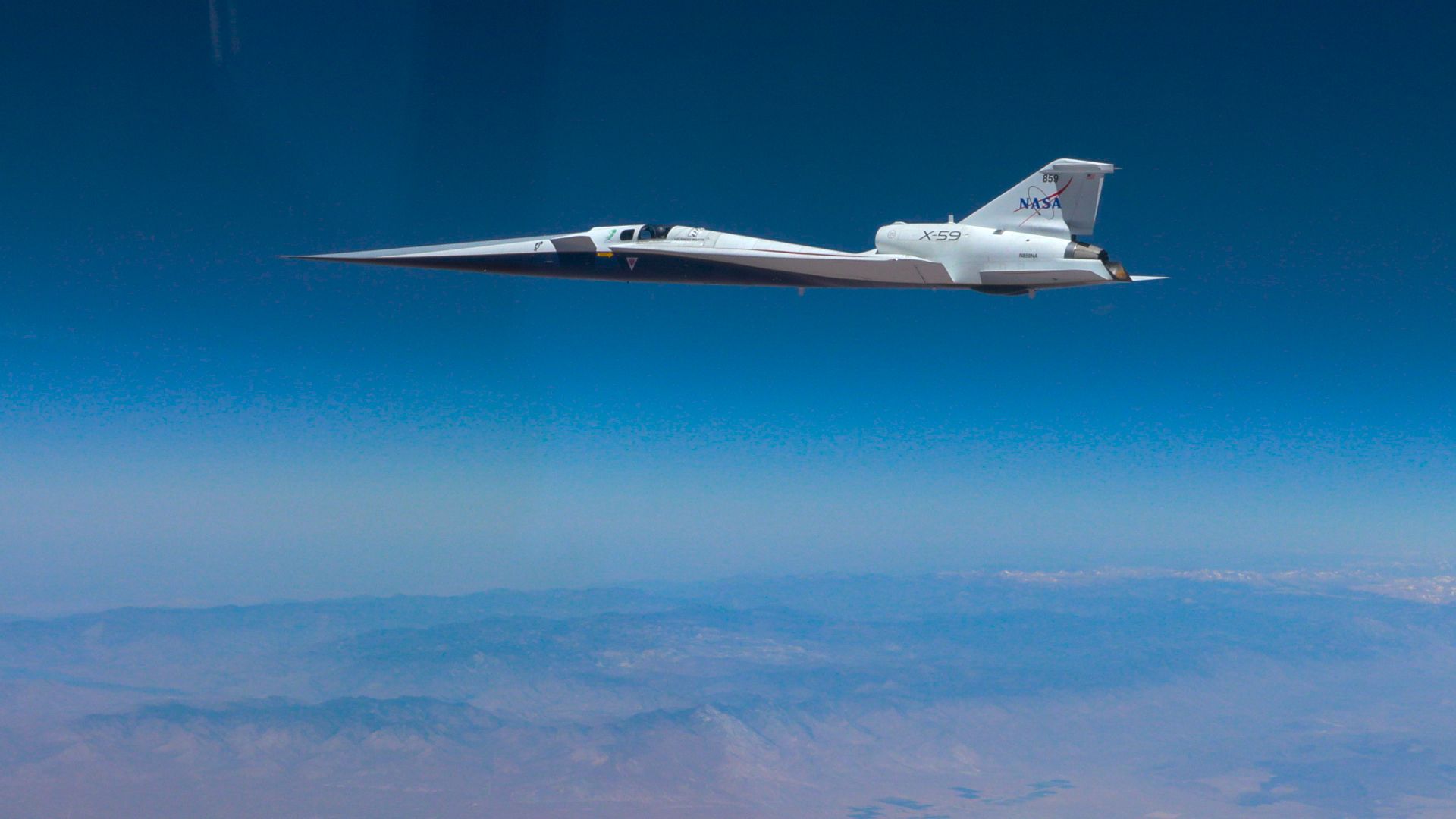
NASA‘s X-59, an experimental supersonic aircraft developed in partnership with Lockheed Martin, has broken the sound barrier for the first time. The test represents an important step toward “quiet supersonic” flight, in which a craft surpasses Mach 1 — the speed of sound — with a small thump rather than a deafening crash.
On June 5, test pilot Jim “Clue” Less flew the craft from Edwards Air Force Base in California for an 81-minute round trip, NASA announced in a statement. During that time, the X-59 reached a speed of Mach 1.1 — 713 mph (1,147 km/h) — at an altitude of 43,400 feet (13,200 meters).
However, despite passing this key test, the craft’s “quiet” supersonic capabilities are still not well defined; during this flight, the X-59 was trailed by an F-15 fighter jet, whose loud supersonic boom cloaked the noise from the X-59. Further testing planned for later this year will better demonstrate the experimental aircraft’s progress on the noise-reduction front.
Breaking barriers
The world’sfirst supersonic flight took place in 1947, when U.S. Air Force test pilot Charles “Chuck” Yeager flew the Bell X-1 aircraft over California’s Mojave Desert. Yeager piloted the craft to a speed of Mach 1.06, opening a new frontier of possibilities in aviation — but not necessarily for commercial air travel.
“We always kind of joke that the X-1 broke the sound barrier and now we’re trying to fix it,” Catherine Bahm, NASA’s Low Boom Flight Demonstrator project manager, who oversees the X-59’s development, told the BBC in 2023.
When a plane moves forward, it pushes aside the air molecules in front of it. This causes the air to vibrate, creating sound waves that spread from the aircraft like the wake trailing a boat. When a craft breaks the sound barrier, the air pressure waves behind it compress and build into a shock wave, which releases energy as a thunderous “sonic boom.”
This view from NASA’s X-59 eXternal Vision System shows the craft reaching Mach 1.077 on Friday, June 5, marking the aircraft’s first time reaching supersonic speed.
Get the world’s most fascinating discoveries delivered straight to your inbox.
Although Air France and British Airways’ Concorde, which ran between London or Paris and New York City from 1976 to 2003, was the world’s first commercial supersonic flight, that aircraft was allowed to operate only because it broke the sound barrier over the Atlantic Ocean. It was ultimately decommissioned after one flight crashed during takeoff from France’s Charles de Gaulle airport, killing everyone aboard.
The X-59’s ultra-long, skinny nose is designed to minimize the shockwave its sonic boom creates. A plane that produces a quieter sonic “thud” could allow for faster-than-sound commercial domestic flights over land. That would mean passengers could, for example, get from Los Angeles to New York City in under three hours (compared with the current five-to-six-hour flight time). However, NASA has not yet released information about how many decibels X-59’s first sonic boom produced.
Beyond its commercial possibilities, quiet supersonic flight has obvious military applications, as it makes secret missions significantly stealthier. NASA plans to run X-59’s first “mission conditions” test flight, which will reach speeds of Mach 1.4 at an altitude of approximately 55,000 feet (17,000 m), in the coming weeks.
We use cookies on our website to give you the most relevant experience by remembering your preferences and repeat visits. By clicking “Accept”, you consent to the use of ALL the cookies.
This website uses cookies to improve your experience while you navigate through the website. Out of these, the cookies that are categorized as necessary are stored on your browser as they are essential for the working of basic functionalities of the website. We also use third-party cookies that help us analyze and understand how you use this website. These cookies will be stored in your browser only with your consent. You also have the option to opt-out of these cookies. But opting out of some of these cookies may affect your browsing experience.
Necessary cookies are absolutely essential for the website to function properly. These cookies ensure basic functionalities and security features of the website, anonymously.
Cookie
Duration
Description
cookielawinfo-checkbox-analytics
11 months
This cookie is set by GDPR Cookie Consent plugin. The cookie is used to store the user consent for the cookies in the category "Analytics".
cookielawinfo-checkbox-functional
11 months
The cookie is set by GDPR cookie consent to record the user consent for the cookies in the category "Functional".
cookielawinfo-checkbox-necessary
11 months
This cookie is set by GDPR Cookie Consent plugin. The cookies is used to store the user consent for the cookies in the category "Necessary".
cookielawinfo-checkbox-others
11 months
This cookie is set by GDPR Cookie Consent plugin. The cookie is used to store the user consent for the cookies in the category "Other.
cookielawinfo-checkbox-performance
11 months
This cookie is set by GDPR Cookie Consent plugin. The cookie is used to store the user consent for the cookies in the category "Performance".
viewed_cookie_policy
11 months
The cookie is set by the GDPR Cookie Consent plugin and is used to store whether or not user has consented to the use of cookies. It does not store any personal data.
Functional cookies help to perform certain functionalities like sharing the content of the website on social media platforms, collect feedbacks, and other third-party features.
Performance cookies are used to understand and analyze the key performance indexes of the website which helps in delivering a better user experience for the visitors.
Analytical cookies are used to understand how visitors interact with the website. These cookies help provide information on metrics the number of visitors, bounce rate, traffic source, etc.
Advertisement cookies are used to provide visitors with relevant ads and marketing campaigns. These cookies track visitors across websites and collect information to provide customized ads.