
Close Menu
    Facebook X (Twitter) Instagram Pinterest YouTube LinkedIn TikTok
    TopBuzzMagazine.com
    Facebook X (Twitter) Instagram Pinterest YouTube LinkedIn TikTok
    • Home
    • Movies
    • Television
    • Music
    • Fashion
    • Books
    • Science
    • Technology
    • Cover Story
    • Contact
      • About
      • Amazon Disclaimer
      • Terms and Conditions
      • Privacy Policy
      • DMCA / Copyrights Disclaimer
    TopBuzzMagazine.com
    Home»Science»James Webb telescope detects ‘galaxy-killing wind’ near the dawn of time
    Science

    James Webb telescope detects ‘galaxy-killing wind’ near the dawn of time

    By AdminJune 22, 2026
    Facebook Twitter Pinterest LinkedIn Tumblr Email
    James Webb telescope detects ‘galaxy-killing wind’ near the dawn of time


    When galaxies collide, it’s less like a train wreck and more like a marriage: Two separate entities merge into a single massive celestial structure. But relationships are hard, whether you’re a human or a galaxy — and ,this process may also “kill” the merging galaxies by unleashing star-quenching winds.

    This mechanism may help to explain an enigma in the early universe. A glut of James Webb Space Telescope (JWST) observations have shown that galaxies grew surprisingly massive within 1 billion years of the Big Bang. Just as unexpectedly, many of these galaxies appear to have already stopped producing stars and grown quiescent (or dead) only about a billion years later.

    Galactic winds have previously been considered as galaxy-killing culprits, but astronomers lacked the direct evidence to confirm that this process can meaningfully suppress star formation at such an early stage of cosmic history. Now, in a paper published June 10 in the journal Monthly Notices of the Royal Astronomical Society, an international team of astronomers has described how star-driven winds can quench galaxies, creating the kaleidoscope of quiescent structures observed by JWST.

    Gas leak near the dawn of time

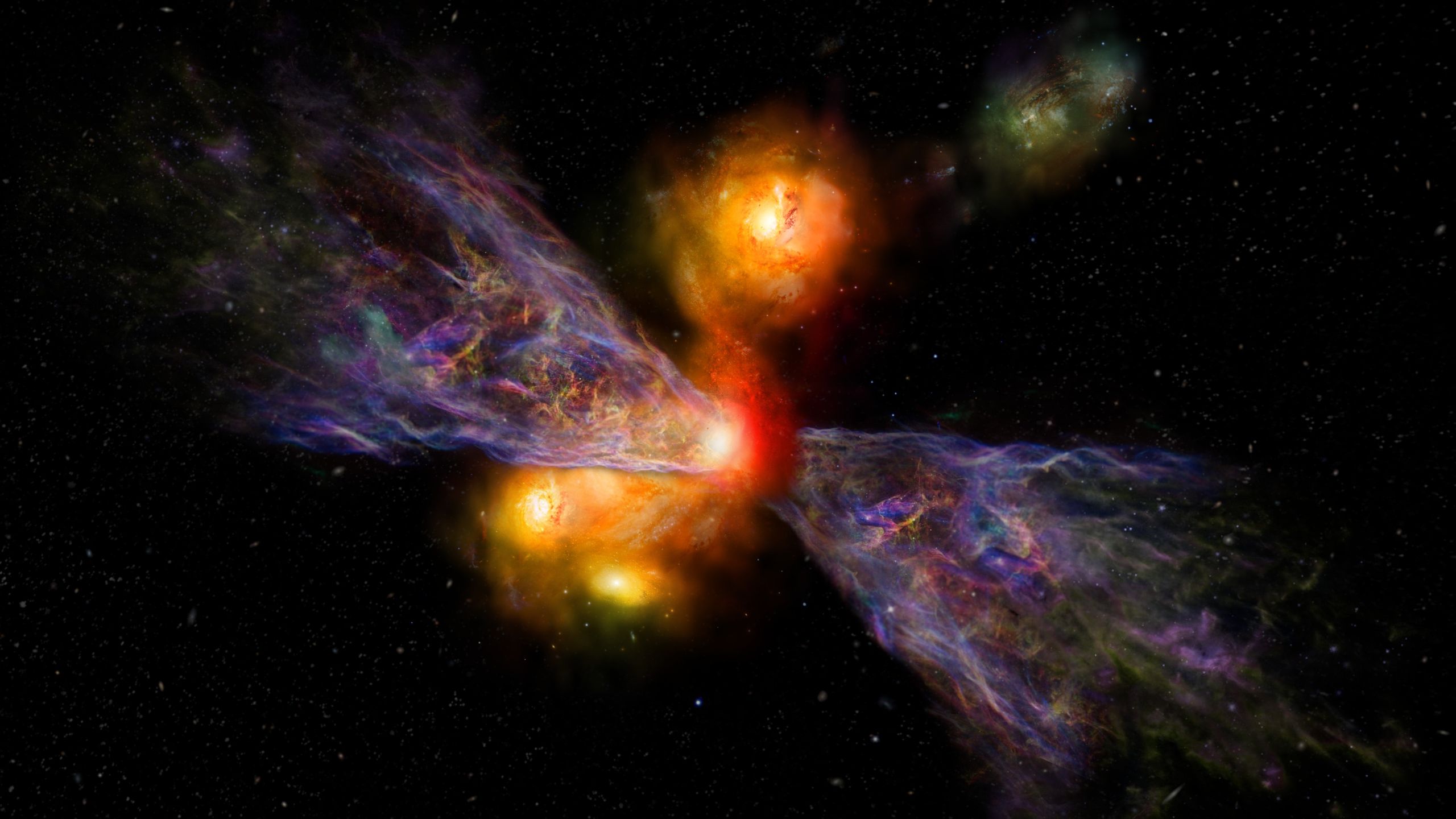
    The researchers used JWST and the Atacama Large Millimeter/submillimeter Array radio telescope in Chile’s Atacama Desert to observe a system of galaxies called CRISTAL-02 as it appeared only 1 billion years after the Big Bang.

    With a stellar mass around 10 billion times greater than the sun’s, CRISTAL-02 is a galactic merger that represents the latter stages of a multigalaxy collision. It also exhibits an immense plume of gas, almost as long as the galaxy system itself, that is escaping into space at hundreds of miles per second.


    You may like

    This immense outflow, comprising 1.5 billion solar masses, appears to be driven by the intense winds generated through a rapid burst of star formation, as well as star death, the study authors said. Both processes occur as galaxies collide, shocking large gas clouds into birthing new stars, including extremely massive ones that die within a few million years in violent supernova explosions.

    The intense radioactive winds released from these young stars and their dying elder siblings can then suppress stellar formation, by energizing and dispersing pockets of cool molecular gas before it can gravitationally collapse to birth baby stars.

    Get the world’s most fascinating discoveries delivered straight to your inbox.

    “The galaxy has a powerful wind that is ejecting material twice as fast as the galaxy forms stars,” first author Rebecca Davies, an astrophysicist at the Swinburne University of Technology in Australia, said in a statement.

    Image of the James Webb Space Telescope placed in front of a star-filled blue and black background.

    An illustration of the James Webb Space Telescope observing a distant galaxy

    (Image credit: Getty Images)

    The CRISTAL-02 galaxy system may be forming around 260 new solar-mass stars per year — a rate three times higher than galaxies with similar masses and ages. Yet it’s also losing more than 500 solar masses per year, — 20 times faster than typical massive galaxies, the researchers found.

    “We don’t know much about how the first galaxies stopped forming stars. This work directly shows that process in action,” co-author Andreas Faisst, an observational astronomer at Caltech, told Live Science via email.


    What to read next

    “If the outflow keeps going, the galaxy will run out of gas to form stars in less than 100 million years from now — a blink of an eye in astrophysical terms.”

    A widespread cosmic phenomenon

    This research offers a blueprint for galactic senescence, or gradual deterioration. “Almost half of early massive galaxies are interacting with other nearby galaxies, suggesting this isn’t a quirk but a widespread cosmic phenomenon,” Davies added.

    But previous simulations have suggested that outflows from active black holes, rather than stars, may be primarily responsible for creating quiescent galaxies. Star-burst-driven outflows cease once star formation stops, whereas black-hole-driven outflows can persist for hundreds of millions of years afterward.

    Therefore, the researchers cannot rule out that the CRISTAL-02 outflow was generated by a powerful black hole that was inactive at the time of the observation.

    Additionally, the researchers compared the outflow from CRISTAL-02 with a sample of 99 other similar outflows spanning 12 billion years to determine whether this feedback process evolves over time.

    They discovered that outflow efficiency has remained roughly constant across cosmic history, even as the internal properties of galaxies have changed while the universe has aged and expanded. Additionally, constraining the early-universe feedback mechanisms that dictate galactic evolution can help astronomers improve cosmological simulations that aim to explain why the cosmos looks and behaves the way it does today.

    “If many early galaxies collide and experience rapid growth, then it may not be surprising that we see so many dead galaxies in the early universe,” Davies explained. “CRISTAL-02 offers a natural solution to the mystery of why these massive galaxies live fast and die young.”

    These processes are still at work today, governing local star-dense sectors in our galaxy. They may also dictate its far off future, as the Milky Way could collide with our biggest neighbor, Andromeda, in around 4.5 billion years. When this merger occurs, it “will likely trigger a starburst associated with strong stellar winds — maybe similar to what we see in CRISTAL-02,” Faisst said via email.

    “The Milky Way and Andromeda system will subsequently likely become a large quiescent elliptical galaxy.”

    Davies, R. L., Fisher, D. B., Herrera-Camus, R., Faisst, A., Spilker, J., González-López, J., Fujimoto, S., Amorín, R., Aravena, M., Assef, R. J., Barcos-Muñoz, L., Boquien, M., Dessauges-Zavadsky, M., Ferrara, A., Schreiber, N. M. F., Ginolfi, M., Gómez-Espinoza, D., Ibar, E., Ikeda, R., . . . Zamorani, G. (2026). Multiphase images of a powerful supernova-driven wind in the early Universe. Monthly Notices of the Royal Astronomical Society, 549(3). https://doi.org/10.1093/mnras/stag874

    TOPICS


    James Webb Space Telescope

    View Original Source Here

    Share. Facebook Twitter Pinterest LinkedIn Tumblr Email

    Related Posts

    We've found a mysterious substance on Titan and Pluto

    June 22, 2026

    Today's housing emergency is nearly 200 years in the making, says new report

    June 21, 2026

    ‘You kill the bacteria and heal the wound at the same time’: Emerging nanotech could be the future of wound healing

    June 21, 2026

    Faecal transplant makes the brains of old mice act young again

    June 20, 2026

    Heatwave hits more than one in two people in France

    June 20, 2026

    Estrogen levels in both the male and female brain may shape memory’s resilience in face of stress

    June 19, 2026
    popular posts

    Apollo astronauts discovered the moon is covered in tiny orange glass beads. Now we finally know why.

    I Found the Perfect Pair of Flats at Old Navy,

    Rooted in Wonder: Jane Gallagher on Nature, Movement, and the Mystery of Life

    Is cleaner air accelerating global warming more than we expected?

    Cocteau Twins’ Elizabeth Fraser Shares New Sun’s Signature Song “Golden

    Discussing the Complexity Behind a Great Love Story and Being the “Man” in Romance

    A Glamorous Guide to the Holidays

    Categories
    • Books (3,934)
    • Cover Story (15)
    • Events (24)
    • Fashion (2,808)
    • Interviews (60)
    • Movies (3,230)
    • Music (3,524)
    • News (178)
    • Politics (13)
    • Science (5,085)
    • Technology (3,227)
    • Television (3,955)
    • Uncategorized (932)
    Archives
    Facebook X (Twitter) Instagram Pinterest YouTube Reddit TikTok
    © 2026 Top Buzz Magazine. All rights reserved. All articles, images, product names, logos, and brands are property of their respective owners. All company, product and service names used in this website are for identification purposes only. Use of these names, logos, and brands does not imply endorsement unless specified. By using this site, you agree to the Terms of Use and Privacy Policy.

    Type above and press Enter to search. Press Esc to cancel.

    We use cookies on our website to give you the most relevant experience by remembering your preferences and repeat visits. By clicking “Accept”, you consent to the use of ALL the cookies.
    Do not sell my personal information.
    Cookie SettingsAccept
    Manage consent

    Privacy Overview

    This website uses cookies to improve your experience while you navigate through the website. Out of these, the cookies that are categorized as necessary are stored on your browser as they are essential for the working of basic functionalities of the website. We also use third-party cookies that help us analyze and understand how you use this website. These cookies will be stored in your browser only with your consent. You also have the option to opt-out of these cookies. But opting out of some of these cookies may affect your browsing experience.
    Necessary
    Always Enabled
    Necessary cookies are absolutely essential for the website to function properly. These cookies ensure basic functionalities and security features of the website, anonymously.
    CookieDurationDescription
    cookielawinfo-checkbox-analytics11 monthsThis cookie is set by GDPR Cookie Consent plugin. The cookie is used to store the user consent for the cookies in the category "Analytics".
    cookielawinfo-checkbox-functional11 monthsThe cookie is set by GDPR cookie consent to record the user consent for the cookies in the category "Functional".
    cookielawinfo-checkbox-necessary11 monthsThis cookie is set by GDPR Cookie Consent plugin. The cookies is used to store the user consent for the cookies in the category "Necessary".
    cookielawinfo-checkbox-others11 monthsThis cookie is set by GDPR Cookie Consent plugin. The cookie is used to store the user consent for the cookies in the category "Other.
    cookielawinfo-checkbox-performance11 monthsThis cookie is set by GDPR Cookie Consent plugin. The cookie is used to store the user consent for the cookies in the category "Performance".
    viewed_cookie_policy11 monthsThe cookie is set by the GDPR Cookie Consent plugin and is used to store whether or not user has consented to the use of cookies. It does not store any personal data.
    Functional
    Functional cookies help to perform certain functionalities like sharing the content of the website on social media platforms, collect feedbacks, and other third-party features.
    Performance
    Performance cookies are used to understand and analyze the key performance indexes of the website which helps in delivering a better user experience for the visitors.
    Analytics
    Analytical cookies are used to understand how visitors interact with the website. These cookies help provide information on metrics the number of visitors, bounce rate, traffic source, etc.
    Advertisement
    Advertisement cookies are used to provide visitors with relevant ads and marketing campaigns. These cookies track visitors across websites and collect information to provide customized ads.
    Others
    Other uncategorized cookies are those that are being analyzed and have not been classified into a category as yet.
    SAVE & ACCEPT