
Close Menu
    Facebook X (Twitter) Instagram Pinterest YouTube LinkedIn TikTok
    TopBuzzMagazine.com
    Facebook X (Twitter) Instagram Pinterest YouTube LinkedIn TikTok
    • Home
    • Movies
    • Television
    • Music
    • Fashion
    • Books
    • Science
    • Technology
    • Cover Story
    • Contact
      • About
      • Amazon Disclaimer
      • Terms and Conditions
      • Privacy Policy
      • DMCA / Copyrights Disclaimer
    TopBuzzMagazine.com
    Home»Science»Hubble telescope discovers ‘Cloud-9’, a dark and rare ‘failed galaxy’ that’s unlike anything seen before
    Science

    Hubble telescope discovers ‘Cloud-9’, a dark and rare ‘failed galaxy’ that’s unlike anything seen before

    By AdminJanuary 9, 2026
    Facebook Twitter Pinterest LinkedIn Tumblr Email
    Hubble telescope discovers ‘Cloud-9’, a dark and rare ‘failed galaxy’ that’s unlike anything seen before


    Astronomers using the Hubble Space Telescope have just spotted a new type of celestial object: Cloud-9, a starless, gas-rich cloud of dark matter that was slightly too light to become a full-fledged galaxy.

    As detailed in a study published Nov. 10 in The Astrophysical Journal Letters and presented this week at the 247th meeting of the American Astronomical Society in Phoenix, this odd object is located more than 14 million light-years from Earth, near the spiral galaxy Messier 94 (M94). Cloud-9 is a cosmic relic, a primordial building block of galaxies that confirms the critical mass threshold needed for a body of gas and dark matter to collapse into a galaxy.

    As a result, the discovery of Cloud-9 strongly supports a cornerstone of the leading cosmological framework that aims to explain the structure and composition of the universe — the Lambda cold dark matter model (LCDM). One of the model’s major predictions is that dark matter settles in halos, which may or may not grow heavy enough to anchor galaxies.


    You may like

    “These ‘dark halos’ should be plentiful, however most of them do not retain any hydrogen gas, thus remaining invisible,” Deep Anand, astronomer at the Space Telescope Science Institute (STScI) and the study’s lead author, told Live Science via email. “Cloud-9 lies at the very upper end of the dark halo mass range, thus allowing it to retain its gas, and therefore being visible through radio observations. This is indeed a strong confirmation of a cornerstone prediction of LCDM.”

    Accordingly, Cloud-9 offers the first hint of evidence that the universe could be teeming with low-mass dark matter halos that remain devoid of stars, as theory predicts.

    Digging up a cosmic fossil

    Astronomers discovered Cloud-9 three years ago with the Five-hundred-meter Aperture Spherical Telescope (FAST) in Guizhou, China. The massive radio telescope has been “very productive in finding similar clouds” and may find others in the future, study co-author Andrew Fox, also an astronomer at STScI, told Live Science via email.

    Previously, the researchers used the Very Large Array, a 28-telescope array in New Mexico, to focus on the peak of Cloud-9’s radio emissions, originating from its 5,000-light-year wide core. However, the observations failed to identify the object’s true nature, potentially owing to telescope sensitivity limits. Perhaps Cloud-9 was simply a ho-hum dwarf galaxy that was too faint to be properly viewed by ground-based facilities, the researchers considered.

    Get the world’s most fascinating discoveries delivered straight to your inbox.

    But, as described in the new study, a follow-up with the Hubble Space Telescope’s Advanced Camera for Surveys revealed a much rarer phenomenon, one that astronomers had been seeking for years: a “theoretical phantom object” and the first-ever confirmed RELHIC, or Reionization-Limited H I Cloud. In other words, a cloud of neutral hydrogen, a natal leftover from the early cosmos and a unique “window into the dark universe,” Fox said in a NASA press statement.

    This hydrogen detection was proof that Cloud-9 was not a typical dwarf galaxy, but something stranger.

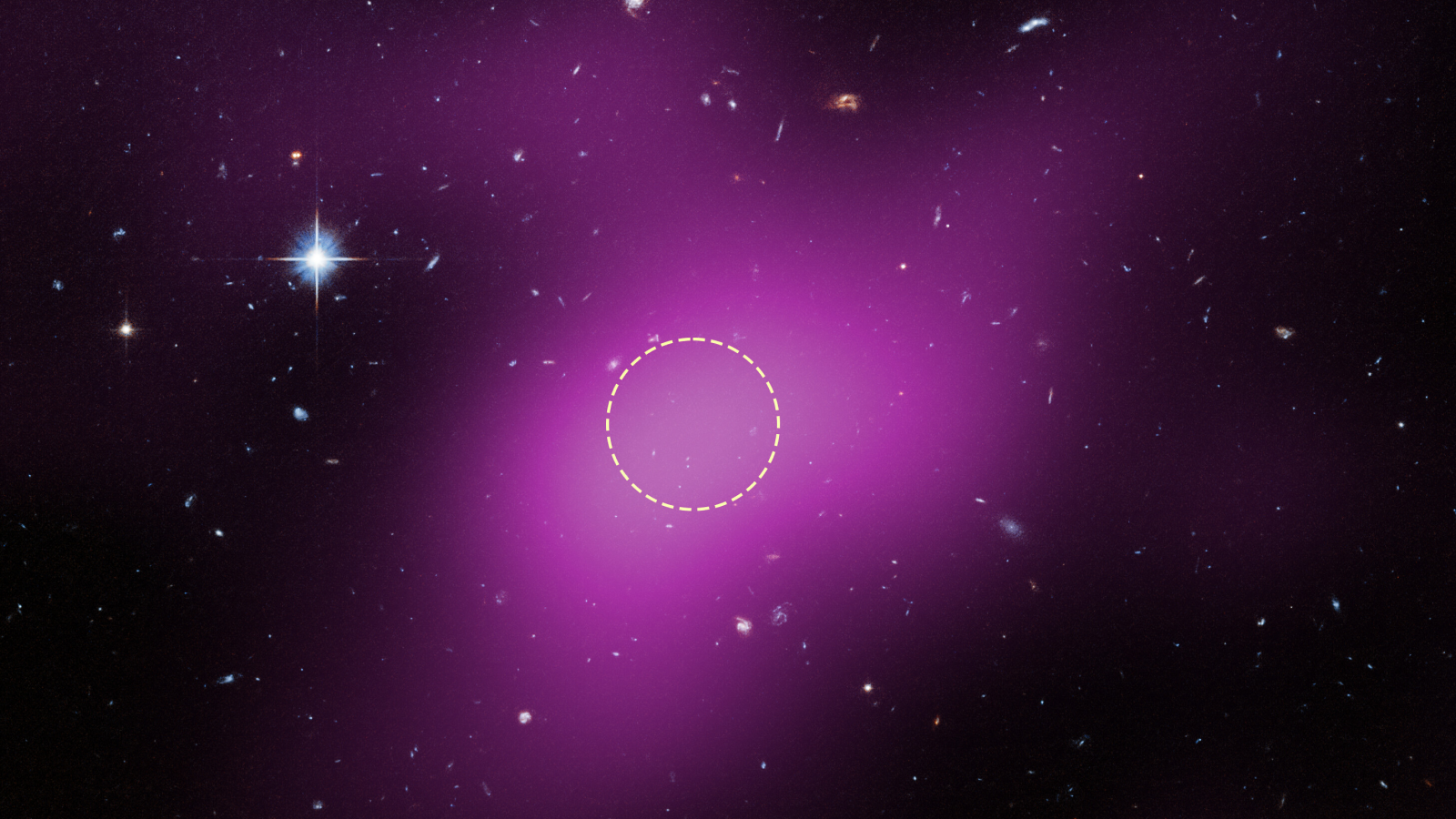
    A dark field with stars and galaxies of various sizes speckled throughout the image. A particularly bright star is visible in the upper left region of the image.

    Cloud-9 was spotted in this region of space, about 2,000 light-years from Earth. (Image credit: NASA, ESA. G. Anand (STScI), and A. Benitez-Llambay (Univ. of Milan-Bicocca); Image processing: J. DePasquale (STScI))

    To be or not to be a galaxy

    The researchers analyzed the gas in Cloud-9 based on the radio waves it emits, and found the gas contributes about one million suns worth of mass to the strange object. That alone is not enough to keep such a large gas cloud together. So, assuming that the system is held together by a balance between gravity, gas pressure, and gas heating, Cloud-9’s dark matter component must weigh in at around five billion solar masses, the team calculated.


    You may like

    This mass hits a sweet spot “remarkably close” to the independently theorized critical mass threshold. At this threshold, Cloud-9 falls just short of having enough mass to collapse into a galaxy, but is massive enough, due to its dark matter component, to keep itself together.

    Cloud-9 is also in thermal equilibrium with the cosmic ultraviolet (UV) background, the UV energy streaming from all the universe’s stars, active black holes, and hot gas. This energy keeps gas ionized, or electrically charged, and relatively hot, suppressing galaxy formation. This also contributes to the cloud’s total lack of stars.

    However, the researchers conclude that Cloud-9 may not be irrevocably doomed to eternal darkness. It may still gather enough mass to become a galaxy, though the exact mechanics that would allow this are speculative.

    Whatever its fate, Cloud-9 serves as a physical benchmark that shows that current dark matter models, as well as galaxy formation theories, are on the right track.

    An exceedingly rare relic from the ancient universe

    Future studies will search for failed galaxies similar to Cloud-9 — though finding them is much easier said than done, for multiple reasons. First, such dim objects are easily outshined by other celestial sources.

    These clouds are also ephemeral, and likely to be eradicated by a process known as ram pressure stripping, which robs them of their gas as they move through intergalactic space. In fact, Cloud-9 appears to be already perturbed by the relatively hot circumgalactic medium around its neighbor galaxy, M94, the researchers said.

    “To survive as a dark, gas-rich cloud into the present-day, a system must meet two stringent, and statistically rare, criteria,” Alejandro Benitez-Llambay, principal investigator of the program to study Cloud-9 and an astrophysicist at the University of Milano-Bicocca, told Live Science via email. “First, its dark matter halo must have an atypically slow assembly history; if it grew too quickly in the early universe, the gas would have collapsed to form stars before the cosmic UV background could heat it up. Second, the system must remain sufficiently isolated.” Fewer than 10% of such gas clouds may have remained as starlessly pristine as Cloud-9, Benitez-Llambay added.

    Finally, as a dark-universe ambassador, Cloud-9 is a crucial reminder that the stunning panoramas of stars we see in most astronomical images represent a small proportion of the cosmos as a whole — the shiny things we can see tell only part of the cosmological story.

    View Original Source Here

    Share. Facebook Twitter Pinterest LinkedIn Tumblr Email

    Related Posts

    NASA head Isaacman tempers Artemis praise with ideas on the program's future

    January 23, 2026

    6 science-backed tips to kickstart your exercise routine and actually stick to it

    January 22, 2026

    Piercing crocodile close-up wins ecology photo competition

    January 22, 2026

    Olympic visitors to Milan get a rare chance to glimpse restoration of a long-hidden Leonardo gem

    January 21, 2026

    Why gut pain may be more severe in women than in men, according to a preclinical study

    January 21, 2026

    Sunscreens made from ground-up wood reach an SPF of over 180

    January 20, 2026
    popular posts

    Bookish DIY Kits To Buy and Make for Holiday Gifting

    The Velvet Queen review – A hypnotic lesson in watchful

    8 Essential Pieces of Women’s Fiction From Authors of Color

    California Science Center starts complex process to display Space Shuttle

    Small, stocky dinosaur related to Velociraptor named as new species

    WWE Shake Up: Vince McMahon Retires — Read His Statement

    Producing ‘green’ energy – literally

    Categories
    • Books (3,671)
    • Cover Story (10)
    • Events (21)
    • Fashion (2,664)
    • Interviews (55)
    • Movies (2,970)
    • Music (3,258)
    • News (168)
    • Politics (7)
    • Science (4,823)
    • Technology (2,965)
    • Television (3,695)
    • Uncategorized (932)
    Archives
    Facebook X (Twitter) Instagram Pinterest YouTube Reddit TikTok
    © 2026 Top Buzz Magazine. All rights reserved. All articles, images, product names, logos, and brands are property of their respective owners. All company, product and service names used in this website are for identification purposes only. Use of these names, logos, and brands does not imply endorsement unless specified. By using this site, you agree to the Terms of Use and Privacy Policy.

    Type above and press Enter to search. Press Esc to cancel.

    We use cookies on our website to give you the most relevant experience by remembering your preferences and repeat visits. By clicking “Accept”, you consent to the use of ALL the cookies.
    Do not sell my personal information.
    Cookie SettingsAccept
    Manage consent

    Privacy Overview

    This website uses cookies to improve your experience while you navigate through the website. Out of these, the cookies that are categorized as necessary are stored on your browser as they are essential for the working of basic functionalities of the website. We also use third-party cookies that help us analyze and understand how you use this website. These cookies will be stored in your browser only with your consent. You also have the option to opt-out of these cookies. But opting out of some of these cookies may affect your browsing experience.
    Necessary
    Always Enabled
    Necessary cookies are absolutely essential for the website to function properly. These cookies ensure basic functionalities and security features of the website, anonymously.
    CookieDurationDescription
    cookielawinfo-checkbox-analytics11 monthsThis cookie is set by GDPR Cookie Consent plugin. The cookie is used to store the user consent for the cookies in the category "Analytics".
    cookielawinfo-checkbox-functional11 monthsThe cookie is set by GDPR cookie consent to record the user consent for the cookies in the category "Functional".
    cookielawinfo-checkbox-necessary11 monthsThis cookie is set by GDPR Cookie Consent plugin. The cookies is used to store the user consent for the cookies in the category "Necessary".
    cookielawinfo-checkbox-others11 monthsThis cookie is set by GDPR Cookie Consent plugin. The cookie is used to store the user consent for the cookies in the category "Other.
    cookielawinfo-checkbox-performance11 monthsThis cookie is set by GDPR Cookie Consent plugin. The cookie is used to store the user consent for the cookies in the category "Performance".
    viewed_cookie_policy11 monthsThe cookie is set by the GDPR Cookie Consent plugin and is used to store whether or not user has consented to the use of cookies. It does not store any personal data.
    Functional
    Functional cookies help to perform certain functionalities like sharing the content of the website on social media platforms, collect feedbacks, and other third-party features.
    Performance
    Performance cookies are used to understand and analyze the key performance indexes of the website which helps in delivering a better user experience for the visitors.
    Analytics
    Analytical cookies are used to understand how visitors interact with the website. These cookies help provide information on metrics the number of visitors, bounce rate, traffic source, etc.
    Advertisement
    Advertisement cookies are used to provide visitors with relevant ads and marketing campaigns. These cookies track visitors across websites and collect information to provide customized ads.
    Others
    Other uncategorized cookies are those that are being analyzed and have not been classified into a category as yet.
    SAVE & ACCEPT