
Close Menu
    Facebook X (Twitter) Instagram Pinterest YouTube LinkedIn TikTok
    TopBuzzMagazine.com
    Facebook X (Twitter) Instagram Pinterest YouTube LinkedIn TikTok
    • Home
    • Movies
    • Television
    • Music
    • Fashion
    • Books
    • Science
    • Technology
    • Cover Story
    • Contact
      • About
      • Amazon Disclaimer
      • Terms and Conditions
      • Privacy Policy
      • DMCA / Copyrights Disclaimer
    TopBuzzMagazine.com
    Home»Science»Diagnostic dilemma: Woman’s ‘biologically implausible’ infection led her to sneeze ‘worms’ out of her nose
    Science

    Diagnostic dilemma: Woman’s ‘biologically implausible’ infection led her to sneeze ‘worms’ out of her nose

    By AdminApril 8, 2026
    Facebook Twitter Pinterest LinkedIn Tumblr Email
    Diagnostic dilemma: Woman’s ‘biologically implausible’ infection led her to sneeze ‘worms’ out of her nose


    The patient: A 58-year-old woman in Greece

    The symptoms: The patient, who worked outdoors on a Greek island, developed pain around the center of her face that grew progressively worse. About two to three weeks after this pain began, she also developed a severe cough.

    Shortly after that, “worms” came out of her nose when she sneezed, prompting her to seek medical attention, she told doctors.


    You may like

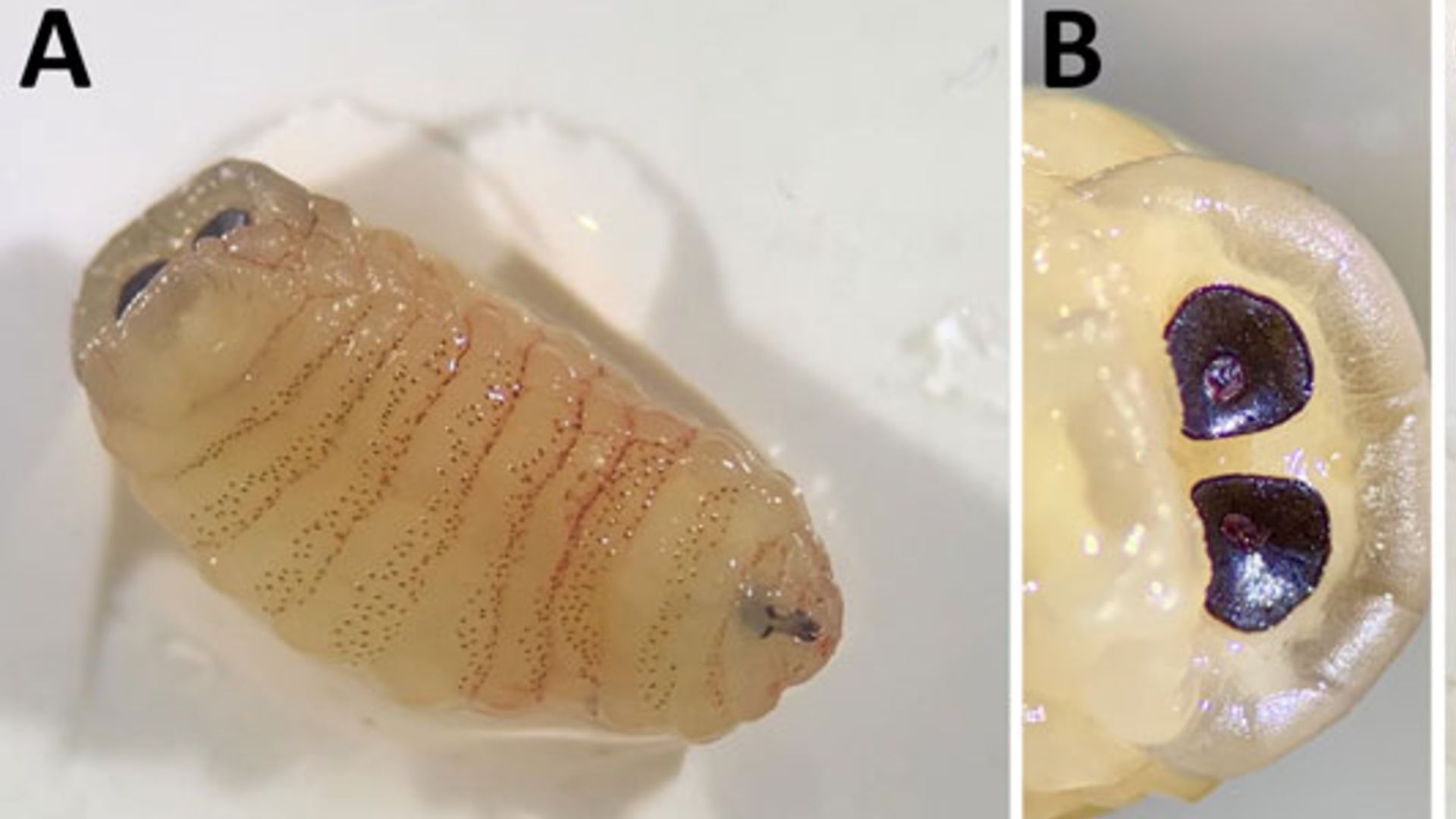
    What happened next: A report of the case doesn’t describe how the patient was examined. However, it notes that an ear, nose and throat specialist surgically removed wriggling creatures from her maxillary sinuses, the large sinuses located on the sides of the nose. These critters included 10 larvae and one pupa (the insect life stage between the larval and adult stages).

    Following this extraction, experts closely examined two of the larvae and part of a puparium, the pupa’s protective outer casing in which it matures into an adult. One larva was pale yellow and about 0.6 inches (15 millimeters) long, while the other was light brown and 0.8 inches (20 mm) long. The puparium was black and wrinkled, and it contained remnants of the pupa, they noted.

    The team visually examined the larvae and extracted DNA for analysis.

    The diagnosis: This examination revealed the wormlike creatures to be the larvae of the sheep bot fly (Oestrus ovis). This parasite is typically found in the nasal passages and sinuses of sheep and goats. Notably, the outdoor area where the woman works is located next to a field with grazing sheep, the report authors wrote.

    Get the world’s most fascinating discoveries delivered straight to your inbox.

    Parasitic fly infections are generally known as “myiasis,” so the woman was diagnosed with “O. ovis nasal myiasis with pupation.”

    The treatment: In addition to having the larvae and pupa surgically removed from her sinuses, the woman was given nasal decongestants. With these two treatments, she made a “complete recovery,” according to the report.

    What makes the case unique: Human cases of O. ovis myiasis have been reported in the past, but these infections have typically affected the eyes, rather than the nasal passages.


    What to read next

    “O. ovis bot flies infrequently affect humans, most often depositing larvae in the conjunctival sac,” which is located between the eyelid and eyeball, the report authors noted. More rarely, the flies have been reported to deposit larvae into people’s nostrils, mouths or ear canals, they added.

    Historically, it was thought that O. ovis couldn’t develop for very long in humans, making it to only the first larval stage, known as L1. But in recent cases, older larvae, including L2 and L3, have been identified, the report authors wrote. Pupation, the point at which larvae mature into “teenagers,” follows the L3 stage.

    A close up of half of a black conical shape outer husk that is next to a pile of yellow mucus, all on a petri dish.

    The puparium and remnants of the pupa. (Image credit: Ilias P. Kioulos, Emmanouil Kokkas, and Evangelia-Theophano Piperaki)

    “The patient we report had a severely deviated nasal septum and appears to have been inoculated with a large larval burden,” they noted. “From a purely anatomic perspective,” the authors hypothesize that the high number of larvae combined with the woman’s septum deviation prevented said larvae from exiting her nose. This permitted the larvae to progress to the L3 stage and, in one instance, pupation, they concluded.

    When infecting sheep and goats, adult female O. ovis deposit larvae (also called maggots) in and around the host animals’ nostrils. The larvae then travel into the nasal passages and sinuses, where they may mature for months before exiting the nostrils. Once out, they burrow into the ground and enter the pupa life stage for several weeks. Once mature, the adult fly breaks free of its puparium and emerges from the ground.

    On occasion, L3 larvae can get stuck in the nasal passages of their host animals, but they don’t typically pupate at that point. Instead, they usually dry up, liquefy or calcify, and their remains can sometimes trigger secondary bacterial infections.

    The maggots die because the sinuses don’t provide a favorable environment for them to enter the pupal stage. As such, “pupation of O. ovis larvae within any mammalian host is considered biologically implausible,” the authors noted. Nonetheless, it happened in their patient.

    The authors suggest that some “unidentified anatomic or physiologic factors” must have allowed pupation to occur in the woman’s case. Alternatively, the strange occurrence may reflect an evolutionary adaptation that could enable the species to complete its life cycle in humans, they mused.

    “In either scenario, additional cases and data are needed to understand this phenomenon, but clinicians should be aware of the potential for human bot fly infections in endemic areas,” they concluded.

    For more intriguing medical cases, check out our Diagnostic Dilemma archives.

    This article is for informational purposes only and is not meant to offer medical advice.

    Kioulos, I. P., Kokkas, E., & Piperaki, E. (2026). Oestrus ovis Nasal Myiasis with Pupation in Human Host, Greece, October 2025. Emerging Infectious Diseases, 32(3), 445-447. https://doi.org/10.3201/eid3203.251077.

    View Original Source Here

    Share. Facebook Twitter Pinterest LinkedIn Tumblr Email

    Related Posts

    Physicists just witnessed pinpricks of darkness moving faster than the speed of light ‪—‬ without breaking the laws of relativity

    April 14, 2026

    Modern living may be causing big changes to our oestrogen levels

    April 13, 2026

    Deep learning turns weather satellite thermal imagery into hourly ocean current maps

    April 13, 2026

    Human ancestors butchered and ate elephants 1.8 million years ago, helping to fuel their large brains

    April 12, 2026

    NASA’s Artemis II mission was a historic success

    April 12, 2026

    AI pragmatists: How language teachers are navigating AI with nuance

    April 11, 2026
    popular posts

    Netflix Sets ‘My Life with the Walter Boys’ Cast

    Interview with J.L. Calder, Author of DoubleHelix

    The Lowdown’s Ryan Kiera Armstrong Talks Season 2, Working With Ethan Hawke

    Everything New Streaming on Max at Launch

    Reginald the Vampire Season 1 Episode 5 Review: Fools in

    Days of Our Lives Round Table: Philip Is Back! But

    Pop Singer Ava Della Pietra Releases New Music

    Categories
    • Books (3,796)
    • Cover Story (14)
    • Events (23)
    • Fashion (2,732)
    • Interviews (57)
    • Movies (3,092)
    • Music (3,383)
    • News (173)
    • Politics (10)
    • Science (4,947)
    • Technology (3,088)
    • Television (3,817)
    • Uncategorized (932)
    Archives
    Facebook X (Twitter) Instagram Pinterest YouTube Reddit TikTok
    © 2026 Top Buzz Magazine. All rights reserved. All articles, images, product names, logos, and brands are property of their respective owners. All company, product and service names used in this website are for identification purposes only. Use of these names, logos, and brands does not imply endorsement unless specified. By using this site, you agree to the Terms of Use and Privacy Policy.

    Type above and press Enter to search. Press Esc to cancel.

    We use cookies on our website to give you the most relevant experience by remembering your preferences and repeat visits. By clicking “Accept”, you consent to the use of ALL the cookies.
    Do not sell my personal information.
    Cookie SettingsAccept
    Manage consent

    Privacy Overview

    This website uses cookies to improve your experience while you navigate through the website. Out of these, the cookies that are categorized as necessary are stored on your browser as they are essential for the working of basic functionalities of the website. We also use third-party cookies that help us analyze and understand how you use this website. These cookies will be stored in your browser only with your consent. You also have the option to opt-out of these cookies. But opting out of some of these cookies may affect your browsing experience.
    Necessary
    Always Enabled
    Necessary cookies are absolutely essential for the website to function properly. These cookies ensure basic functionalities and security features of the website, anonymously.
    CookieDurationDescription
    cookielawinfo-checkbox-analytics11 monthsThis cookie is set by GDPR Cookie Consent plugin. The cookie is used to store the user consent for the cookies in the category "Analytics".
    cookielawinfo-checkbox-functional11 monthsThe cookie is set by GDPR cookie consent to record the user consent for the cookies in the category "Functional".
    cookielawinfo-checkbox-necessary11 monthsThis cookie is set by GDPR Cookie Consent plugin. The cookies is used to store the user consent for the cookies in the category "Necessary".
    cookielawinfo-checkbox-others11 monthsThis cookie is set by GDPR Cookie Consent plugin. The cookie is used to store the user consent for the cookies in the category "Other.
    cookielawinfo-checkbox-performance11 monthsThis cookie is set by GDPR Cookie Consent plugin. The cookie is used to store the user consent for the cookies in the category "Performance".
    viewed_cookie_policy11 monthsThe cookie is set by the GDPR Cookie Consent plugin and is used to store whether or not user has consented to the use of cookies. It does not store any personal data.
    Functional
    Functional cookies help to perform certain functionalities like sharing the content of the website on social media platforms, collect feedbacks, and other third-party features.
    Performance
    Performance cookies are used to understand and analyze the key performance indexes of the website which helps in delivering a better user experience for the visitors.
    Analytics
    Analytical cookies are used to understand how visitors interact with the website. These cookies help provide information on metrics the number of visitors, bounce rate, traffic source, etc.
    Advertisement
    Advertisement cookies are used to provide visitors with relevant ads and marketing campaigns. These cookies track visitors across websites and collect information to provide customized ads.
    Others
    Other uncategorized cookies are those that are being analyzed and have not been classified into a category as yet.
    SAVE & ACCEPT