
Humans are the only species known to use fully symbolic language: a system capable of expressing abstract ideas, imaginary worlds and endless combinations of meaning. But how did we get there?
The origins of language have fascinated philosophers, scientists and storytellers for thousands of years. Despite all our advances in linguistics, archaeology and cognitive science, we still don’t know exactly how language began.
That uncertainty hasn’t stopped people from trying to solve the mystery. In fact, some of the earliest theories of language’s origins are among the strangest and most entertaining ideas in the history of science.
Bow wow, ding-dong
In the 19th century, scholars proposed a flurry of curious theories to explain how speech first emerged. Many of these theories were given playful nicknames by the German philologist Max Müller, who intended them partly as satire. Yet the theories were genuine attempts to tackle one of humanity’s biggest questions.

German philologist Max Müller gave playful nicknames to competing theories of language’s origins
The most famous is probably the Bow-Wow Theory. This suggested language began through imitation of natural sounds. Early humans, according to this theory, copied the noises around them: animal cries, splashing water, thunderclaps and birdsong. Words such as “buzz,” “hiss,” “bang” and “splash” seem to support the idea because they sound like what they describe.
But there is a problem. Different languages hear the same sounds differently. English dogs go “woof” or “bow-wow,” but in Turkish they go “hev-hev,” while Indonesian dogs go “guk-guk.” Even animal noises, it turns out, are filtered through culture and language.
And onomatopoeic words (words that imitate sounds) make up only a tiny fraction of our vocabularies. Most words sound nothing like their meanings. For instance, there is nothing inherently tree-like about the word “tree.”
Get the world’s most fascinating discoveries delivered straight to your inbox.
That brings us to the Ding-Dong Theory, which argued that sounds and meanings are naturally connected in some deeper, almost mystical way.
Some words do seem to fit their meanings uncannily well. “Mini,” “teeny” and “itsy-bitsy” feel small and delicate. “Lump,” “rump” and “plump” sound heavier and rounder.
Modern linguists call this sound symbolism. One famous experiment asked participants to match two nonsense words, “bouba” and “kiki,” to two shapes: one rounded and one jagged. Most people matched “bouba” with the soft shape and “kiki” with the sharp one.
The effect is real, but it is limited. Most language still appears to be arbitrary, which means there is no natural reason why a particular sound should mean a particular thing.
Pooh-pooh, la-la, ye-he-ho
Other theories focused less on imitation and more on emotion and social interaction.
The Pooh-Pooh Theory proposed that speech began with instinctive emotional cries such as “ouch,” “oh” or perhaps less publishable exclamations uttered after stubbing a toe. According to this idea, language evolved from spontaneous vocal reactions to pain, surprise, fear or joy.
Again, though, there are complications. Interjections vary widely across languages. English speakers say “ouch.” Greeks say “aou.” Czechs might exclaim “ach.” Emotional sounds are not nearly as universal as they seem.
Then there is the wonderfully named Yo-He-Ho Theory, which suggested language emerged from rhythmic chants used during collective labor, like sailors chanting “yo-heave-ho” while hauling ropes, or workers singing together to coordinate physical effort.
The theory may sound quaint, but modern researchers do think rhythm, cooperation and social bonding played important roles in human evolution. Language is, after all, deeply social.
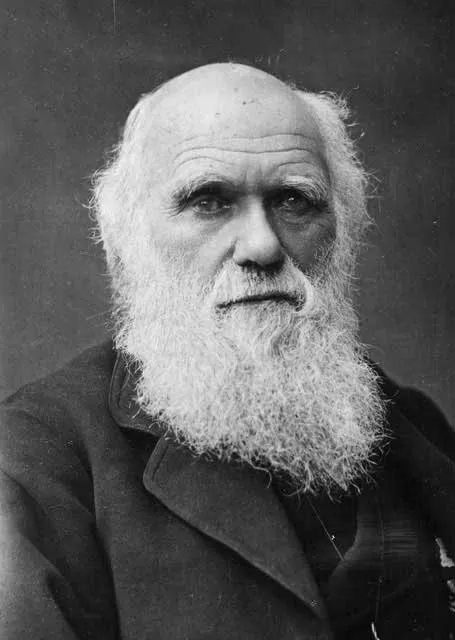
Charles Darwin speculated that speech evolved from musical expression.
Another proposal, the La-La Theory, linked language to music. Charles Darwin entertained the possibility that speech evolved from musical calls used in courtship and emotional expression. Before humans spoke, perhaps we sang?
Some modern theories echo this idea. One hypothesis suggests that, as early humans began walking upright, parents increasingly needed to soothe babies from a distance. Sing-song vocalizations, cooing and proto “baby talk” may have helped strengthen emotional bonds and eventually paved the way for speech.
Gestures, symbols and brains
Today, most scientists think no single theory fully explains language origins. Instead, language probably emerged gradually through a combination of gestures, vocalizations, facial expressions, social cooperation and increasing cognitive complexity.
Some researchers argue that language began with gestures before shifting to speech. Others believe language evolved as a tool for social bonding, allowing larger groups of humans to cooperate and share information. Still others see language as tied to the evolution of symbolic thought itself: our ability to imagine, plan, remember and communicate abstract ideas.
Biology is also a factor. Humans have developed unusually precise control over the tongue, lips and vocal tract. We have evolved specialized brain regions linked to language processing.
But anatomy alone cannot explain language. Parrots can mimic speech sounds. Many animals communicate. None, however, appear to possess grammar and symbolism on the human scale. And, frustratingly, early language leaves no evidence behind. Spoken words don’t fossilize.

Saraswati is the Hindu goddess of knowledge and speech.
That lack of evidence is one reason the topic became so controversial that, in 1866, the Société de Linguistique de Paris banned discussions about language origins altogether, dismissing the field as hopelessly speculative.
Of course, theories about language origins also appear in religion and mythology. In Greek mythology, the messenger god Hermes was associated with language and communication. In the Hindu tradition, the goddess of knowledge and speech Saraswati bestowed Sanskrit upon humanity. In the Judeo-Christian tradition, language was a gift from God, who enabled Adam to name the animals in the Garden of Eden.
These stories reflect something deeply human: our urge to explain where language came from, because language itself feels almost magical. Every theory of language origins captures a small piece of the puzzle. Imitation, emotion, rhythm, music, gesture, cooperation and symbolic thought probably all played some role.
But none can provide a complete answer. The truth is that language evolved so long ago, and likely so gradually, that we will never pinpoint a single moment when it began, unless someone invents a time machine.
The birth of language will probably remain one of humanity’s greatest unsolved mysteries. Still, the theories themselves tell us something important. Humans are always trying to explain what makes us human. And language may be the most human thing of all.
This edited article is republished from The Conversation under a Creative Commons license. Read the original article.