
Close Menu
    Facebook X (Twitter) Instagram Pinterest YouTube LinkedIn TikTok
    TopBuzzMagazine.com
    Facebook X (Twitter) Instagram Pinterest YouTube LinkedIn TikTok
    • Home
    • Movies
    • Television
    • Music
    • Fashion
    • Books
    • Science
    • Technology
    • Cover Story
    • Contact
      • About
      • Amazon Disclaimer
      • Terms and Conditions
      • Privacy Policy
      • DMCA / Copyrights Disclaimer
    TopBuzzMagazine.com
    Home»Science»500-year-old gold dental bridge is earliest known oral care of its kind in Scotland — and it likely held a fake tooth
    Science

    500-year-old gold dental bridge is earliest known oral care of its kind in Scotland — and it likely held a fake tooth

    By AdminMay 8, 2026
    Facebook Twitter Pinterest LinkedIn Tumblr Email
    500-year-old gold dental bridge is earliest known oral care of its kind in Scotland — and it likely held a fake tooth


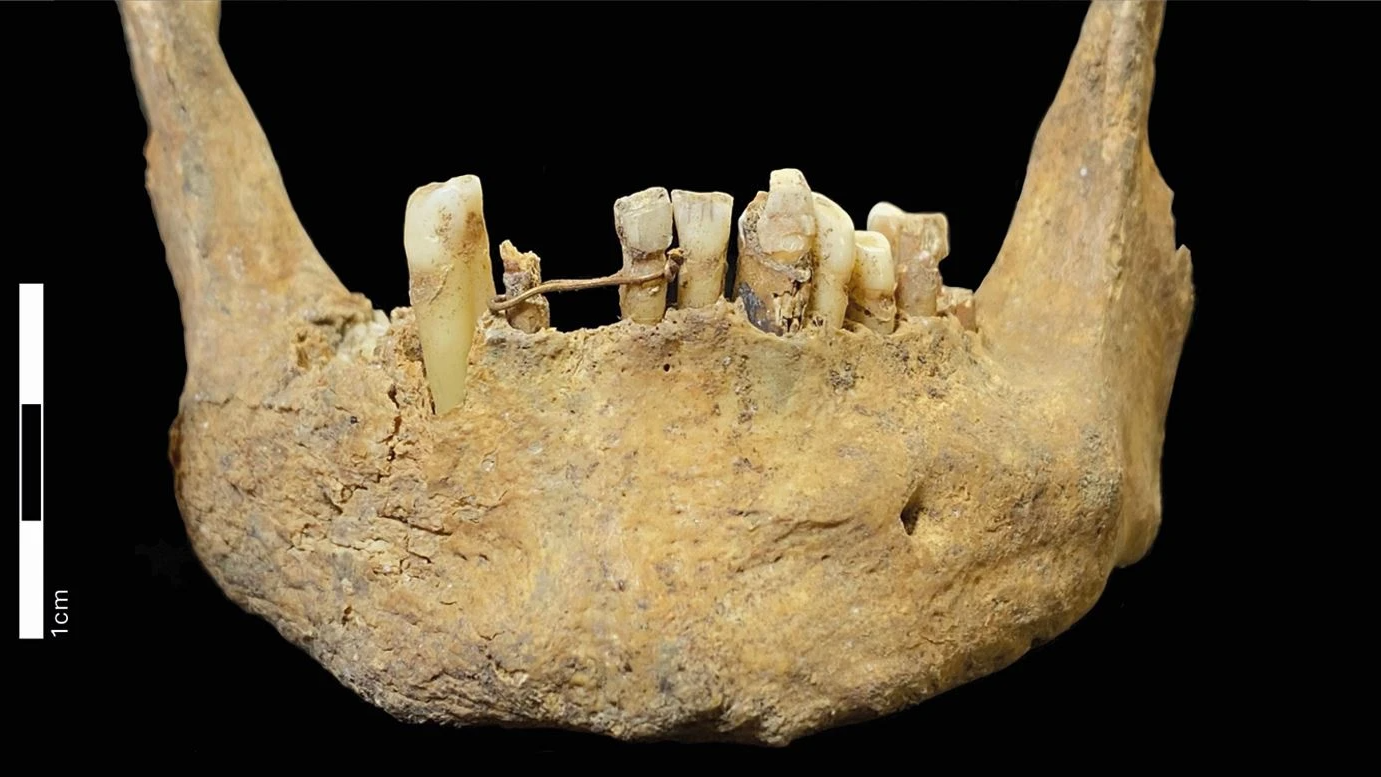
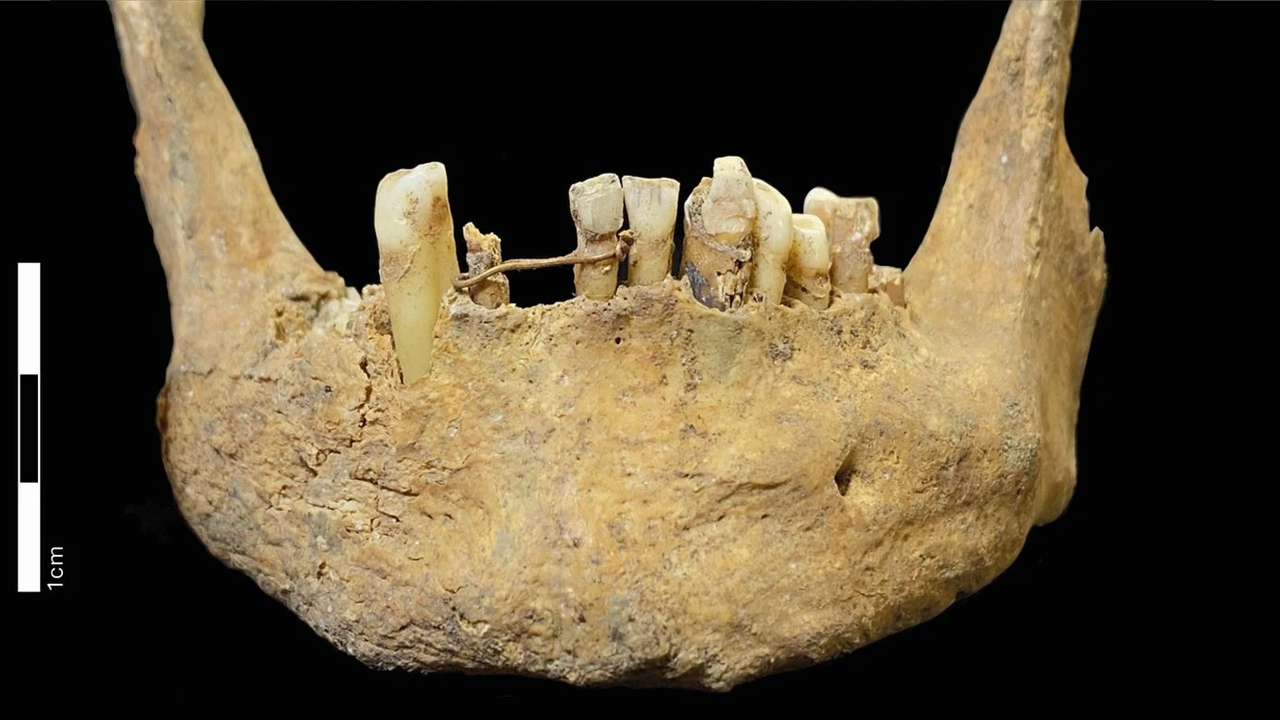
    A man’s lower jaw recovered from a medieval church in Aberdeen reveals the oldest known use of a dental bridge in Scotland, a new study finds. The gold wire, called a ligature, was installed around two teeth about 500 years ago to span the gap created by a lost tooth.

    “The application of the ligature would likely have caused some discomfort during the procedure,” Rebecca Crozier, a bioarchaeologist at the University of Aberdeen and co-author of the new study on the jawbone, told Live Science in an email. But the man, who was middle-aged when he died between 1460 and 1670, “would have most likely gotten used to the presence of the wire over time and probably stopped noticing it,” she said.

    In a study published April 24 in the British Dental Journal, Crozier and colleagues described a lower jawbone discovered as part of an excavation at the St. Nicholas East Kirk in Aberdeen, Scotland. The church, which was likely built in the 11th century and used until the Protestant Reformation in the late 16th century, contained over 900 burials and thousands of individual human bones. Although the wired jawbone was not found as part of a complete burial, the researchers could tell from the bone’s shape and the wear on the individual’s teeth that it was likely from a middle-aged man.


    You may like

    The lower jaw preserved nine teeth, as well as evidence that one of the man’s incisors — the lower right central one — had been lost during life. The man had hardened plaque on all of his teeth, cavities on three teeth, and periodontal disease from receding gums, demonstrating poor oral health. Although bad teeth were not unusual in the late medieval period, the gold wire installed around two tooth roots was noteworthy, the researchers wrote.

    A 20-karat-gold wire encircled the lower right lateral incisor and the lower left central incisor, spanning the gap caused by the loss of the lower right central incisor. The wire was looped around one tooth root and was secured by a twisted knot around the other tooth root.

    “The wire had been rubbing against the root of one of the anchoring teeth for some time,” Crozier said. “The wire was either holding in place the actual lost tooth or a prosthetic (fake) tooth.”

    Dentistry was not organized as a profession until the 19th century, the researchers wrote in the study, but barbers, healers and even jewelers practiced semiskilled dental procedures long before then, as dental fillings date back at least 13,000 years.

    Get the world’s most fascinating discoveries delivered straight to your inbox.

    In medieval Europe, securing loose teeth using wire was a well-known treatment described in several medical treatises. A recent discovery in France showed later evidence of this: An aristocratic 17th-century woman had gold ligatures around multiple teeth in her upper jaw.

    “The underlying reasons for undergoing this procedure were likely multifaceted,” the researchers wrote. While the ligature may have helped the man regain some chewing functionality, he probably underwent treatment for the sake of his appearance.

    In this time period, a person’s appearance and perceived health were linked to their moral character, so people who could afford it sought out dental treatments. In the case of the Scotsman, it is likely that the jeweler who made the gold wire also installed it, the researchers wrote.

    “It is very difficult to talk about individual experiences of pain or discomfort in someone that died hundreds of years ago,” Crozier said, but “the unstable ligatured tooth would have made actions such as biting into something hard or firm like an apple quite problematic.”

    Dittmar, J.M., Crozier, R., Cameron, A., Mann, B., Oxenham, M.F. (2026). Restorative dentistry in Early Modern Scotland: archaeological evidence of the use of a gold ligature. British Dental Journal 240: 555-559. https://doi.org/10.1038/s41415-025-9107-3


    See how much you know about gemstones with our gold and gems quiz!

    View Original Source Here

    Share. Facebook Twitter Pinterest LinkedIn Tumblr Email

    Related Posts

    Fingal’s Cave: Scotland’s ‘cave of melody’ where eerie echoes bounce off pillars of solidified lava

    May 29, 2026

    Mathematical AI helps researchers crack 50-year-old problem

    May 29, 2026

    Adequate potassium management is key to maximizing cotton yield and fiber quality, researchers reiterate

    May 28, 2026

    1,200-year-old gold hoard discovered in Saudi Arabia may have been buried by a medieval pilgrim

    May 28, 2026

    We may finally know why gold stays so shiny

    May 27, 2026

    Red shift: Study gauges salamanders' sprint speed as connected to their color

    May 27, 2026
    popular posts

    7 Harlan Coben Books That Need to Be Adapted for TV Next

    2022 Austin City Limits Festival Lineup Revealed

    Nicola Coughlan Weighs in on ‘Big Mood’ & ‘Bridgerton’s Friendship

    She-Hulk Finale Introduces the Hulk’s Son Skaar: Details

    Lollapalooza Security Guard Allegedly Fakes Mass Shooting Threat Alert

    Genetic mechanisms of coral metamorphosis identified

    Exposure to microplastic makes animals want to eat it more

    Categories
    • Books (3,886)
    • Cover Story (15)
    • Events (24)
    • Fashion (2,782)
    • Interviews (60)
    • Movies (3,182)
    • Music (3,475)
    • News (176)
    • Politics (11)
    • Science (5,037)
    • Technology (3,179)
    • Television (3,907)
    • Uncategorized (932)
    Archives
    Facebook X (Twitter) Instagram Pinterest YouTube Reddit TikTok
    © 2026 Top Buzz Magazine. All rights reserved. All articles, images, product names, logos, and brands are property of their respective owners. All company, product and service names used in this website are for identification purposes only. Use of these names, logos, and brands does not imply endorsement unless specified. By using this site, you agree to the Terms of Use and Privacy Policy.

    Type above and press Enter to search. Press Esc to cancel.

    We use cookies on our website to give you the most relevant experience by remembering your preferences and repeat visits. By clicking “Accept”, you consent to the use of ALL the cookies.
    Do not sell my personal information.
    Cookie SettingsAccept
    Manage consent

    Privacy Overview

    This website uses cookies to improve your experience while you navigate through the website. Out of these, the cookies that are categorized as necessary are stored on your browser as they are essential for the working of basic functionalities of the website. We also use third-party cookies that help us analyze and understand how you use this website. These cookies will be stored in your browser only with your consent. You also have the option to opt-out of these cookies. But opting out of some of these cookies may affect your browsing experience.
    Necessary
    Always Enabled
    Necessary cookies are absolutely essential for the website to function properly. These cookies ensure basic functionalities and security features of the website, anonymously.
    CookieDurationDescription
    cookielawinfo-checkbox-analytics11 monthsThis cookie is set by GDPR Cookie Consent plugin. The cookie is used to store the user consent for the cookies in the category "Analytics".
    cookielawinfo-checkbox-functional11 monthsThe cookie is set by GDPR cookie consent to record the user consent for the cookies in the category "Functional".
    cookielawinfo-checkbox-necessary11 monthsThis cookie is set by GDPR Cookie Consent plugin. The cookies is used to store the user consent for the cookies in the category "Necessary".
    cookielawinfo-checkbox-others11 monthsThis cookie is set by GDPR Cookie Consent plugin. The cookie is used to store the user consent for the cookies in the category "Other.
    cookielawinfo-checkbox-performance11 monthsThis cookie is set by GDPR Cookie Consent plugin. The cookie is used to store the user consent for the cookies in the category "Performance".
    viewed_cookie_policy11 monthsThe cookie is set by the GDPR Cookie Consent plugin and is used to store whether or not user has consented to the use of cookies. It does not store any personal data.
    Functional
    Functional cookies help to perform certain functionalities like sharing the content of the website on social media platforms, collect feedbacks, and other third-party features.
    Performance
    Performance cookies are used to understand and analyze the key performance indexes of the website which helps in delivering a better user experience for the visitors.
    Analytics
    Analytical cookies are used to understand how visitors interact with the website. These cookies help provide information on metrics the number of visitors, bounce rate, traffic source, etc.
    Advertisement
    Advertisement cookies are used to provide visitors with relevant ads and marketing campaigns. These cookies track visitors across websites and collect information to provide customized ads.
    Others
    Other uncategorized cookies are those that are being analyzed and have not been classified into a category as yet.
    SAVE & ACCEPT