
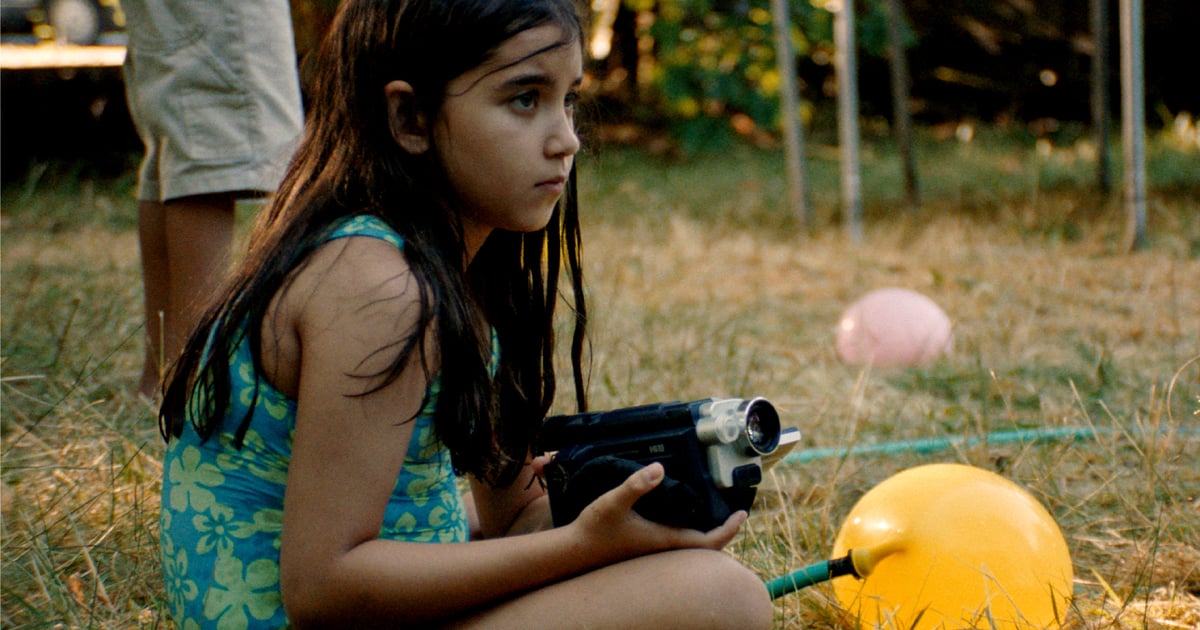

The films of Sophy Romvari are slippery things. The Canadian filmmaker already has something of a cult following among very-online cinephiles, despite only just having made her debut feature. The film, Blue Heron, is a sun-bleached portrait of a dysfunctional family of six, told through a series of hazy pre-millennial memories following their migration from Hungary. The territory isn’t exactly new for Romvari, whose short films – notably 2020’s Still Processing and Remembrance of József Romvári, as well as Nine Behind (2016) – also employ her own family history to establish a cinematic space between docufiction, autobiography and fantasy.
Blue Heron is titled after a bird that, one diegetic nature programme tells us, has an increasingly weaker bond with its children relative to their age. Troubled teen Jeremy (Edik Beddoes) is the older brother to Henry (Liam Serg), Felix (Preston Drabble) and eight-year-old Sasha (Eylul Guven) – Romvari’s self-insert from whose perspective the story is primarily delivered.
Get more Little White Lies
Their parents (Iringó Réti and Ádám Tompa) struggle to control Jeremy – the only child of the four from their mother’s first marriage – as the ways in which he acts out become more and more concerning. Lanky, sullen and mostly non-verbal, Jeremy swings wildly between being cautiously playful and willfuly destructive. The professionals they consult are unable to provide a diagnosis, or really any actionable guidance, though they note Jeremy shows signs of oppositional defiant disorder (ODD): a condition that encompasses a pattern of anger and irritability toward parents and other authority figures.
In the film, Sasha’s father tenderly documents the antics of his young children, keeping a camcorder trained on them as they bounce on trampolines and play in the sprinklers. The mother directs the blame for Jeremy’s actions inward: “Maybe it was me,” she says over the phone, as the narrative takes a turn for the formally experimental around the film’s halfway mark. “Maybe, with someone else, he would be a superstar.”
The film then dips into a timeline involving an older version of Sasha (Amy Zimmer), who also narrates the first scene — a Virgin Suicides-esque introduction that also uses an omniscient narrator and overlays a series of white sketches, in this case several maps that were hand-drawn by Romvari’s own brother. Blue Heron is rich in these kinds of nostalgic flourishes, almost avant-garde in its meticulous attention to sensory detail. Despite feeling like a fairly typical genre exercise in some ways, it’s a film that resists easy answers and categorisation. Contemporary cinematic works like this are only made possible when the stars align in terms of funding, talent, a degree of luck and a singular vision.
The proposition behind Blue Heron is a deceptively simple one: that childhood memories have a texture, that your personal history is really a series of incomplete dreams. So, would you like to sit with some of them here and now, in the dark?