

Despite its entirely digital construction and sometimes uncanny mix of 24 and 48FPS 3D, Avatar: Fire and Ash is full of messy human impulse which place it well above its big budget Hollywood contemporaries. As fellow Little White Lies contributor Mark Asch said, it’s funny to think of James Cameron as a traditionalist when his work has long-been technology-forward (“Recent years have seen so many former enemies upgraded to auteur status.“) but it’s those beats which make Avatar feel both old school and curiously new at once. Picking up pretty soon after its predecessor director James Cameron sticks to archetypical figures as he did in The Way of Water, but with some fascinating complications enabled by various parts of Avatar’s wild premise, such as the (formerly) white US marine Jake Sully continuing to live as a blue man with dreadlocks.
Some of the best tension comes from a brief interrogation of Jake Sully’s (Sam Worthington) reconciliation with his dual identity – indeed Fire and Ash comes with a lot of contradictions which give it the spark required to differentiate itself from its predecessor, especially as much of its structure and action design circles similar ideas about intertwined environmentalism and resistance to colonialism (told through an evocation of international indigenous struggles against white invaders). The third film follows directly on from The Way of Water, with the death of Jake and Neytiri’s (Zoe Saldana) eldest son, Neteyam (Jamie Flatters), still hanging over everyone.
Get more Little White Lies
An early eyeroller of a line – “The fire of hate leaves only the ashes of grief” – hints at incoming “cycle of violence” clichés but the film has more interesting stories about characters struggling to break out of the orbit of certain structures. The patriarch of the Sully family deals with the loss with momentum, literally combing the wreckage of the very battle against the invading Resource and Development Administration (or RDA) that claimed his boy for anything of use.
As well as the set-up of Na’Vi spirituality against often cold human pragmatism, it’s through this moment that Fire and Ash sets up a compelling tension – between the blockbuster pyrotechnics Cameron is known for and an apparent hatred of the gun. “To touch them poisons the heart,” one says, and the film goes on to demonstrate the number of ways how: including the Javert-esque Colonel Miles Quaritch (Stephen Lang), recently reborn in an avatar body, deciding to arm a group of fire-worshipping Eywa-agnostics who murder and pillage the other Na’Vi tribes.
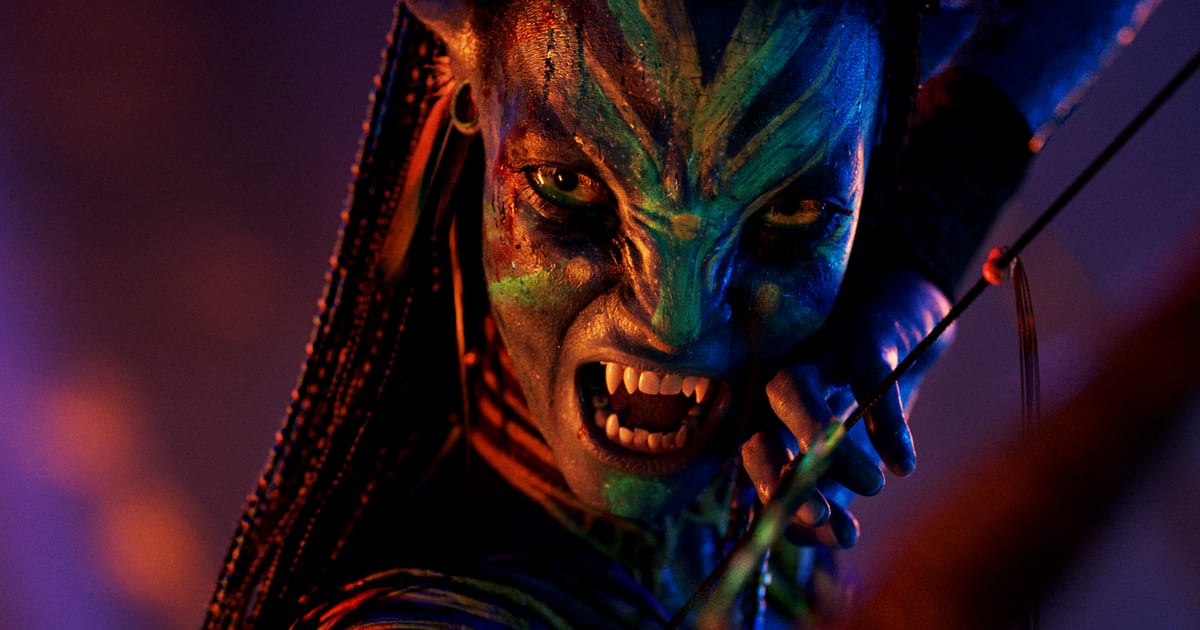
Speaking of the fire-worshippers, their leader Varang (Oona Chaplin) is a highlight of the film both through the sensuality and swagger of the captured performance as well as the striking difference with the other Na’Vi seen so far. No interest in the contemplative, harmonious spirituality of the other clans, only earthly vices and pleasures (and violence) – which ties up in an amusingly volatile manner with Quaritch’s own soul-searching. After raiding a trader’s convoy the Sully’s have stowed away on, Varang strikes up a rivalry with Neytiri, and though never spoken aloud, their stark ideological differences give a little more bite to the ensuing aerial dogfights.
It’s at once a movie thoroughly disgusted by America and its violent exports, but also rather traditional in its use of Biblical allegories (including immaculate conception) and having the Na’Vi nuclear family at its centre. Regarding the former, the film takes aim at sneering news media who act as state apparatus, demonising the “traitor” Jake Sully, as well as delivering a few choice thoughts about guns and colonialist history. Meanwhile, Quaritch’s arc perhaps feels the most contemporary – a few people have already made comparisons to the hypocrisy of One Battle After Another’s Colonel Lockjaw in how he covets women from the people he actively works to destroy.
There are some smaller ironies to go along with these – like how Spider, the Tarzan-esque human adoptee of the family having his body “colonised” by flora from Pandora which would potentially allow humans to fully colonise the planet themselves.
Appropriately, it’s also a film that sometimes also feels at war with its own projection method, which wavers between immersive clarity and display TV uncanniness. The Avatar films are effectively animated ones with the sheer amount of motion capture and digital backgrounds at play. The verisimilitude of Pandora and its inhabitants still feels like a magic trick even as there’s still no fully getting used to high frame rate 3D, especially through many first person perspectives.
But the mind for satisfying action beats – not to mention an incredibly satisfying bloodlust when it comes to levying justice towards colonialist pricks – keeps everything level, enough so that the prospect of a fourth and fifth film doesn’t seem like its own spiral of self-destruction. Some will find the earnest silliness which ties a lot of Fire and Ash’s beats together tiresome, but – along with the work of some very gifted digital artists – it’s what keeps them feeling real and not just empty capitalisation on a billion dollar box office.