
National Weatherperson’s Day honors the science, skill and judgment behind forecasts designed to keep us safe. But history — and fiction — are full of moments when the warning was issued, the data was sound, and the danger still went unheeded. Not because people didn’t hear it, but because the threat felt abstract, manageable or temporary.
The books below explore those moments across six weather-related categories, pairing one novel and one work of nonfiction in each. Together, they reveal a recurring human pattern: we underestimate duration and intensity, assume the worst won’t happen here, or trust that we’ll have more time before conditions turn deadly.
Across eras, genres and weather types, these stories demonstrate that the forecast is only the beginning. Whether the danger arrives as heat, wind, water or cold, the real test lies in what happens between the warning and the impact. On National Weatherperson’s Day, these books remind us that surviving weather disasters isn’t just about recognizing the danger signs — it’s about believing them soon enough to act.
EXTREME COLD
The Long Winter by Laura Ingalls Wilder
While meteorology was very rudimentary in the late 1800s, an early blizzard, repeated storms and mounting supply shortages should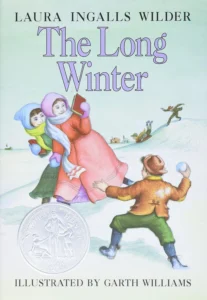 have warned the Dakota frontier that this winter would be different. Still, in this Newbery Award-winning book in the Little House series, the town of De Smet clings to routine and optimism, convinced the cold will break as it always has. Instead, the season stretches on relentlessly, turning endurance into a daily calculation of survival. Wilder’s understated prose captures how danger doesn’t always arrive dramatically — it can settle in, week after freezing week, while people hope for relief that never comes. Of course, in true Wilder style, there’s a happy, heartwarming ending, but the peril runs like an undercurrent beneath the surface.
Amazon | Barnes & Noble | Bookshop
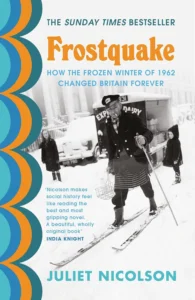
Frostquake: The Frozen Winter of 1962 and How Britain Emerged a Different Country by Juliet Nicolson
 Remember The Dream Academy hit, “Life in a Northern Town”? “In winter 1963, it felt like the world would freeze with John F. Kennedy and the Beatles …” Well, this was the winter they were singing about.
The winter of 1962–63 began like any other, but Britain soon found itself locked in a ten-week deep freeze that overwhelmed infrastructure and daily life. Early cold snaps were treated as temporary, and preparations assumed a quick thaw that never came. Drawing on firsthand accounts and social history, Frostquake shows how extreme cold became a national stress test — one made worse by the belief that winter hardship would soon pass. It also became a catalyst for some of the most profound cultural changes of the mid-20th century.
Amazon | Barnes & Noble | Bookshop
BLIZZARDS
Snowblind by Ragnar Jónasson
In a remote Icelandic town, a blizzard closes roads, cuts off communication and exposes how isolation can turn deadly. The storm is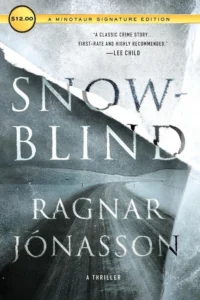 forecast, but its consequences — total confinement and delayed help — are underestimated. As bodies are discovered, tensions rise and secrets surface. The weather becomes both barrier and accomplice in this twisty crime thriller, the first book in Jonasson’s Dark Iceland series.
Amazon | Barnes & Noble | Bookshop
The Children’s Blizzard by David Laskin
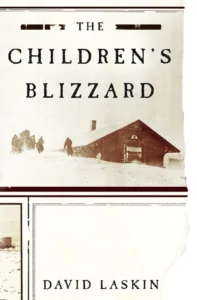 It was a mild January day in 1888 on the newly settled Great Plains, so warm that many parents even sent their children off to school without coats or gloves. This was to change dramatically by afternoon. As their teachers dismissed early warning signs to send the children home, temperatures began to plummet, and the winds exploded. By the next morning, around 500 people, many of them schoolchildren, would lie dead in the drifting snow in one of the deadliest blizzards in American history. Laskin’s account shows how a narrow window of misjudgment can be catastrophic, with results heartbreakingly cruel.
Amazon | Barnes & Noble | Bookshop
HURRICANES
Odds Against Tomorrow by Nathaniel Rich
A risk analyst — not a meteorologist per se but a gifted mathematician — models worst-case scenarios for a shadowy financial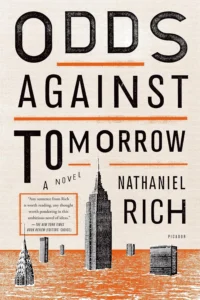 consulting firm in a ploy to sell indemnities. Even so, he watches his warnings dismissed as paranoia — until a hurricane floods New York City almost exactly as predicted. Rich’s darkly satirical novel skewers a culture that treats forecasting as an intellectual exercise rather than a call to action.
Amazon | Barnes & Noble | Bookshop
Isaac’s Storm: A Man, a Time, and the Deadliest Hurricane in History by Erik Larson
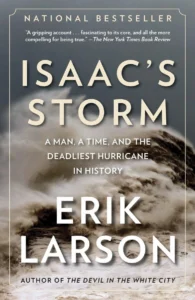 I first became fascinated by the 1900 Galveston hurricane after reading an account of eight orphans and their caretaker, bound together by rope in a last-ditch effort to prevent them from being separated, being swept out to sea. The story only gets more harrowing and horrifying from there.
Tragically, early meteorological signals and alternative forecasting methods pointed to disaster but were ignored by the local meteorologist, Isaac Cline. His confidence in existing knowledge — and his resistance to outside expertise — led him to issue muted public warnings. The result was the deadliest natural disaster in U.S. history.
Amazon | Barnes & Noble | Bookshop
TORNADOES
Night of the Twisters by Ivy Ruckman
Based on the 1980 Grand Island, Nebraska, tornado outbreak, this middle-grade novel captures the confusion of overlapping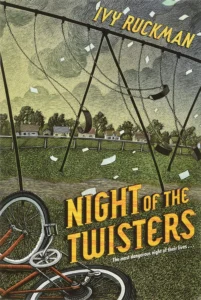 warnings and the disbelief that sets in when danger arrives repeatedly. One Tuesday evening in June, during an otherwise typical tornado watch, the sirens begin to wail, and 12-year-old Dan Hatch, his baby brother and his best friend Arthur dash to the cellar. Little do they know this will not be the first moment of peril they’ll encounter that night. Through a child’s eyes, the supercell storm becomes terrifying not just for its power, but for how hard it is to process in real time.
Amazon | Barnes & Noble | Bookshop
What Stands in a Storm: A True Story of Love and Resilience in the Worst Superstorm in History by Kim Cross
 Covering the 2011 tornado outbreak, Cross shows how accurate, timely warnings still collided with human hesitation, warning fatigue and uncertainty about sheltering. Yet again, it was a case where science was right, but belief lagged behind. Over the course of three days, 358 tornadoes touched down in 21 states from Arkansas to New York, destroying entire towns. But nowhere would the death toll be higher than in Alabama, and this is where Cross focuses her lens on a community devastated by personal loss yet also redeemed by the everyday heroism of neighbors and strangers.
Amazon | Barnes & Noble | Bookshop
HEAT WAVES
The Ministry for the Future by Kim Stanley Robinson
This sci-fi novel opens with a devastating heat wave in India — one scientists had long warned was possible. The catastrophe isn’t unforeseeable; it’s the result of delay, denial and global inaction. Robinson treats heat not as background, but as a lethal force that demands systemic change. Yet it’s not all doom and gloom. Through fictional eyewitness accounts, we watch as members of society come together to launch creative, cooperative plans to remedy the climate crisis.
Amazon | Barnes & Noble | Bookshop
Heat Wave: A Social Autopsy of Disaster in Chicago by Eric Klinenberg
 In mid-July 1995, it was so hot in Chicago that the pavement buckled and the power grid failed from overuse, leaving residents without electricity for days. In Klinenberg’s forensic examination of one of the deadliest heat waves in U.S. history, he reveals how inaccurate forecasts, social isolation and political hesitation combined to kill over 700 people in the course of a week, many of them seniors living in the poorest neighborhoods in the city. It’s an example of how heat becomes deadly not just through temperature, but through social, political and institutional neglect.
Amazon | Barnes & Noble | Bookshop
RAINSTORM FLOODS
Flood by Stephen Baxter
In this speculative novel, four hostages are released from a group of religious extremists after five years of captivity. But the world as they know it has changed dramatically. Relentless rainfall triggers global flooding that scientists warned was possible — but too extreme to be believed. The danger lies not in a single storm, but in accumulation, as rain keeps falling and assumptions collapse.
Amazon | Barnes & Noble | Bookshop
Rising Tide: The Great Mississippi Flood of 1927 and How It Changed America by John M. Barry
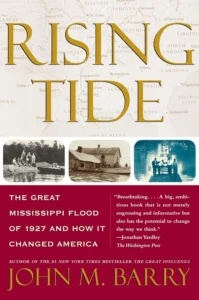 The Great Mississippi Flood of 1927 followed weeks of heavy rain and clear river-gauge warnings. Officials trusted levees to hold and delayed hard decisions. The flood destroyed the homes of almost one million people, drove hundreds of thousands of African Americans north, and transformed American society and politics forever. Barry’s definitive account demonstrates not only the dangers of underestimating the weather but also how those dangers are amplified when racism and political turmoil are added to the equation.
Amazon | Barnes & Noble | Bookshop