
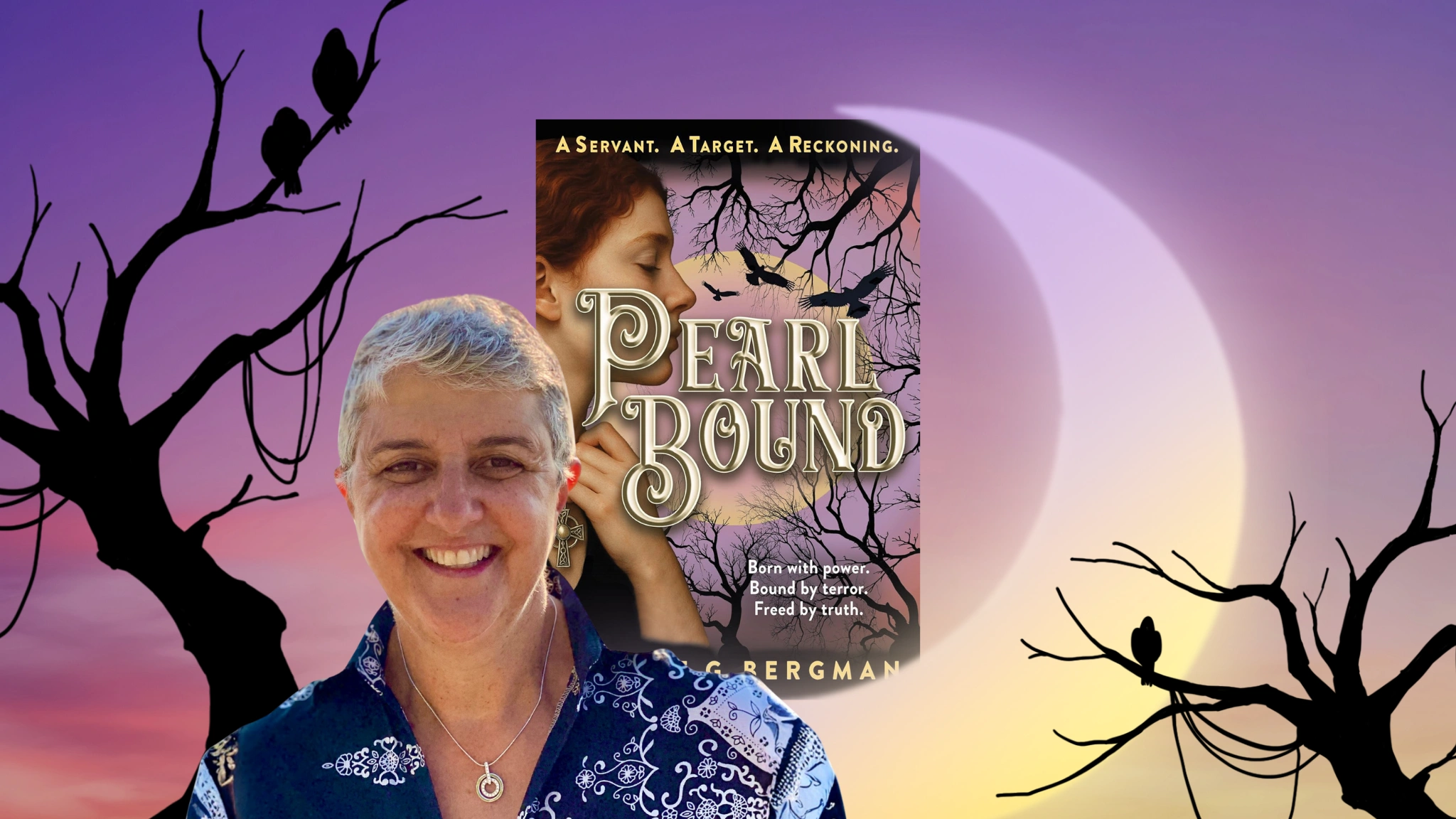
- What inspired you to set Pearl Bound in late winter 1883 in Upstate New York, and how does the historical context influence the story?
I chose late winter 1883 and then 1899 in upstate New York because the Gilded Age mirrors our own moment in unsettling ways—extreme income inequality, unchecked power concentrated in the hands of a few and a social order that rewards cruelty behind a veneer of refinement. That tension felt dramatically fertile.
Setting the story in this period allowed me to explore what life looked like for a working-class woman—an immigrant, no less—trying to survive inside a system designed to exploit her. The lack of laws, the labor conditions, the social hierarchies were overt then, but the constraints on women’s autonomy, safety and economic power are not as distant as we like to believe. The historical context isn’t decorative; it’s the engine of the story. The wealth of the robber barons of that era, and the rigid class and gender boundaries all intensify the danger and underscore how little protection society offered women regardless of whether they were considered respectable or not.
2. Eve demonstrates unusual abilities that unsettle her mother. How do you approach the theme of the supernatural in the context of family dynamics in the novel?
I approached the supernatural in Pearl Bound less as spectacle and more as inheritance. Eve’s abilities aren’t an external disruption to the family—they’re an extension of it. Families pass down far more than genetics: they transmit fear, silence, survival strategies and unresolved trauma. In that sense, the supernatural becomes a language for what can’t be safely spoken.
Her mother’s unease isn’t just fear of the unknown; it’s fear of recognition. Eve’s abilities threaten to surface buried histories and truths that have been suppressed for generations. That tension—between protection and control, love and terror—felt truer to real family dynamics than a simple embrace or rejection of the uncanny.
By framing the supernatural through lineage and maternal anxiety, I wanted to explore how inherited trauma doesn’t disappear—it mutates. What one generation learns to hide, the next may be forced to confront, often at great cost.
3. The characters experience significant emotional turmoil throughout the story. Can you discuss how you developed the complex relationships between Eve, her mother and Sean?
In the opening chapters, I was focused on establishing isolation as a lived condition, not a mood. Eve, her mother and Sean are immigrants in a new country with limited resources, little social protection and no margin for error. That pressure shapes every interaction between them. Love exists, but it’s constrained by fear, exhaustion and the constant threat of displacement.
I built their relationships around what each character needs versus what they are capable of giving. Eve’s mother operates from survival and containment; Sean from loyalty and obligation; Eve from longing and a desire to be seen. Those competing impulses create emotional fault lines that deepen as the story progresses.
The turmoil comes from intimacy under strain. When people have only each other and no safety net, affection can easily turn into control, silence or sacrifice. Rather than smoothing those edges, I leaned into them—because for families living on the margins, emotional complexity isn’t a luxury, it’s a consequence of survival.
4. Your book intertwines elements of realism and mystery. What challenges did you face in blending these genres, and how did you overcome them?
The central challenge was escalation—how to let the magical elements evolve without breaking the internal logic of the world. I wasn’t interested in magic as a sudden rupture from reality; I wanted it to feel unsettling precisely because it obeys rules, even if the characters don’t fully understand them at first.
To manage that balance, I treated the mystery and the supernatural as systems with consequences. Each new development raises the stakes in a concrete way—socially, emotionally or physically—rather than existing for atmosphere alone. The question was never “What can the magic do?” but “What does it cost, and who pays for it?”
Grounding those moments in realism—class constraints, bodily danger, social fallout—helped keep the story coherent as it grew darker. If the logic held, the mystery could deepen without tipping into abstraction, and the horror could emerge from inevitability rather than spectacle.
5. The portrayal of women’s roles and power dynamics plays a crucial part in Pearl Bound. How do you feel this reflects your own experiences or views on gender and independence?
The power dynamics in Pearl Bound are inseparable from my own lived experience. I’m a woman, an immigrant to the United States, Jewish and a lesbian—identities that carry a long history of being scrutinized, constrained or legislated against. That awareness shapes how I write women navigating systems that were never designed to protect them.
I’m interested in independence not as a triumphal arc, but as something hard-won and often punished. The women in this novel are judged not just for what they do, but for what they desire, what they refuse and what they survive. That mirrors the reality of being “othered,” where autonomy is frequently mistaken for threat.
Rather than writing power as something granted, I wanted to show it as something claimed—sometimes quietly, sometimes at great personal cost. The historical setting sharpens that truth, but the dynamics themselves remain painfully contemporary.
6. Given your background in screenwriting, how does this influence your writing style and storytelling approach?
My screenwriting background deeply shaped how I approached the novel. In screenwriting, the fundamental rule is show, don’t tell, and that discipline carried over directly. I think in sequences, momentum and visual logic, so many scenes in Pearl Bound began as fully realized cinematic moments that naturally translated into chapters.
What the novel form gave me was access to interiority. The external architecture—the pacing, the reveals, the physical movement through space—was already there. Writing prose allowed me to layer in the inner lives of the characters: their fears, desires, rationalizations and contradictions. That interior voice adds psychological depth without sacrificing forward motion.
The result is a story that moves visually and structurally like a film, but with the emotional density and interior complexity that only a novel can sustain.
7. What messages or themes do you hope readers take away, particularly regarding personal destiny and the bonds of family?
At its core, Pearl Bound argues that destiny is not something bestowed—it’s something negotiated, often under duress. I wanted to explore the idea that women can take a stand and make choices, even deeply unpopular ones, in order to live truthfully. Those choices don’t come without cost, and the novel doesn’t pretend otherwise.
Family bonds are central because they’re where love and obligation collide most fiercely. Loyalty can protect, but it can also imprison. The story asks whether preserving those bonds is always the highest good, or whether breaking from them is sometimes the only way to survive.
If there’s a takeaway, it’s that autonomy isn’t rebellion for its own sake—it’s an act of moral clarity. Choosing oneself, especially in a world determined to deny that right, is both a risk and a form of inheritance in its own right.