
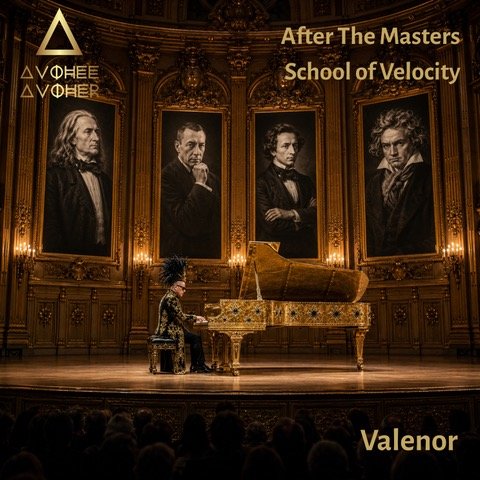
Every pianist who sits down at the keyboard sits down with ghosts. Three centuries of composers and virtuosos have shaped what those 88 keys can say, and their shadows fall across every note played today. Most musicians spend their lives trying to honor those ghosts. Avohee Avoher has decided to have a conversation with them. His thrilling new composition, “Valenor,” arrived this September as the opening chapter of After the Masters – School of Velocity, an ambitious cycle of original works that asks one daring question: once you have absorbed everything the great masters left behind, where do you go next?
For Avoher, that question is personal. His own pianistic lineage traces directly back to Franz Liszt, passed from teacher to student across generations until it landed in his hands. That kind of inheritance could easily become a museum piece, something to be polished and protected. Avoher treats it instead as a launching pad. Liszt and Sergei Rachmaninoff, the two giants whose influence runs deepest through this project, never simply repeated what came before them. They expanded what the piano could do, and they did it without ever sacrificing feeling. Avoher is following their example rather than their exact footsteps.
You understand that the moment “Valenor” begins. There is no polite introduction. A minor-key motif takes off like something being chased, notes tumble across the keyboard, and the rhythm keeps slipping out from under your feet as the harmonic tension climbs higher and higher. It plays like a film score for a movie that exists only in your head. Is it a pursuit? An escape? A burst of pure determination? Then, just when the storm seems unstoppable, it breaks. The music suddenly turns tender and exposed, almost haunting, as if reaching for something just out of reach. And then, just as suddenly, it is off and running again.
That push and pull between speed and stillness, power and fragility, is what lifts “Valenor” far above a mere showcase of technique. Make no mistake, the piece is fiendishly demanding. But virtuosity has always carried a trap: the faster the fingers fly, the easier it is for audiences to watch the hands and forget the heart. Avoher turns that equation on its head. In his music, speed creates urgency, shifting rhythms create unease, and a sudden hush creates vulnerability. Technique is not the point. It is simply one more language for emotion.
Longtime listeners will recognize the thread connecting this new work to Avoher’s earlier cycle, 12V, in which he explored the human experience through twelve emotional “voltages” and invited listeners to bring their own memories and meanings to the music. “Valenor” carries that same generous spirit. There is no official story behind it, and that is entirely by design. One listener may hear fear, another ambition; one may find longing in the quiet passages, another relief. Avoher provides the emotional signals and trusts his audience to follow them wherever they lead.
The recording itself received its finishing touches at the legendary Abbey Road Studios, with mastering by Stefan Brown, giving every thunderous run and every whispered phrase the room it deserves.
And “Valenor” is only the beginning. Avoher envisions After the Masters – School of Velocity as a cascading series of releases that will move steadily from solo piano into bolder, more experimental territory, including original compositions written for two pianos. That is where the title truly comes alive. Velocity, in Avoher’s world, is not simply about playing fast. With two instruments, musical ideas can race side by side, chase one another, collide and break apart. One pianist can plant a theme while the other interrupts it, reshapes it or tears it down. The piano stops being a solitary voice and becomes a conversation, and sometimes a glorious argument.
Calling a project After the Masters takes nerve. It practically dares the listener to ask what could possibly follow composers whose music has endured for centuries. But Avoher understands something the masters knew themselves: tradition stays alive only when it is allowed to move. With “Valenor,” he tips his hat to the giants behind him, then turns his face toward everything still ahead. History sits on one side, possibility on the other, and between them sits a pianist with 88 keys and the freedom to decide what happens next. If this opening chapter is any indication, what happens next is going to be extraordinary.
“Valenor” by Avohee Avoher is available now on major streaming platforms.
Official Website:
https://avohee.com/
Listen on Spotify:
https://open.spotify.com/artist/7qmylYYDrduXxzjHFkfmai