
Close Menu
    Facebook X (Twitter) Instagram Pinterest YouTube LinkedIn TikTok
    TopBuzzMagazine.com
    Facebook X (Twitter) Instagram Pinterest YouTube LinkedIn TikTok
    • Home
    • Movies
    • Television
    • Music
    • Fashion
    • Books
    • Science
    • Technology
    • Cover Story
    • Contact
      • About
      • Amazon Disclaimer
      • Terms and Conditions
      • Privacy Policy
      • DMCA / Copyrights Disclaimer
    TopBuzzMagazine.com
    Home»Science»A giant cosmic ‘fart’ is making a wobbling zombie star repeatedly flash us, ‘groundbreaking’ observations reveal
    Science

    A giant cosmic ‘fart’ is making a wobbling zombie star repeatedly flash us, ‘groundbreaking’ observations reveal

    By AdminSeptember 27, 2026
    Facebook Twitter Pinterest LinkedIn Tumblr Email
    A giant cosmic ‘fart’ is making a wobbling zombie star repeatedly flash us, ‘groundbreaking’ observations reveal


    An enormous, ongoing cosmic “fart” is causing a mysterious zombie star to flare up repeatedly, shining bright pulses of X-rays toward Earth, a new study reveals. The unprecedented observations shed light on how some of the universe’s most extreme objects interact with one another.

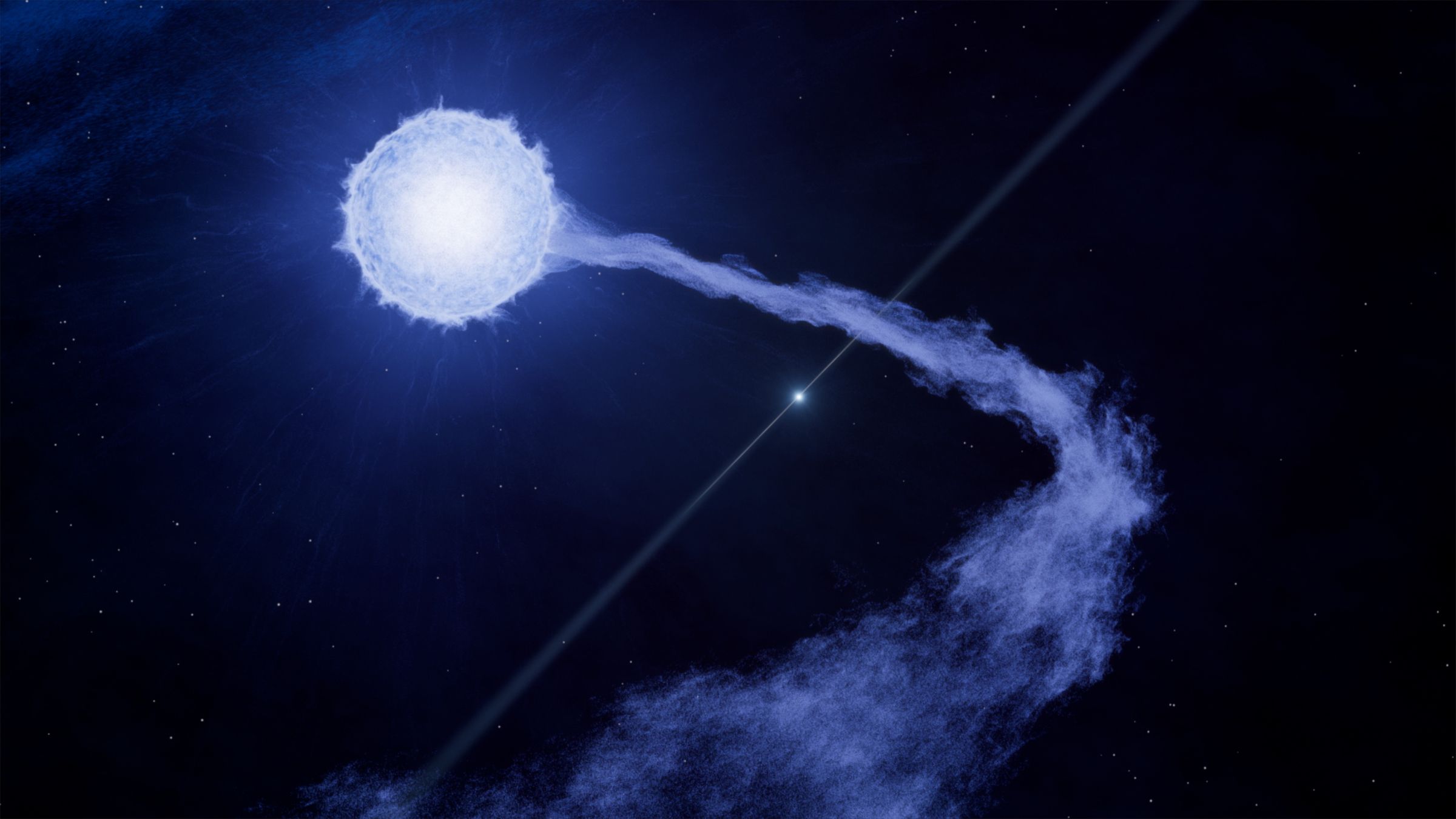
    Around 13,000 light-years from Earth lies an unusual binary star system, known as BP Crucis. It contains a blue hypergiant star roughly 60 times larger than the sun, dubbed Wray 977, alongside a neutron star — the undead and ultradense remains of a star that exploded via a supernova — that astronomers have labeled GX 301-2.

    This stellar “zombie,” which contains the same mass as our home star packed into an object roughly 12 miles (20 kilometers) across, is a type of neutron star called a pulsar, which has an extremely powerful magnetic field and spins rapidly. This means it constantly shoots out a wobbling beam of powerful electromagnetic radiation, including X-rays, into the cosmos at regular intervals. When this beam aligns with Earth — approximately every 11 minutes, in the case of GX 301-2 — our planet’s telescopes detect a flash.

    However, unlike most other known pulsars, GX 301-2 also emits frequent X-ray flares (separate from the regular beams), which cause it to shine much brighter at repeated intervals. And, until now, researchers were unsure why.

    In the new study, published Sept. 18 in the journal Science Advances, researchers used the X-ray Imaging and Spectroscopy Mission (XRISM) — a space telescope jointly operated by NASA and the Japan Aerospace Exploration Agency — to take a closer look at BP Crucis. In doing so, they discovered that the neutron star flared up every time it passed through a giant plume of “stellar wind plasma” shooting out of its hypergiant partner.

    You may like

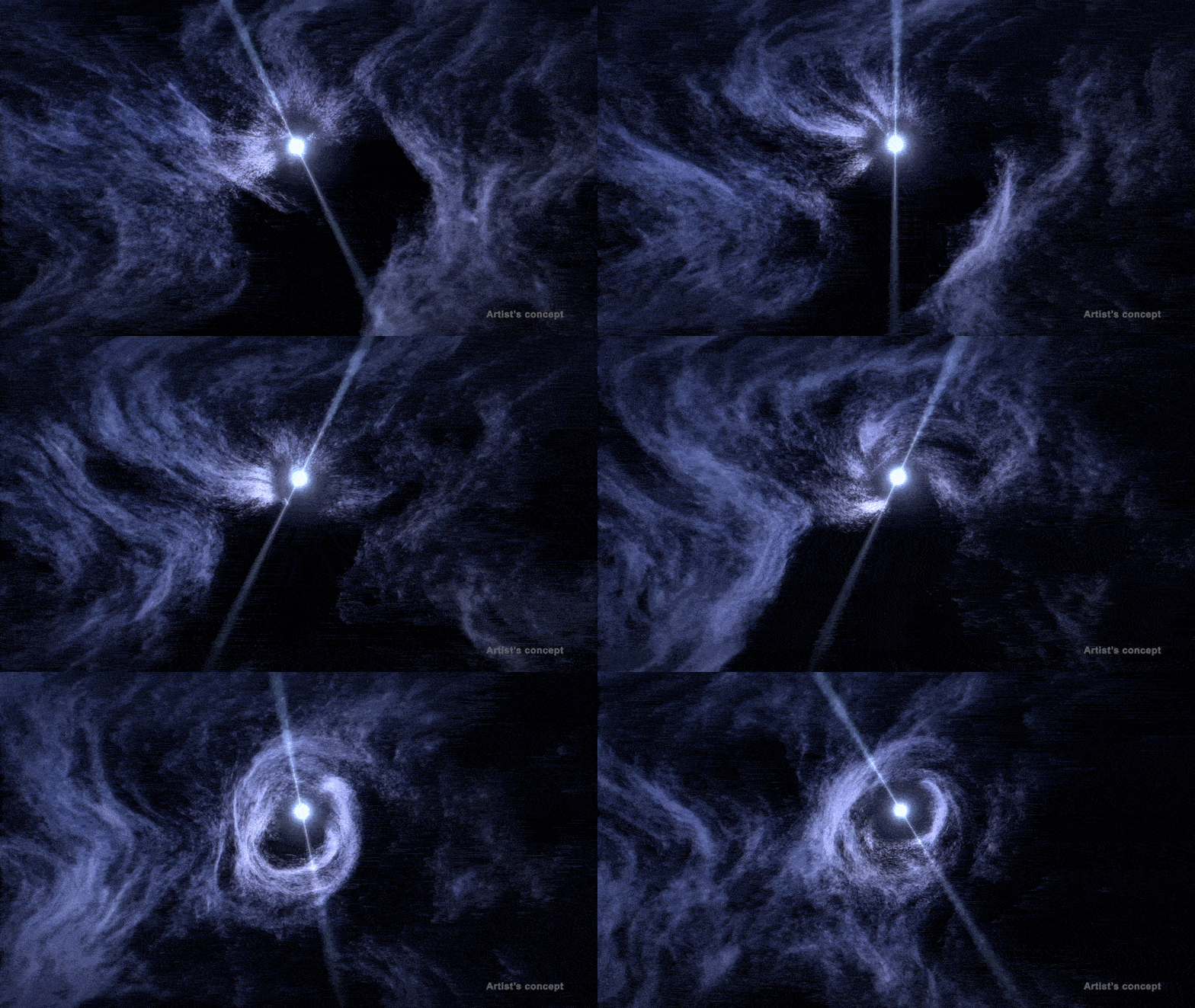
    Looped animation showing how plasma falls onto the neutron star as it passes through the plume

    New observations reveal that GX 301-2 flares up when it passes through the stellar wind plume ejected by Wray 77. This animation shows how the plasma swirls around and interacts with the wobbling neutron star.

    (Image credit: NASA’s Goddard Space Flight Center/Conceptual Image Laboratory)

    This is the first time that researchers have ever detected this type of stellar material interacting with a neutron star, or with any other similar stellar remnant, opening the door to studying similar systems in the future.

    “We’ve never before seen clear indications of wind plasma falling onto a compact object,” study first author Roi Rahin, a researcher at the University of Maryland, Baltimore County (UMBC) and NASA’s Goddard Space Flight Center, said in a statement. “We can now test our understanding of these processes in much greater detail.”

    Get the world’s most fascinating discoveries delivered straight to your inbox.

    Whoever smelt it … explodes?

    All stars that actively burn via nuclear fusion release streams of radiation and charged particles known as stellar wind. The sun emits such a stream, known as the solar wind, which can trigger vibrant aurora displays near Earth’s poles.

    However, massive stars like Wray 977 blow stellar winds that are much more extreme. The blue hypergiant emits a single giant plume of concentrated ionized gas, or plasma, that spills out at around 335,000 mph (540,000 km/h). (Scientists think the stellar wind is likely sculpted into a single, concentrated plume due to the gravitational effects of the star’s ultradense neighbor.)

    GX 301-2 circles Wray 977 every 41.5 days and experiences its X-ray flares when it reaches its closest and farthest points from its partner, with the strongest flares occurring at its closest point. As a result, researchers had long suspected that the flares occurred when the neutron star passed through the stellar wind plume. However, they had no way of proving this without more evidence.


    What to read next

    A graph showing the X-ray spectrum of the neutron star

    XRISM was able to capture detailed spectra of GX 301-2 and Wray 77’s plasma plume, allowing the researchers to accurately simulate how the stellar wind material interacted with the neutron star.

    (Image credit: NASA’s Goddard Space Flight Center, JAXA/NASA, Rahin et al. 2026)

    During a 16-hour observation period coinciding with one of the neutron star’s flares, researchers used XRISM to capture highly detailed X-ray spectra, revealing “rapidly changing emission and absorption lines” that showed how the plume ebbed and flowed around GX 301-2, NASA representatives wrote.

    “We could see how the dense stream of plasma acts very close to the neutron star,” study co-author Nazma Islam, an astronomer at the Manipal Centre for Natural Sciences in India and formerly a researcher at UMBC and NASA Goddard, said in the statement. “It was clear that these observations were groundbreaking, but at the same time this meant the analysis had to be especially detailed.”

    Using this data, the researchers could simulate exactly how the plasma fell onto and swirled around the passing neutron star. When enough stellar material has accumulated on its surface, the stellar zombie explodes, unleashing the bright flashes we can detect on Earth.

    The team now hopes to use XRISM to study future flaring events to better understand the relationship between GX 301-2 and Wray 977’s windy plume.

    “The BP Crucis system is an ideal laboratory for studying wind-fed pulsar accretion,” Brian Williams, XRISM project scientist at NASA Goddard, said in the statement, and XRISM is “an ideal instrument for advancing our understanding of the processes involved.”

    Rahin, R., Ballhausen, R., Islam, N., Leutenegger, M. A., Behar, E., Zamora, D., Coley, J., Hell, N., Kallman, T., Lorenz, M., Pradhan, P., Wilms, J., & Zainab, A. (2026). Direct spectroscopic observation of matter falling onto a compact stellar object. Science Advances, 12(38), eaef6686. https://doi.org/10.1126/sciadv.aef6686

    View Original Source Here

    Share. Facebook Twitter Pinterest LinkedIn Tumblr Email

    Related Posts

    Harvest Moon 2026: See the first full moon of autumn rise with bright Saturn tonight

    September 27, 2026

    ‘Call it Genghis Khan’s final victory’: Why the tomb of the ‘Disturber of the Universe’ remains hidden after 800 years

    September 26, 2026

    NASA teases new PRIMA telescope that could peer even deeper into the infrared universe than the James Webb Space Telescope

    September 26, 2026

    ‘Everything we know about space travel is going to change within a decade’: The fusion breakthrough that could unlock a path to the stars

    September 25, 2026

    Ancient Etruscan ‘tomb of the very highest rank’ discovered north of Rome, and it contains weapons, jewelry and a rare pair of women’s shoes

    September 25, 2026

    How did Hurricane Polo get so powerful?

    September 24, 2026
    popular posts

    Daughter, Mother, Wife, Girlfriend, Artist: On Splintered Identity

    Joe Biden, and the Country, Could Really Use a CTO

    Teenage Mutant Ninja Turtles: Mutant Mayhem review – Turtle Power

    An Animated Classic Comes to Life in First ‘Pinocchio’ Trailer

    Joker’s Monstrous Redesign Gets Terrifying New Look

    The Best Books of 2024, According to the New York Public Library

    AMOC unlikely to collapse this century despite climate change pressures, model suggests

    Categories
    • Books (4,128)
    • Cover Story (23)
    • Events (29)
    • Fashion (2,910)
    • Interviews (63)
    • Movies (3,425)
    • Music (3,722)
    • News (184)
    • Politics (17)
    • Science (5,239)
    • Technology (3,421)
    • Television (4,156)
    • Uncategorized (932)
    Archives
    Facebook X (Twitter) Instagram Pinterest YouTube Reddit TikTok
    © 2026 Top Buzz Magazine. All rights reserved. All articles, images, product names, logos, and brands are property of their respective owners. All company, product and service names used in this website are for identification purposes only. Use of these names, logos, and brands does not imply endorsement unless specified. By using this site, you agree to the Terms of Use and Privacy Policy.

    Type above and press Enter to search. Press Esc to cancel.

    We use cookies on our website to give you the most relevant experience by remembering your preferences and repeat visits. By clicking “Accept”, you consent to the use of ALL the cookies.
    Do not sell my personal information.
    Cookie SettingsAccept
    Manage consent

    Privacy Overview

    This website uses cookies to improve your experience while you navigate through the website. Out of these, the cookies that are categorized as necessary are stored on your browser as they are essential for the working of basic functionalities of the website. We also use third-party cookies that help us analyze and understand how you use this website. These cookies will be stored in your browser only with your consent. You also have the option to opt-out of these cookies. But opting out of some of these cookies may affect your browsing experience.
    Necessary
    Always Enabled
    Necessary cookies are absolutely essential for the website to function properly. These cookies ensure basic functionalities and security features of the website, anonymously.
    CookieDurationDescription
    cookielawinfo-checkbox-analytics11 monthsThis cookie is set by GDPR Cookie Consent plugin. The cookie is used to store the user consent for the cookies in the category "Analytics".
    cookielawinfo-checkbox-functional11 monthsThe cookie is set by GDPR cookie consent to record the user consent for the cookies in the category "Functional".
    cookielawinfo-checkbox-necessary11 monthsThis cookie is set by GDPR Cookie Consent plugin. The cookies is used to store the user consent for the cookies in the category "Necessary".
    cookielawinfo-checkbox-others11 monthsThis cookie is set by GDPR Cookie Consent plugin. The cookie is used to store the user consent for the cookies in the category "Other.
    cookielawinfo-checkbox-performance11 monthsThis cookie is set by GDPR Cookie Consent plugin. The cookie is used to store the user consent for the cookies in the category "Performance".
    viewed_cookie_policy11 monthsThe cookie is set by the GDPR Cookie Consent plugin and is used to store whether or not user has consented to the use of cookies. It does not store any personal data.
    Functional
    Functional cookies help to perform certain functionalities like sharing the content of the website on social media platforms, collect feedbacks, and other third-party features.
    Performance
    Performance cookies are used to understand and analyze the key performance indexes of the website which helps in delivering a better user experience for the visitors.
    Analytics
    Analytical cookies are used to understand how visitors interact with the website. These cookies help provide information on metrics the number of visitors, bounce rate, traffic source, etc.
    Advertisement
    Advertisement cookies are used to provide visitors with relevant ads and marketing campaigns. These cookies track visitors across websites and collect information to provide customized ads.
    Others
    Other uncategorized cookies are those that are being analyzed and have not been classified into a category as yet.
    SAVE & ACCEPT