
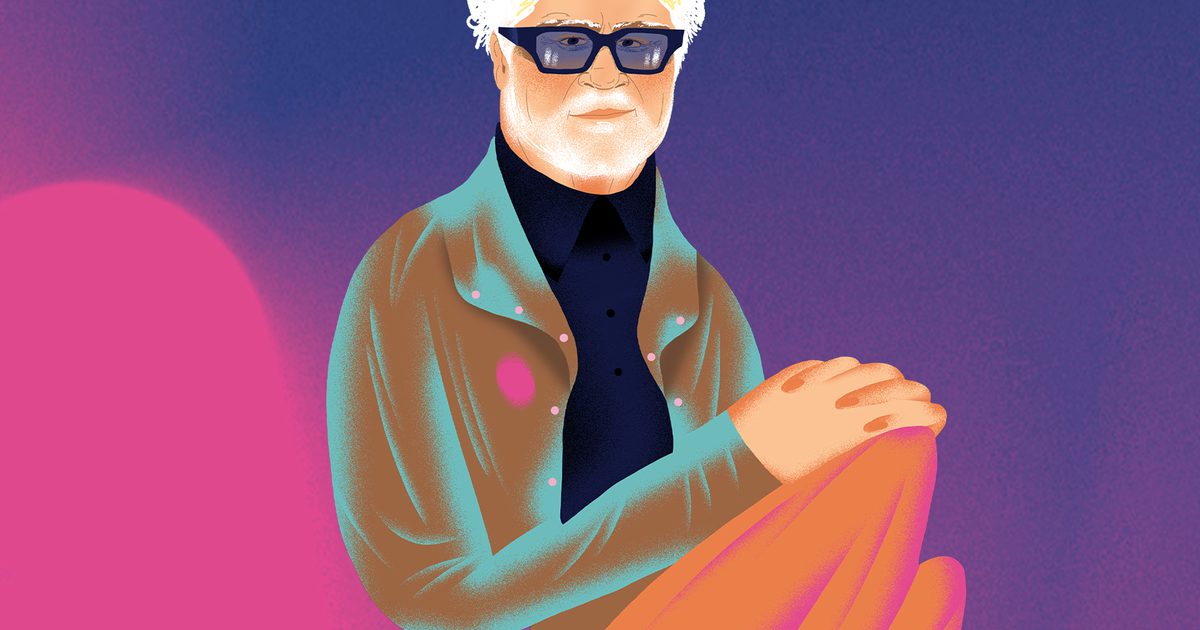

One of the most storied, successful and stylish filmmakers in modern European history, Spain’s Pedro Almodóvar has shelves filled with festival trophies and awards. His career began in the 1980s, buoyed by the newfound freedoms following the fall of the dictator, General Franco, and he blossomed from being an anarchic rapscallion into a paragon of taste, emotion and visual panache. All About My Mother, Talk To Her, Bad Education and Volver are among the most cherished of his pictures, but he has been on his strongest run ever since 2016’s gorgeous Julieta. His new film, Bitter Christmas, takes a cue from 2019’s Pain & Glory, in that it is a reflective drama about the ethics of filmmaking concerning a filmmaker, Raúl, who is taken to task by his assistant, Mónica, for the content and inspirations of some of his supposedly fictional stories.
LWLies: In Bitter Christmas we meet the character of Raúl, who is looking for material that captivates him as an artist and filmmaker. When do you know you’re captivated by something?
Get more Little White Lies
Almodóvar: I don’t get the whole story that comes to me. It’s more like a spark of an idea. And it really can happen in any moment in my quotidian life. What I do is, when it does come, I immediately stop and I take notes. You don’t really know it from the beginning, as I write down these ideas and then, as they continue to haunt me, and I come back to them again and again, there comes a point when I suddenly realise that there is a story. And I begin to develop that. As I develop these stories, they don’t all turn into scripts. Some of them will just sit in my desk drawer, waiting for the perfect moment to see the light of day. In some cases, they’re just buried. In these frustrated stories sometimes there are parts that I really like, so I might take those stories and turn them into set pieces. Even though I don’t like the ending or the totality of a story, parts of those stories make it into other films.
This collection of thoughts and ideas, do you look at them when you’re blocked and searching for inspiration?
I don’t really revisit these fragments of stories when I’m blocked. I almost read them more as a form of entertainment. I’ll go back to things that I’ve written in the past and see them from a new perspective, and from a new time I discover things. But the thing to stress here is that everything is useful.
You’ve spoken about this film and said you’ve been quite self critical with it. What has motivated that self-criticism?
This is really a practice that comes a bit more from theatre. Something like the work of Pirandello, where characters might challenge or push back against the author. As I was developing Bitter Christmas, I never knew I was going to arrive at the final 20 minutes of the film, when Mónica begins to question the parameters of the movie itself. It was exciting for me as it was new. It brought me to a place where I was able to reflect on my own process and my own way of working.
Is there someone like Mónica in real life, someone who, through your career, has been able to offer you honest criticism of your work?
There are not many people who I share the script with. When I feel that it is ready I do share with my brother [and producer], Agustín [Almodóvar]. And there are probably two or three other people who I entrust with reading that script. Yet, by the time I share the script, I am quite satisfied and I’m just looking for other voices, other points of view, a sense of how they’re seeing and hearing the story. During the process of development, I’m actually quite self-critical of my own work, so I have already worked out many of the problems in advance. It’s quite a finished draft when I share it.
Did you find this element self-criticism therapeutic? Was there a cathartic element to writing this film?
As you’re writing, you’re always going to come across problems that you’re trying to solve. For me, I shared the example of the last 20 minutes that were a surprise to me, in that it’s such a magical moment when something like that surprises me. If there’s anything that comes close to catharsis, it’s the moment of satisfaction that comes from when something I’ve been working on really jolts me in that way. I would really have to spend a lot of time thinking about my 23 films, but when these unexpected things come to me, I receive them as epiphanies. If I think about the films that are really at the top of my career – things like All About My Mother, Talk to Her, Bad Education, Volver – these are films that took me many, many, many years to write. They are all films that are representative of a lot of work, and they encompass a lot of layers of meaning and try to solidify a story. So it’s less of a cathartic element associated with those films, but more of a need for a lot of patience and a lot of belief in the kind of story you want to tell.
One way to read the Raúl character in this film is to believe Mónica’s suggestion that what he is doing is unethical and immoral. Yet there is a paradox, as how else is he able to be creative and find inspiration away from direct human experience?
I think the case for all screenwriters, or anyone who writes stories, is that the base of what you write is founded on real life or the world that surrounds you. Whether that’s friends, society, the things you experience. This is true for anyone, even when you’re talking about genre film, let’s say science-fiction films that appear detached from reality. There are always going to be experiences that are hiding behind characters that might otherwise seem not so realistic. So it’s by default that everything and everyone that surrounds a writer feeds their creation. And I think this is particularly true of those we most love, who are closest to us. There should probably be ethical limits to autofiction. In this case, it’s not managed by law. Yes, there might be some cases where, contractually, there are some clauses around confidentiality where you can’t speak of certain things. Yet by and large, it’s something that the writer imposes upon themself. The moral limits are limits that you chose yourself. An author is going to be fundamentally selfish. You’re always going to care more about the story you’re writing than you are by the person who inspired the story. What you try to do is not hurt the person that is close to you. That’s something that’s my own stance, my own moral code. I try to not hurt the people around me. This is an eternal problem. Any family who has a writer in it is a family in danger of being exposed. Writers in this way are fundamentally dangerous.
The artists and filmmakers you depict in your films tend to be very lonely, introverted, mercurial characters. How true is that to your reality?
The process of writing you’re going to have to do alone, so it already implicates this sense of solitude. The moment of the shoot is very different as it’s more of a communal experience. Age also matters. When I was young I could write, shoot a movie but also go out to the disco and be out all hours of the night and next morning be right back at it. The kind of process when I was 25 years old is very different to my process in my seventies and I need to focus more and have more solitude. Now I have to write, focus and take care of myself so I can continue what I’m doing.
Do you have any superstitions or ways of working that are integral to your writing process and being creative?
It’s not quite a superstition, but my profound belief behind my practice is to just lead a normal life. By that I mean trying to not travel too much, not doing a bunch of interviews, allowing myself to focus on the work, but to also interrupt that work with simple daily events – see my friends, go for a walk, have dinner. Keep a minimal social life. The reason for that is that you can’t leave a story at home, the story keeps growing within you. I might go for a walk and the story keeps developing. I begin to see the world through the lens of the story I’m working on. I might hear a song that I’ve heard a thousand times before, but I haven’t heard it in the context of the story I’m working on. Suddenly that song takes on a brand new meaning. The same thing might go for a movie. As you walk around the world and experience your daily life, your pores become more receptive and opened up to all these influences.
There are so many musical interludes in your films. There’s an amazing one in this film, and one of my favourite scenes ever is Penélope Cruz singing ‘Volver’. As a student of classic Hollywood cinema, have you ever considered writing a musical?
My only experience of musicals was when Women on the Verge of a Nervous Breakdown was adapted into a Broadway play. It really was impressive to see how much work goes on, and how profound and intense the work was, behind any kind of Broadway production. Bitter Christmas has about five songs that have a very specific narrative element to them. But it’s not in the manner of the musical. I’m actually not interested in doing a full-blown musical, despite the fact that I do like that songs become part of the story. Even though my characters sing, they are more part of daily life.
They are more like Jacques Demy films than Hollywood, the way the songs are part of this daily life.
Even though Jacques Demy was a French director obsessed with American musicalcomedies. That was his dream. He does it in his own way, which is a very different way and it’s great. It’s one of my favourites. The colour is completely pop and completely extreme. I adore it. Françoise Dorléac and Catherine Deneuve are amazing.
I find this period of your work, which encompasses this seam of self-reflection, to be very exciting. Will it continue into the future?
After this movie, I don’t think I want to be inspired by myself for quite a long time. After 23 features and two long shorts, the thing that excites me the most is to approach different stories and do things I haven’t done before. The path I’m on now is about looking for the thing I haven’t done before. The next thing I do will be very different from these self-reflexive films, very different from my earlier films. But you’ll still be able to recognise me and they will still have a lot of songs.