

Close Menu
    Facebook X (Twitter) Instagram Pinterest YouTube LinkedIn TikTok
    TopBuzzMagazine.com
    Facebook X (Twitter) Instagram Pinterest YouTube LinkedIn TikTok
    • Home
    • Movies
    • Television
    • Music
    • Fashion
    • Books
    • Science
    • Technology
    • Cover Story
    • Contact
      • About
      • Amazon Disclaimer
      • Terms and Conditions
      • Privacy Policy
      • DMCA / Copyrights Disclaimer
    TopBuzzMagazine.com
    Home»Science»Building a massive dam between Alaska and Russia could prevent AMOC collapse, scientists say
    Science

    Building a massive dam between Alaska and Russia could prevent AMOC collapse, scientists say

    By AdminApril 24, 2026
    Facebook Twitter Pinterest LinkedIn Tumblr Email
    Building a massive dam between Alaska and Russia could prevent AMOC collapse, scientists say


    Building a giant dam between Russia and Alaska might save a key Atlantic current that is crucial to regulating the climate in northern Europe. However, that massive undertaking presents other risks, researchers explain in a new study.

    By stretching across the Bering Strait and disconnecting the Pacific Ocean from the Arctic Ocean, this huge geoengineering scheme could buy more time for the threatened conveyor belt of currents known as the Atlantic Meridional Overturning Circulation (AMOC), according to the study. However, the study authors and other researchers caution that the effect is variable, the results are preliminary, and further modeling studies are needed to see if such a bold course of action might be merited.

    Impending AMOC collapse

    The AMOC moves warm, salty water from the tropics northward, where it cools and sinks, and shifts cold water south, sustaining marine life and regulating the climate across Europe, Africa and the Americas. It is why Europe has a relatively mild climate despite its high latitude.


    You may like

    Numerous studies have suggested that the AMOC is weakening and may collapse. Research published earlier this month says it will slow down between 43% and 59% by 2100 — a 60% stronger weakening than past models predicted — so it may be closer to collapse than previously thought. If it does fail, the consequences could be catastrophic, causing temperatures in Northern Europe to plummet, bringing drought, raising the sea level along the northeast coast of North America by at least 1.6 feet (50 centimeters), as well as disrupting food production.

    “The evidence is pointing towards collapse, but it’s very uncertain,” lead author Jelle Soons, a researcher who studies the AMOC at the Institute for Marine and Atmospheric Research at Utrecht University in the Netherlands, told Live Science.

    There are two ways global warming could stop the AMOC. One possibility is that warmer North Atlantic waters could prevent the warm, salty water it is carrying from cooling and sinking. Another is that melting ice sheets in the North could add more fresh water to the mix, thereby diluting the saltiness of the arriving water and stopping it from sinking.

    Previous research showed that the AMOC was stronger in the mid-Pliocene some 3 million years ago, primarily because there was a land bridge closing off the Bering Strait. “So I wondered what would happen if we closed off the Bering Strait again,” Soons said.

    Get the world’s most fascinating discoveries delivered straight to your inbox.

    Three dams across the strait

    In the new study, published Friday (April 24) in the journal Science Advances, Soons and his colleague Henk Dijkstra, a physical oceanographer at the Institute for Marine and Atmospheric Research, modeled what would happen if that passage were closed. First, it would require three dams to cover the 51-mile-wide (82 kilometers) stretch of water, because two islands sit in the middle of the strait. The longest would need to be about 24 miles (38 km) in length.

    They found that with lower levels of carbon dioxide (CO2) emissions and a minor weakening of the AMOC, the closure of the Bering Strait could strengthen the AMOC and allow it to continue to function as CO2 emissions rise. However, they also discovered that with a much weaker AMOC, a closure of the Bering Strait would accelerate AMOC weakening.
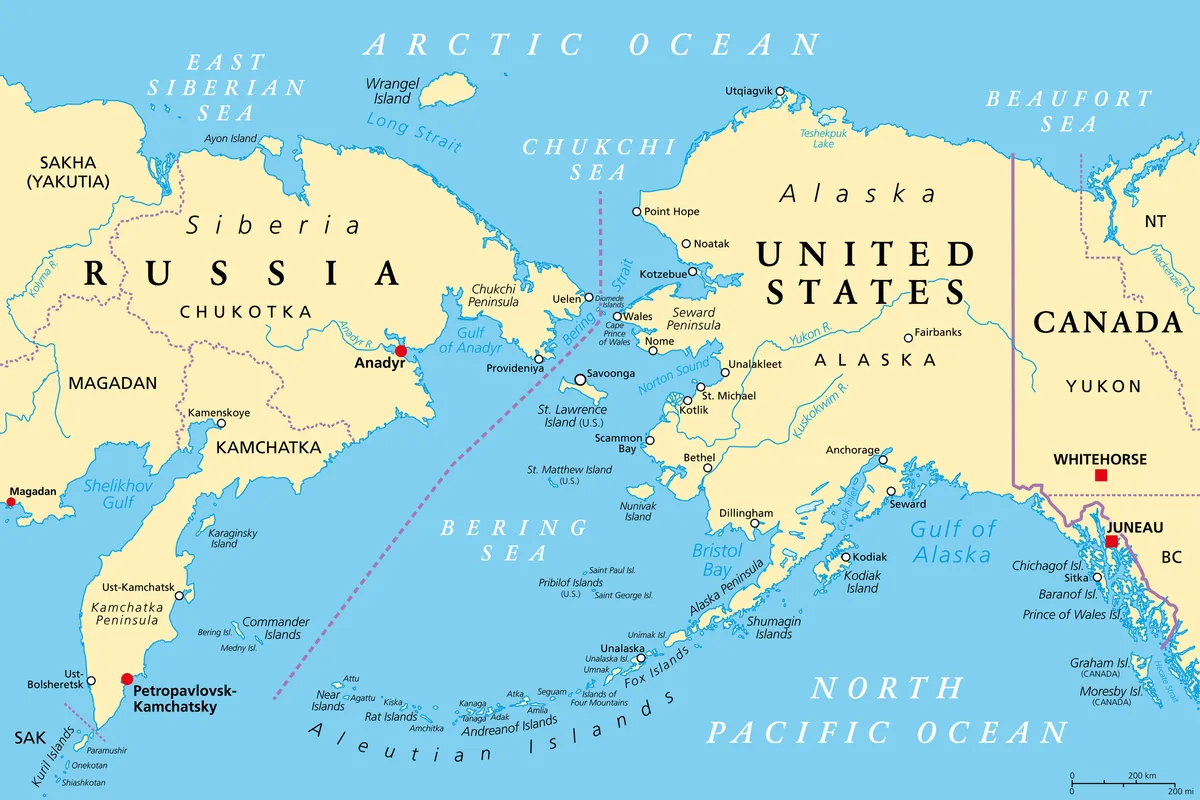
    map showing USA and Russia with the oceans highlighted

    The proposed dams would sit across the strait, stretching 51 miles in total. (Image credit: PeterHermesFurian/Getty Images)

    “This means it is not a straightforward solution,” Jonathan Baker, an ocean scientist at the U.K. Met Office who wasn’t involved in the study, told Live Science in an email. This means a dam might put off AMOC collapse only in some situations, he added.


    What to read next

    The result is very interesting and provides an alternative way to mitigate the effects of rising CO2 levels, said Aixue Hu, an oceanographer at the National Center for Atmospheric Research who wasn’t involved in the work.

    “However, the overall effect is not consistent and highly depends on the AMOC strength and CO2 levels,” Hu told Live Science via email. “Even if the closure of the Bering Strait can strengthen the AMOC and allow for more CO2 emissions in the near future, the long-term effect is still uncertain.”

    The engineering of a Bering Strait dam should be technically feasible, Soons said. The longer parts wouldn’t be much longer than the Afsluitdijk dam in the Netherlands, which covers 20 miles (32 km), or the Saemangeum Seawall in South Korea, which is 21 miles (33 km) long, he said. A Bering Strait dam would have a maximum depth of 194 feet (59 meters), which isn’t much deeper than the deepest part of the Saemangeum Seawall, which goes down to 177 feet (54 m).

    However, both of those constructions are in relatively calm coastal waters, not in remote locations with strong currents and sea ice, or with rival geopolitical powers on opposite sides.

    Severing the connection between the Pacific and Arctic oceans would also affect wildlife, fishing industries, shipping and Indigenous communities who are dependent on the strait for food and trade, Soons said.

    “Blocking the strait would alter the exchange of water, heat, nutrients and marine life between the Pacific and Arctic Oceans, with potential impacts on marine ecosystems and regional ocean circulation,” Baker said. “It could also lead to changes in climate that are not yet fully understood. Any intervention of this scale would need to carefully consider potential unintended consequences alongside any intended benefits.”

    Soons, Baker and Hu all say more modeling work is needed to explore the findings and get a more detailed picture of what would happen under different scenarios.

    There is also a more straightforward way to save the AMOC. “Closing the Bering Strait might delay a collapse under some conditions, but it does not remove the underlying risk from continued warming,” Baker said. “The most reliable way to reduce AMOC risk remains cutting greenhouse gas emissions.”

    View Original Source Here

    Share. Facebook Twitter Pinterest LinkedIn Tumblr Email

    Related Posts

    Largest ever octopus was great white shark of invertebrate predators

    April 24, 2026

    Milky Way's 'little cousins' may hold clues about infant universe

    April 23, 2026

    Meet AGI CPU — a specialist processor that engineers believe will power the next wave of AI

    April 23, 2026

    98 per cent of meat and dairy sustainability pledges are greenwashing

    April 22, 2026

    Researchers develop dynamic framework to monitor tillage practices from space

    April 22, 2026

    NASA shuts off another Voyager 1 instrument as humanity’s most distant spacecraft prepares for risky ‘Big Bang’ maneuver to save power

    April 21, 2026
    popular posts

    Hundreds of Hospitals Are at Risk of Hurricane Flooding

    Antivirals, some antibodies, work well against BA

    Shopping Break Up, Share Video for Final Single “White Noise”: Watch

    CSI: Vegas Season 3 Episode 1 Review: The Reaper

    Ride’s Tyler Jacob Moore on Gus’s Romance with Missy and

    the US freezes tech export curbs on China to avoid disrupting trade talks and help President Trump secure a 2025 meeting with President Xi Jinping (Demetri Sevastopulo/Financial Times)

    Post Malone Takes a Bad Spill After Stepping Into ‘Big

    Categories
    • Books (3,817)
    • Cover Story (14)
    • Events (23)
    • Fashion (2,744)
    • Interviews (58)
    • Movies (3,113)
    • Music (3,404)
    • News (173)
    • Politics (10)
    • Science (4,968)
    • Technology (3,109)
    • Television (3,838)
    • Uncategorized (932)
    Archives
    Facebook X (Twitter) Instagram Pinterest YouTube Reddit TikTok
    © 2026 Top Buzz Magazine. All rights reserved. All articles, images, product names, logos, and brands are property of their respective owners. All company, product and service names used in this website are for identification purposes only. Use of these names, logos, and brands does not imply endorsement unless specified. By using this site, you agree to the Terms of Use and Privacy Policy.

    Type above and press Enter to search. Press Esc to cancel.

    We use cookies on our website to give you the most relevant experience by remembering your preferences and repeat visits. By clicking “Accept”, you consent to the use of ALL the cookies.
    Do not sell my personal information.
    Cookie SettingsAccept
    Manage consent

    Privacy Overview

    This website uses cookies to improve your experience while you navigate through the website. Out of these, the cookies that are categorized as necessary are stored on your browser as they are essential for the working of basic functionalities of the website. We also use third-party cookies that help us analyze and understand how you use this website. These cookies will be stored in your browser only with your consent. You also have the option to opt-out of these cookies. But opting out of some of these cookies may affect your browsing experience.
    Necessary
    Always Enabled
    Necessary cookies are absolutely essential for the website to function properly. These cookies ensure basic functionalities and security features of the website, anonymously.
    CookieDurationDescription
    cookielawinfo-checkbox-analytics11 monthsThis cookie is set by GDPR Cookie Consent plugin. The cookie is used to store the user consent for the cookies in the category "Analytics".
    cookielawinfo-checkbox-functional11 monthsThe cookie is set by GDPR cookie consent to record the user consent for the cookies in the category "Functional".
    cookielawinfo-checkbox-necessary11 monthsThis cookie is set by GDPR Cookie Consent plugin. The cookies is used to store the user consent for the cookies in the category "Necessary".
    cookielawinfo-checkbox-others11 monthsThis cookie is set by GDPR Cookie Consent plugin. The cookie is used to store the user consent for the cookies in the category "Other.
    cookielawinfo-checkbox-performance11 monthsThis cookie is set by GDPR Cookie Consent plugin. The cookie is used to store the user consent for the cookies in the category "Performance".
    viewed_cookie_policy11 monthsThe cookie is set by the GDPR Cookie Consent plugin and is used to store whether or not user has consented to the use of cookies. It does not store any personal data.
    Functional
    Functional cookies help to perform certain functionalities like sharing the content of the website on social media platforms, collect feedbacks, and other third-party features.
    Performance
    Performance cookies are used to understand and analyze the key performance indexes of the website which helps in delivering a better user experience for the visitors.
    Analytics
    Analytical cookies are used to understand how visitors interact with the website. These cookies help provide information on metrics the number of visitors, bounce rate, traffic source, etc.
    Advertisement
    Advertisement cookies are used to provide visitors with relevant ads and marketing campaigns. These cookies track visitors across websites and collect information to provide customized ads.
    Others
    Other uncategorized cookies are those that are being analyzed and have not been classified into a category as yet.
    SAVE & ACCEPT