
Close Menu
    Facebook X (Twitter) Instagram Pinterest YouTube LinkedIn TikTok
    TopBuzzMagazine.com
    Facebook X (Twitter) Instagram Pinterest YouTube LinkedIn TikTok
    • Home
    • Movies
    • Television
    • Music
    • Fashion
    • Books
    • Science
    • Technology
    • Cover Story
    • Contact
      • About
      • Amazon Disclaimer
      • Terms and Conditions
      • Privacy Policy
      • DMCA / Copyrights Disclaimer
    TopBuzzMagazine.com
    Home»Science»Fresh look at Apollo moon rocks solves decades-old mystery about the moon’s magnetic field
    Science

    Fresh look at Apollo moon rocks solves decades-old mystery about the moon’s magnetic field

    By AdminFebruary 26, 2026
    Facebook Twitter Pinterest LinkedIn Tumblr Email
    Fresh look at Apollo moon rocks solves decades-old mystery about the moon’s magnetic field


    For decades, a debate has raged about whether the moon ever had a strong magnetic field, or if it was always weak. Now, a new analysis of Apollo-era moon rocks suggests the moon’s magnetic field might be mostly weak, despite brief outbursts of strong activity — potentially solving the mystery for good.

    The research, published Thursday (Feb. 26) in the journal Nature Geoscience, shows that the moon’s magnetic field amped up for brief periods in its early history, roughly 3.5 billion to 4 billion years ago, but for most of the moon’s 4.5 billion-year-old history, the magnetic field was weak.

    “For very short periods of time — no more than 5,000 years, but possibly as short as a few decades — melting of titanium-rich rocks at the moon’s core-mantle boundary resulted in the generation of a very strong field,” lead author Claire Nichols, an associate professor of the geology of planetary processes at the University of Oxford, said in a statement.


    You may like

    A long debate

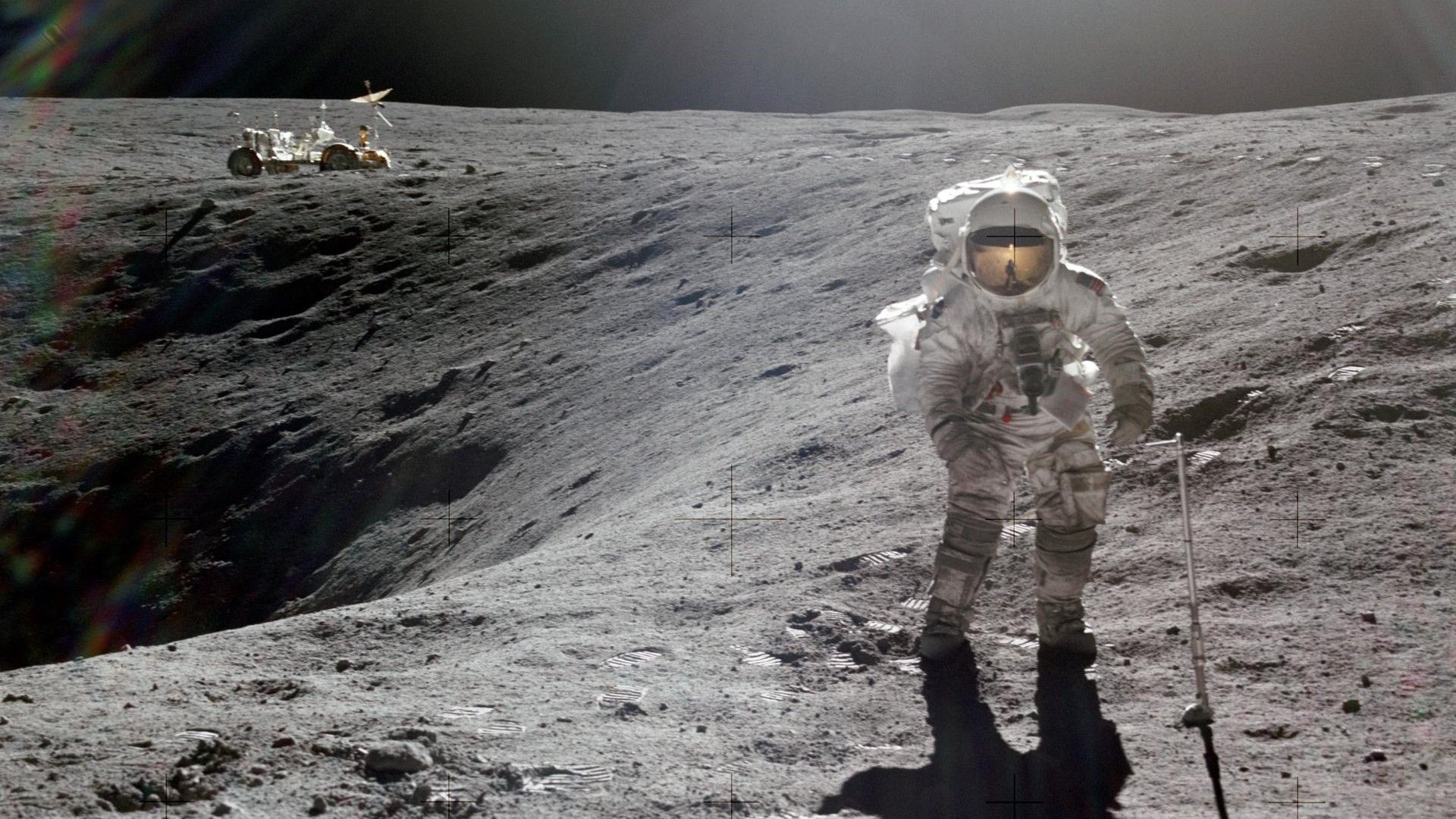
    The debate about the moon’s magnetic field stems from a limited sample of lunar rocks. Six Apollo missions landed on the moon between 1969 and 1972, in zones roughly around the lunar equator. These missions landed in about the same spot, in zones with similar types of rocks, the researchers said.

    It was easiest for the astronauts to land their small craft on large, flat basaltic areas called maria, which are old lava plains formed after ancient meteorite crashes that melted the original rock there. These Apollo landing areas are rich in titanium basalts.

    An astronaut holding a sample of lunar rocks on the moon

    An Apollo 12 astronaut collects lunar samples while his fellow crew member takes a photo. (Image credit: NASA)

    The new research charted the amount of titanium content in lunar samples against how strongly magnetized the rocks were. The scientists found that rock samples that were less than 6% titanium had weak magnetic fields and that the magnetic fields were stronger in rocks with higher titanium concentrations.

    This suggests the formation of high-titanium rocks and the generation of a strong lunar magnetic field are connected, according to the statement. The researchers think both were caused by the melting of titanium-rich material deep inside the moon, which temporarily generated a very strong magnetic field.

    Get the world’s most fascinating discoveries delivered straight to your inbox.

    A limited sample

    A dark moon rock held by tweezers in a lab

    Apollo samples, like this rock collected during the Apollo 12 landing mission, account for a majority of the lunar samples on Earth. (Image credit: AccuSoft Inc. / NASA)

    Apollo moon rocks form a substantial part of Earth’s lunar inventory. The auction house Christie’s suggests that about 1,433 pounds (650 kilograms) of moon rocks on our planet comes from meteorites. Of that inventory, the Apollo archive constitutes roughly 842 pounds (382 kg), according to NASA.

    Many of the titanium-rich Apollo rocks nevertheless have been analyzed by scientists, creating the perception that strong magnetism was present on the moon for a long time, according to the Oxford statement. But that appeared strange to other scientists, who argued that the small size of the moon’s core — only one-seventh of its radius — could not allow the moon to create a strong field for long periods of its history.

    The researchers confirmed the sampling bias by running models, which showed a random set of moon samples analyzed by scientists would have only few rocks containing a strong magnetic field. The hope is that the NASA-led Artemis astronaut missions will land in a larger variety of spots, gathering samples that show a range of the moon’s 4.5 billion-year history.

    “If we were aliens exploring the Earth, and had landed here just six times, we would probably have a similar sampling bias — especially if we were selecting a flat surface to land on,” study co-author Jon Wade, an associate professor of planetary materials at Oxford, said in the statement. “It was only by chance that the Apollo missions focussed so much on the mare region of the moon — if they landed somewhere else, we would likely have concluded that the Moon only ever had a weak magnetic field and missed this important part of early lunar history entirely.”

    View Original Source Here

    Share. Facebook Twitter Pinterest LinkedIn Tumblr Email

    Related Posts

    AIs can’t stop recommending nuclear strikes in war game simulations

    February 25, 2026

    UN data shows 6.5 million people at risk of severe hunger from drought

    February 25, 2026

    Coros Pace 4 review: The ideal first serious fitness watch

    February 24, 2026

    Stone Age symbols may push back the earliest form of writing

    February 24, 2026

    Warming Antarctic waters come with a cost for the 'robust' rockcod

    February 23, 2026

    How menopause affects the brain — and what we still don’t know

    February 23, 2026
    popular posts

    Bloomer Shorts Are Trending — Here’s Where to Buy Them

    The Biggest Disney Box Office Bombs

    Some plants are more flammable than others

    Better Alice in Chains Era

    Screen Actors Guild Awards Will No Longer Air on TNT

    Interview with Jim Diggins, Author of Anubis: The Weigher of

    How Meghan Markle Celebrated Her 41st Birthday

    Categories
    • Books (3,740)
    • Cover Story (12)
    • Events (22)
    • Fashion (2,701)
    • Interviews (55)
    • Movies (3,038)
    • Music (3,327)
    • News (169)
    • Politics (8)
    • Science (4,892)
    • Technology (3,034)
    • Television (3,763)
    • Uncategorized (932)
    Archives
    Facebook X (Twitter) Instagram Pinterest YouTube Reddit TikTok
    © 2026 Top Buzz Magazine. All rights reserved. All articles, images, product names, logos, and brands are property of their respective owners. All company, product and service names used in this website are for identification purposes only. Use of these names, logos, and brands does not imply endorsement unless specified. By using this site, you agree to the Terms of Use and Privacy Policy.

    Type above and press Enter to search. Press Esc to cancel.

    We use cookies on our website to give you the most relevant experience by remembering your preferences and repeat visits. By clicking “Accept”, you consent to the use of ALL the cookies.
    Do not sell my personal information.
    Cookie SettingsAccept
    Manage consent

    Privacy Overview

    This website uses cookies to improve your experience while you navigate through the website. Out of these, the cookies that are categorized as necessary are stored on your browser as they are essential for the working of basic functionalities of the website. We also use third-party cookies that help us analyze and understand how you use this website. These cookies will be stored in your browser only with your consent. You also have the option to opt-out of these cookies. But opting out of some of these cookies may affect your browsing experience.
    Necessary
    Always Enabled
    Necessary cookies are absolutely essential for the website to function properly. These cookies ensure basic functionalities and security features of the website, anonymously.
    CookieDurationDescription
    cookielawinfo-checkbox-analytics11 monthsThis cookie is set by GDPR Cookie Consent plugin. The cookie is used to store the user consent for the cookies in the category "Analytics".
    cookielawinfo-checkbox-functional11 monthsThe cookie is set by GDPR cookie consent to record the user consent for the cookies in the category "Functional".
    cookielawinfo-checkbox-necessary11 monthsThis cookie is set by GDPR Cookie Consent plugin. The cookies is used to store the user consent for the cookies in the category "Necessary".
    cookielawinfo-checkbox-others11 monthsThis cookie is set by GDPR Cookie Consent plugin. The cookie is used to store the user consent for the cookies in the category "Other.
    cookielawinfo-checkbox-performance11 monthsThis cookie is set by GDPR Cookie Consent plugin. The cookie is used to store the user consent for the cookies in the category "Performance".
    viewed_cookie_policy11 monthsThe cookie is set by the GDPR Cookie Consent plugin and is used to store whether or not user has consented to the use of cookies. It does not store any personal data.
    Functional
    Functional cookies help to perform certain functionalities like sharing the content of the website on social media platforms, collect feedbacks, and other third-party features.
    Performance
    Performance cookies are used to understand and analyze the key performance indexes of the website which helps in delivering a better user experience for the visitors.
    Analytics
    Analytical cookies are used to understand how visitors interact with the website. These cookies help provide information on metrics the number of visitors, bounce rate, traffic source, etc.
    Advertisement
    Advertisement cookies are used to provide visitors with relevant ads and marketing campaigns. These cookies track visitors across websites and collect information to provide customized ads.
    Others
    Other uncategorized cookies are those that are being analyzed and have not been classified into a category as yet.
    SAVE & ACCEPT