
Close Menu
    Facebook X (Twitter) Instagram Pinterest YouTube LinkedIn TikTok
    TopBuzzMagazine.com
    Facebook X (Twitter) Instagram Pinterest YouTube LinkedIn TikTok
    • Home
    • Movies
    • Television
    • Music
    • Fashion
    • Books
    • Science
    • Technology
    • Cover Story
    • Contact
      • About
      • Amazon Disclaimer
      • Terms and Conditions
      • Privacy Policy
      • DMCA / Copyrights Disclaimer
    TopBuzzMagazine.com
    Home»Science»Every major galaxy is speeding away from the Milky Way, except one — and we finally know why
    Science

    Every major galaxy is speeding away from the Milky Way, except one — and we finally know why

    By AdminFebruary 6, 2026
    Facebook Twitter Pinterest LinkedIn Tumblr Email
    Every major galaxy is speeding away from the Milky Way, except one — and we finally know why


    The structure of the local universe is surprisingly flat, according to new research, and this cosmic quirk may save our Milky Way from colliding with countless other massive, nearby galaxies — except one.

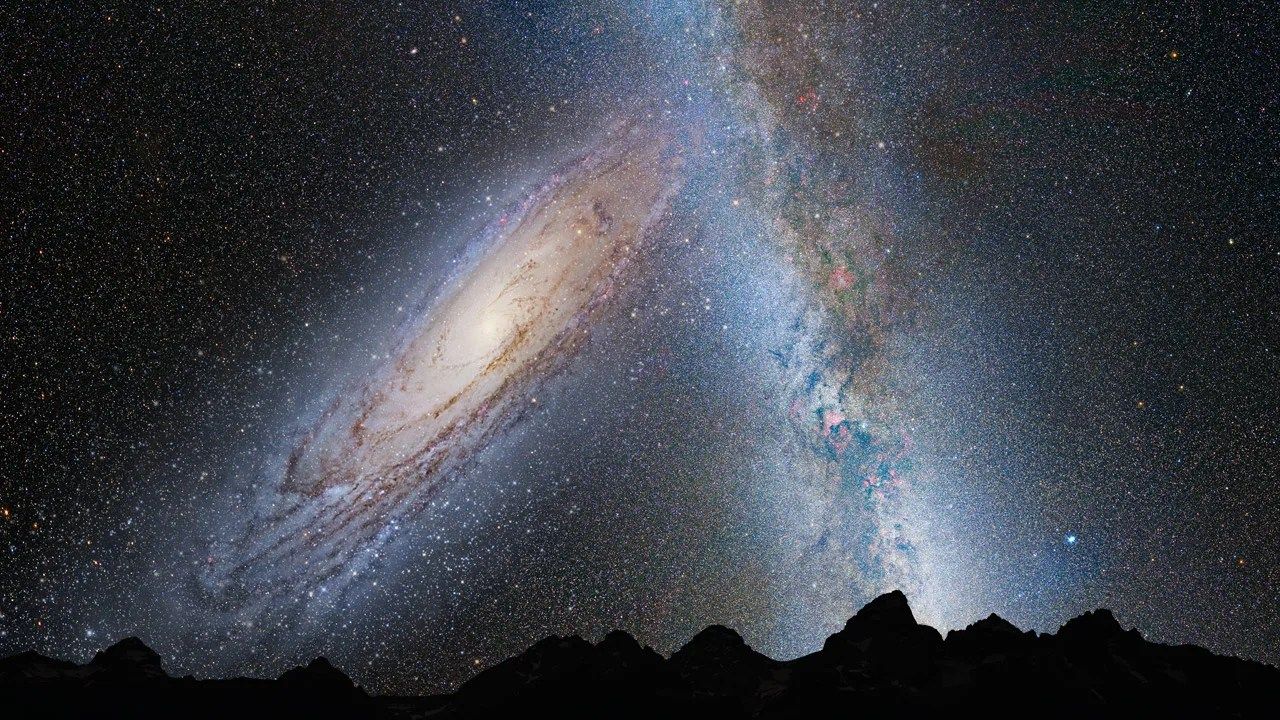
    For decades, astronomers have made the puzzling observation that our nearest galactic neighbor, Andromeda, is speeding toward a possible collision with our galaxy, while other nearby galaxies are moving away from us. Now, a new study may finally reveal why: A vast, flat sheet of dark matter is drawing those galaxies into deep space.

    Dark matter anchors and attracts visible matter, and the gravitational pull from the far-out dark matter sheet, which lies slightly beyond the bounds of Andromeda and the Milky Way, overwhelms the attraction between our galaxy and other neighboring galaxies, researchers reported in a paper published Jan. 27 in the journal Nature Astronomy.


    You may like

    “The observed motions of nearby galaxies and the joint masses of the Milky Way and the Andromeda Galaxy can only be properly explained with this ‘flat’ mass distribution,” the researchers said in a statement.

    Future simulations could further explain how gravity sculpts our surroundings and why the local universe looks the way it does.

    Going with the flow

    The motion of galaxies throughout the expanding fabric of space-time is known as the Hubble flow. It’s mathematically described by Hubble’s law, named after astronomer Edwin Hubble, who discovered the expansion of the universe in the 1920s. His eponymous law constrains an observational phenomenon: Galaxies are moving away from Earth at speeds that are proportional to their distance. The farther a galaxy is from our vantage point, the faster it seems to be receding.

    So why is Andromeda, located 2.5 million light-years away, hurtling toward us at 68 miles per second (110 kilometers per second), while most other large, nearby galaxies are following the flow? Curiously, these receding galaxies appear to resist the immense gravitational attraction of our Local Group, which includes the Milky Way, Andromeda, the Triangulum Galaxy and dozens of gravitationally bound, smaller galaxies.

    Get the world’s most fascinating discoveries delivered straight to your inbox.

    This universal enigma has endured for more than half a century. In 1959, astronomers Franz Kahn and Lodewijk Woltjer found evidence of dark matter situated around Andromeda and the Milky Way. They calculated that to reverse the initial expansion imparted by the Big Bang, these two galaxies would require a combined mass much greater than all their stars put together.

    It turns out that a significant portion of the mass of the Milky Way and Andromeda is contained in dark matter halos that surround each galaxy and facilitate the galaxies’ rapid approach toward each other.

    However, this attraction does not seem to affect nearby galaxies outside the Local Group, where “material is actually moving away from the Milky Way faster than the Hubble flow,” study co-author Simon White, director emeritus of the Max Planck Institute for Astrophysics in Germany, said in a statement.


    You may like

    “Thus, galaxies closer than [roughly 8 million light-years] are moving away from us slower than predicted by Hubble’s Law, whereas galaxies farther than [that] are actually receding faster than predicted,” White told Live Science via email.

    Composite of two images. Each image shows two bright white and red dots in the center. In the left image, the dots are surrounded by dark blue clouds that fade to purple and pink further from the dots. A cluster of neon blue dots surround the white dots. Overlaying the entire image are arrows pointing toward the viewer. The image on the right is similar, except the blue, purple, pink clouds are concentrated horizontally in the center and the arrows are pointed up in the bottom half of the image and pointed down in the top half.

    The average distribution of dark matter in the local universe, showing Andromeda and the Milky Way as the two bright-orange blobs at center and the 31 nearby galaxies outside the Local Group as cyan dots. The left image looks down on the flat sheet of dark matter and galaxies, while the right image views it from the side. (Image credit: Max Planck Institute for Astrophysics)

    Building a universe from scratch

    To find out why, the researchers built their own universe. They ran a multitude of simulations to explore the interactions among dark matter, our Local Group, and the receding galaxies just outside it, to a distance of around 32 million light-years.

    The simulations modeled the evolution of the local universe from the beginning of space-time, starting with the mass distributions observed in the cosmic microwave background, the oldest light in the cosmos, emitted when the universe was just 380,000 years old. The researchers then had the model reproduce certain salient characteristics observed in nearby galaxies, including the mass, position and velocity of Andromeda and the Milky Way, as well as the positions and velocities of 31 galaxies located just outside the Local Group.

    This revealed that the mass just slightly beyond the Local Group, including both dark matter and visible matter, is distributed in a vast, flat sheet that stretches for tens of millions of light-years and continues beyond the boundaries of the simulation.

    Because nearby galaxies are embedded in this flattened sheet of dark matter, any gravitational pull from our Local Group is counteracted by the gravitational pull from the more distant mass in the sheet, drawing them away from us.

    “If the mass were distributed approximately spherically around the Local Group, rather than being flat, then the external galaxies would be moving away from us slower than predicted by Hubble’s law for the cosmic expansion, because they would be slowed down by the gravitational pull of the Milky Way and Andromeda,” White told Live Science. “Instead, the flattened distribution of the surrounding matter pulls these galaxies outwards in a way which almost exactly compensates for the inward pull of the [Milky Way] and [Andromeda].”

    Equally important, the regions above and below the sheet are devoid of galaxies. Such sparse regions occur throughout the cosmos, and the deep Local Voids around our Local Group formed in areas where the initial density of the universe was a bit lower than average.

    “As a result these regions expanded faster than average, and their matter was ‘pushed’ outwards,” White said via email. “By the present day these low-density regions fill most of space and gravitational effects have concentrated most of their material into the ‘walls’ that separate them.”

    Reconciling experiments, observations and models

    The location of the voids is essential. These sparse regions are where any existing structures would fall toward the Local Group; any galaxies there would indeed be moving toward us. So we don’t see any other objects careening toward the Milky Way, as Andromeda is doing, because there simply aren’t any galaxies there to do so.

    Overall, when accounting for the vast sheet of mass, the simulations accurately modeled the distribution of nearby galaxies and the voids, thereby reconciling experimental results with astronomical observations of galactic motions as well as with the leading model of cosmology, known as lambda cold dark matter.

    “We are exploring all possible local configurations of the early universe that ultimately could lead to the Local Group,” lead study author Ewoud Wempe, a cosmologist at the University of Groningen in the Netherlands, said in a different statement. “It is great that we now have a model that is consistent with the current cosmological model on the one hand, and with the dynamics of our local environment on the other.”

    Interestingly, the researchers report that high-latitude galaxies farther out in the cosmos have been observed to be falling toward the flat sheet of matter at several hundred kilometers per hour. Finding additional structures infalling from the directions of the voids could lend further support to the results of this study.

    View Original Source Here

    Share. Facebook Twitter Pinterest LinkedIn Tumblr Email

    Related Posts

    Five stunning images from the Close-up Photographer of the Year awards

    February 6, 2026

    Study links daily mental sharpness to 30 to 40 extra minutes of work

    February 5, 2026

    Genetically unique group in southern Greece can trace their paternal ancestry to the Bronze Age

    February 5, 2026

    Dutch air force reads pilots’ brainwaves to make training harder

    February 4, 2026

    Innate biases of newborn animals inspire adaptive decision-making model

    February 4, 2026

    LaView Galaxy Projector review | Live Science

    February 3, 2026
    popular posts

    11 of the Best Books on Politics: U

    New Books to Read in Literary Fiction

    Research into the nature of memory reveals how cells that

    Björk to Host Podcast Series About Her Discography

    Brain Injuries May Raise the Risk of Alzheimer’s Disease, Say Researchers

    ‘Jeopardy!’ Champions Wildcard Tournament 2025 Finals: Players Lineup and Schedule

    Everyone’s Favorite ‘Simpsons’ Meme is Becoming a Chia Pet

    Categories
    • Books (3,700)
    • Cover Story (10)
    • Events (21)
    • Fashion (2,680)
    • Interviews (55)
    • Movies (2,999)
    • Music (3,287)
    • News (168)
    • Politics (7)
    • Science (4,852)
    • Technology (2,994)
    • Television (3,724)
    • Uncategorized (932)
    Archives
    Facebook X (Twitter) Instagram Pinterest YouTube Reddit TikTok
    © 2026 Top Buzz Magazine. All rights reserved. All articles, images, product names, logos, and brands are property of their respective owners. All company, product and service names used in this website are for identification purposes only. Use of these names, logos, and brands does not imply endorsement unless specified. By using this site, you agree to the Terms of Use and Privacy Policy.

    Type above and press Enter to search. Press Esc to cancel.

    We use cookies on our website to give you the most relevant experience by remembering your preferences and repeat visits. By clicking “Accept”, you consent to the use of ALL the cookies.
    Do not sell my personal information.
    Cookie SettingsAccept
    Manage consent

    Privacy Overview

    This website uses cookies to improve your experience while you navigate through the website. Out of these, the cookies that are categorized as necessary are stored on your browser as they are essential for the working of basic functionalities of the website. We also use third-party cookies that help us analyze and understand how you use this website. These cookies will be stored in your browser only with your consent. You also have the option to opt-out of these cookies. But opting out of some of these cookies may affect your browsing experience.
    Necessary
    Always Enabled
    Necessary cookies are absolutely essential for the website to function properly. These cookies ensure basic functionalities and security features of the website, anonymously.
    CookieDurationDescription
    cookielawinfo-checkbox-analytics11 monthsThis cookie is set by GDPR Cookie Consent plugin. The cookie is used to store the user consent for the cookies in the category "Analytics".
    cookielawinfo-checkbox-functional11 monthsThe cookie is set by GDPR cookie consent to record the user consent for the cookies in the category "Functional".
    cookielawinfo-checkbox-necessary11 monthsThis cookie is set by GDPR Cookie Consent plugin. The cookies is used to store the user consent for the cookies in the category "Necessary".
    cookielawinfo-checkbox-others11 monthsThis cookie is set by GDPR Cookie Consent plugin. The cookie is used to store the user consent for the cookies in the category "Other.
    cookielawinfo-checkbox-performance11 monthsThis cookie is set by GDPR Cookie Consent plugin. The cookie is used to store the user consent for the cookies in the category "Performance".
    viewed_cookie_policy11 monthsThe cookie is set by the GDPR Cookie Consent plugin and is used to store whether or not user has consented to the use of cookies. It does not store any personal data.
    Functional
    Functional cookies help to perform certain functionalities like sharing the content of the website on social media platforms, collect feedbacks, and other third-party features.
    Performance
    Performance cookies are used to understand and analyze the key performance indexes of the website which helps in delivering a better user experience for the visitors.
    Analytics
    Analytical cookies are used to understand how visitors interact with the website. These cookies help provide information on metrics the number of visitors, bounce rate, traffic source, etc.
    Advertisement
    Advertisement cookies are used to provide visitors with relevant ads and marketing campaigns. These cookies track visitors across websites and collect information to provide customized ads.
    Others
    Other uncategorized cookies are those that are being analyzed and have not been classified into a category as yet.
    SAVE & ACCEPT