
QUICK FACTS
Where is it? Guérou, Mauritania [16.930575400, -11.759622605]
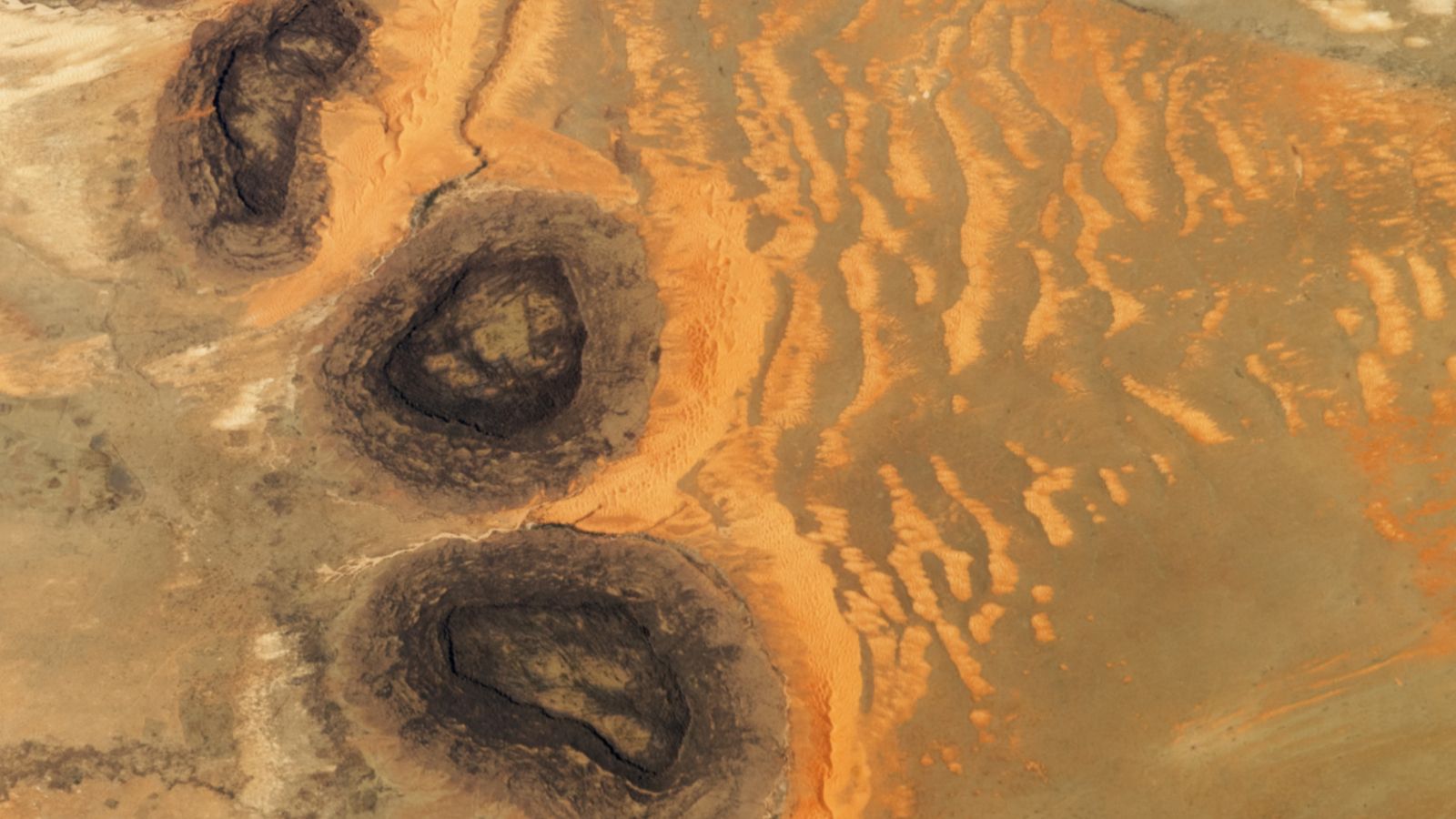
What’s in the photo? Three black mesas surrounded by unusual sand dunes in the Sahara Desert
Who took the photo? An unnamed astronaut onboard the International Space Station (ISS)
When was it taken? May 3, 2023
This intriguing astronaut photo shows a trio of ancient “black mesas”, which sit side-by-side in the Sahara desert. The dark structures have enabled a series of rare sand dunes to form around them while also creating a surprising “dune-free zone.”
The dark color of these circular hills is the result of “rock varnish” — a black, clay-based coating, rich in manganese and iron oxides, that forms on exposed and arid rocks over thousands of years, according to NASA’s Earth Observatory. This coating was likely partly fixed in place by microorganisms and is made up of multiple micrometer-thick laminations, according to Science Direct.
To the west of the mesas (on the left of the photo) is a barren rocky plain with a surprising lack of sand dunes. But to the east of the flattened hills, you can see several sizable dunes that are seemingly flowing away from the black rocks like a rippling tail.
There are two main types of sand dunes visible in the image. The first type are rare “climbing dunes,” which are the larger, ridge-like piles of sand that have piled up along the mesas’ eastern walls. The second type are “barchan dunes,” which are more common and make up the mesas’ stripy tail. In both cases, the dunes have a distinctive reddish-yellow hue.

The sand dunes only form on the eastern side of the mesas because the wind predominantly blows from that direction, carrying sand that then gets caught on the sloped elevations surrounding the black rocks.
Sand does not accumulate to the west of the mesas because of a phenomenon known as “wind scour,” which results from superfast vortices within the wind that gets squeezed in between the mesas, which blow sand away from the flattened hills, according to the Earth Observatory.
Another astronaut photo, taken in 2014, shows this odd effect over a larger area (see below). In this shot, you can see the barchan dunes extend much further away from the mesas in the photo, as well as another larger mesa further east.
During the Paleozoic era, which lasted from 541 million to 251.9 million years ago, all these mesas were likely part of a single massive rock formation that has since been broken up by millennia of water and wind erosion, according to the Earth Observatory.

This formation may have been similar to the Richat Structure — a massive set of concentric rings of rock, also known as the “Eye of the Sahara,” which is located in Mauritania around 285 miles (460 km) north of Guérou.
Mesas can be found across the globe but there is a particularly high concentration of them in the Sahara, as well as throughout parts of the U.S., such as Colorado, New Mexico, Utah, and Arizona, according to the National Park Service.
Elsewhere in the solar system, mesas are a prominent geological feature on Mars, having been carved out of the Red Planet by billions of years of wind erosion, according to Live Science’s sister site Space.com.
For more incredible satellite photos and astronaut images, check out our Earth from space archives.